Fastest-growing AI companies by ARR: a sourced 2026 ranking
Databricks leads at over $7B, Cursor at $2.6B, Ramp at $2B, Lovable past $600M. What 15 AI companies sell, why ARR jumped, what investors paid and the India angle.
 Ishaan Vardhan22 Nov 2026 · 20 min read

Databricks has the largest disclosed run-rate among the AI companies we track: more than $7 billion, as of August 2026. Cursor follows at about $2.6 billion and Ramp at more than $2 billion, while Cognition and Modal both crossed $1 billion this autumn, Cognition about four months after it disclosed $492 million.
Below them sit Lovable (over $600 million), ElevenLabs (over $500 million), Sierra (over $400 million) and seven companies between $100 million and $200 million. For each we cover what it sells, who pays, what drove the growth, what investors paid and what it means for India, using only dated figures the company stated or a named outlet attributed to it.
Key takeaways
- Databricks crossed a $7 billion revenue run-rate with more than 80% year-on-year growth, according to its 13 August 2026 release.
- Coding dominates: Cursor, Cognition, Lovable and Replit sell AI that writes software, and Modal’s sandboxes for code-running agents are a $300 million run-rate product on their own.
- The fastest recent climbs: Cognition from $492 million to $1 billion in about four months, Modal from over $300 million to over $1 billion in about five, Sierra from $200 million to over $400 million in five, and Lovable from $100 million to $400 million in seven.
- On sourced figures, investors paid roughly 12 to 30 times ARR for most of these companies, and about 53 times for Cognition in May 2026.
- India matters as a market more than as a source of these companies: Cursor launched a ₹649-a-month India-only plan, ElevenLabs calls India its second-largest enterprise market, and the one Indian AI-native ARR figure in our data set is Rocket’s $4.5 million from September 2025.
The ranking: 15 AI companies by latest stated ARR
Databricks, Cursor and Ramp lead the list of AI companies by latest disclosed annual recurring revenue (ARR) or run-rate. The table is sorted by the latest figure; where two companies share a figure, the more recent disclosure comes first. “Growth speed” appears only where the same company published two dated figures, and it is the time between them.
| # | Company | What it sells | Latest ARR or run-rate | Date of figure | Growth speed | Source |
|---|---|---|---|---|---|---|
| 1 | Databricks | Data and AI platform | Over $7B run-rate | Aug 2026 (fiscal Q2) | From $4.8B (Dec 2025) in about 8 months | Databricks releases |
| 2 | Cursor (Anysphere) | AI code editor | About $2.6B annualised B2B revenue | Early Jun 2026 | From $100M+ (Jan 2025) to $1B (Nov 2025) in about 10 months | CNBC citing Reuters; Cursor blog |
| 3 | Ramp | Corporate cards and finance software | Over $2B annualised revenue | Oct 2026 | From over $1B (1 Jun 2026) in about 4.5 months | TechCrunch; Ramp release |
| 4 | Cognition | Devin and Windsurf coding agents | $1B annualised run-rate | 25 Sep 2026 | From $492M (May 2026) in about 4 months | Cognition blog |
| 5 | Modal | AI compute cloud | Over $1B annualised run-rate | 14 Oct 2026 | From $300M+ (May 2026) in about 5 months | Modal blog |
| 6 | Lovable | AI app builder | Over $600M annual run-rate | Sep 2026 | From $100M (Jul 2025) to $400M (Feb 2026) in about 7 months | The AI Insider; TechCrunch; Lovable blog |
| 7 | ElevenLabs | Voice AI | Over $500M ARR | First four months of 2026 | From $350M at end-2025 | ElevenLabs blog |
| 8 | Sierra | Customer-service AI agents | Over $400M ARR | Oct 2026 | $200M to $400M+ in 5 months, per Sierra | Sierra blog |
| 9 | HeyGen | AI video avatars | Over $200M ARR | Jun 2026 | From $100M in about 8 months | Upstarts Media (company-reported) |
| 10 | Higgsfield | AI video generation | $200M annualised run-rate | Jan 2026 | One dated figure | Reuters via The Star |
| 11 | fal | Generative media inference | Over $200M revenue (not stated as annualised) | Oct 2025 | One dated figure | TechCrunch citing Bloomberg |
| 12 | Suno | AI music | $200M annual revenue | Nov 2025 | One dated figure | TechCrunch citing the WSJ |
| 13 | Replit | AI app builder | $150M annualised revenue | Sep 2025 | From $2.8M in under a year, per Replit | Replit release |
| 14 | Gamma | AI presentations | Over $100M ARR | Nov 2025 | One dated figure | Gamma release |
| 15 | Linear | Product-development software | Over $100M ARR | “Earlier” in 2026 | One dated figure | Linear blog |
Figures in US dollars, as of 20 November 2026. Each row’s source is named in the company section below and listed under Sources.

The billion-dollar tier: Databricks, Cursor, Ramp, Cognition and Modal
Five companies in this ranking report a run-rate of $1 billion or more. Databricks and Ramp sell data and finance software that now includes AI agents; Cursor and Cognition sell AI coding tools, and Modal rents computing power for AI workloads.
Databricks: over $7 billion
Databricks sells a platform where large companies store, clean and query their data and build AI applications on it; more than 20,000 organisations use it, including Mastercard, Unilever and 70% of the Fortune 500, according to its 13 August 2026 release. Customers pay for what they consume, and the release says more than 1,000 of them spend at a run-rate above $1 million and more than 100 above $10 million.
The same release gives the drivers: the run-rate passed $7 billion with more than 80% growth, its Lakehouse data-warehousing product passed $1.5 billion growing over 100%, and Lakebase, a database built for AI agents, passed $100 million. Eight months earlier, on 16 December 2025, Databricks had reported a $4.8 billion run-rate growing more than 55%, so growth sped up as the company got bigger. It also reported positive adjusted free cash flow over 12 months and a $190 billion valuation after a $5 billion round led by Coatue, with Premji Invest among the new investors. See our Databricks profile.
Cursor: about $2.6 billion
Cursor, made by Anysphere, is a code editor in which AI models and agents write, edit and review code; individuals pay from $8 to $200 a month and teams from $30 per user a month, with third-party model use billed separately, according to its pricing page on 20 November 2026. It had about $2.6 billion in annualised business-to-business revenue in early June 2026, according to company data shared with Reuters and reported by CNBC on 16 June 2026, when SpaceX agreed to buy Anysphere for $60 billion in stock. CNBC said SpaceX wanted a stronger position in enterprise AI and coding, and that Cursor’s enterprise sales were growing sharply.
Cursor’s own posts show the climb: over $100 million in recurring revenue on 16 January 2025, over $500 million on 6 June 2025 and $1 billion on 13 November 2025, when it said it had more than 300 staff and raised $2.3 billion at a $29.3 billion post-money valuation. That is about ten months from $100 million to $1 billion.
Ramp: over $2 billion
Ramp sells corporate cards and finance software to companies, and has expanded from expense management into payments, procurement, vendor management and accounting. It said it had passed $2 billion in annualised revenue when it raised $1.85 billion at a $60 billion valuation, TechCrunch reported on 15 October 2026, with 85,000 customers and annualised purchase volume above $275 billion, up 175% in a year.
The AI angle is in the product: TechCrunch lists AI agents inside procurement, expenses and accounting, a corporate card designed for AI agents, and, since August, a model-routing service that sends customers’ AI requests to different models. In its Series F release in June, Ramp gave over $1 billion in annualised revenue as of 1 June 2026 and more than 70,000 customers. See our Ramp profile.
Cognition: $1 billion
Cognition makes Devin, a coding agent that takes on engineering tasks on its own (our AI agents explainer covers how these work), and owns the Windsurf code editor. It crossed $1 billion in annualised run-rate on 25 September 2026, it said on its blog, under two years from Devin’s general release, and it named GE Aerospace and Rivian among customers. Its 27 May 2026 Series D post gave a $492 million run-rate and a $26 billion valuation, said enterprise usage had grown more than tenfold since January, and listed Citi, Goldman Sachs, Mercedes-Benz and the US Army as customers, and said systems integrators Infosys and Cognizant have built Devin into how they deliver projects.
Part of the scale was bought: Windsurf had $82 million of ARR when Cognition agreed to acquire it in July 2025, while Devin alone had grown from $1 million to $73 million between September 2024 and June 2025, Cognition said.
Modal: over $1 billion
Modal rents out cloud computing, including GPUs, for AI workloads such as inference, training and agent sandboxes. On 14 October 2026 it said it had crossed $1 billion in annualised run-rate, with revenue up more than 15 times year-on-year and its Sandboxes product, isolated environments where AI agents run code, at about $300 million on its own. It named Cognition, Ramp and Linear as customers running background agents, plus Suno for music and Runway for video, so part of Modal’s growth is other companies in this ranking growing. Its Series C post on 21 May 2026 gave more than $300 million, so the run-rate went from a figure above $300 million to one above $1 billion in about five months. The $750 million Series D valued Modal at $15.75 billion post-money; the team is over 200 people.
The $400 million to $1 billion tier: Lovable, ElevenLabs and Sierra
Three companies sit between $400 million and $1 billion. Lovable sells to people who build software; ElevenLabs and Sierra sell AI that talks to customers.
Lovable, a Stockholm company, builds web apps from a chat prompt and charges in credits per request, according to its July 2025 post. Speaking at HumanX in Amsterdam, co-founder Fabian Hedin put annual run-rate revenue above $600 million, against roughly $500 million reported in June, The AI Insider reported on 25 September 2026. The earlier steps are on record: $100 million in July 2025, eight months after its first $1 million (Lovable’s own post), then $200 million in November 2025, $300 million in January 2026 and $400 million in February 2026, when it had 146 full-time staff, TechCrunch reported on 11 March 2026. Its buyers have moved upmarket: Hedin said people at two-thirds of Fortune 500 companies use it, naming Microsoft, Nvidia and Deutsche Telekom, and the same report lists a $300 million round at $6.6 billion in December 2025 and $400 million at $13.3 billion in August 2026. For how it compares with Cursor, Replit and others, see our guide to the best AI for coding.
ElevenLabs sells AI voices, dubbing and voice agents to creators, developers and companies. It said it ended 2025 with $350 million in ARR and passed $500 million within the first four months of 2026, in a post dated 5 May 2026. It credits enterprises using voice agents for support, sales, hiring and marketing, and names Deutsche Telekom, Salesforce, Santander and KPN. The post says it has 530 people across more than 50 countries; no valuation is given.
Sierra builds customer-service agents for large companies and, unusually, charges for outcomes (a claim paid, a sale closed, a customer kept) rather than for tokens used, according to its 30 October 2026 post. That post says Sierra passed $400 million in ARR, added more than $150 million in the third quarter alone, and went from $100 million to $200 million in six months, then to $400 million in five. Sierra’s February 2026 review said one in four of its customers has revenue above $10 billion, naming ADT, Cigna, DIRECTV and SiriusXM. Its reasons for the speed-up: bigger, regulated customers want more agents faster, agents now handle conversations that last weeks, and its Ghostwriter tool cut one large US retailer’s set-up to 27 days. Our AI customer support tools guide covers options for smaller teams.
The $100 million to $200 million tier
Seven companies have disclosed figures between $100 million and $200 million. Several figures are a year old, so their current position is likely different.
- HeyGen makes AI avatar videos for small businesses, estate agents, trainers and course creators, priced on usage credits. ARR passed $200 million about eight months after $100 million, CEO Joshua Xu told Upstarts Media on 25 June 2026. HeyGen has raised only $74 million, says it is cash-flow break-even in 2026 and reports $1.5 million of revenue per employee; it credits owning its own models instead of paying for third-party APIs. See our HeyGen profile and our AI video generators guide.
- Higgsfield, a video-generation tool used mostly by social media marketers (about 85% of usage), had a $200 million annualised run-rate when it raised at over $1.3 billion, Reuters reported on 15 January 2026. Reuters described that run-rate as a projection of future revenue and said the company had nearly 70 staff.
- fal hosts image, video and audio AI models for developers. It had surpassed $200 million in revenue as of October 2025, according to Bloomberg as cited by TechCrunch on 10 December 2025. The report does not say whether that is annualised.
- Suno makes songs from text prompts for consumers, with a free tier and $8 and $24 monthly plans. It told The Wall Street Journal it had reached $200 million in annual revenue, TechCrunch reported on 19 November 2025, alongside a $250 million round at $2.45 billion post-money. At the time it was being sued by Sony, Universal and Warner over training data, TechCrunch noted.
- Replit lets people build and deploy apps by describing them to an agent. It said annualised revenue reached $150 million, up from $2.8 million in under a year, on 10 September 2025, when it had more than 40 million users and launched Agent 3, which it says can work for up to 200 minutes on its own.
- Gamma turns prompts into presentations, documents and websites. It said it had passed $100 million in ARR with 70 million users, a 50-person team and more than two years of profitability, in its 10 November 2025 release. Alternatives are in our AI presentation makers guide.
- Linear, issue-tracking software used by OpenAI, Cursor and Cognition, said on 26 August 2026 that it passed $100 million in ARR earlier in the year, with more than 40,000 paying companies, 177% net revenue retention and positive cash flow. AI agents now create half the work in Linear, up from 3% a year earlier, it said.
Which AI companies grew fastest
Measured in dollars added between two company-stated figures, Databricks is still the fastest: from $4.8 billion in December 2025 to over $7 billion in August 2026, at least $2.2 billion in about eight months, or roughly $275 million a month on the stated floors. Ramp added about $1 billion in about 4.5 months and Cognition about $500 million in four. In relative terms, Modal grew fastest among the large companies, from over $300 million to over $1 billion in about five months.
The earlier-stage climbs are steeper still: Lovable from $1 million to $100 million in eight months and then to $400 million seven months later, and Replit from $2.8 million to $150 million in under a year. These are measured from a small base, so they are not comparable with Databricks adding over $2 billion in eight months on a base of $4.8 billion.
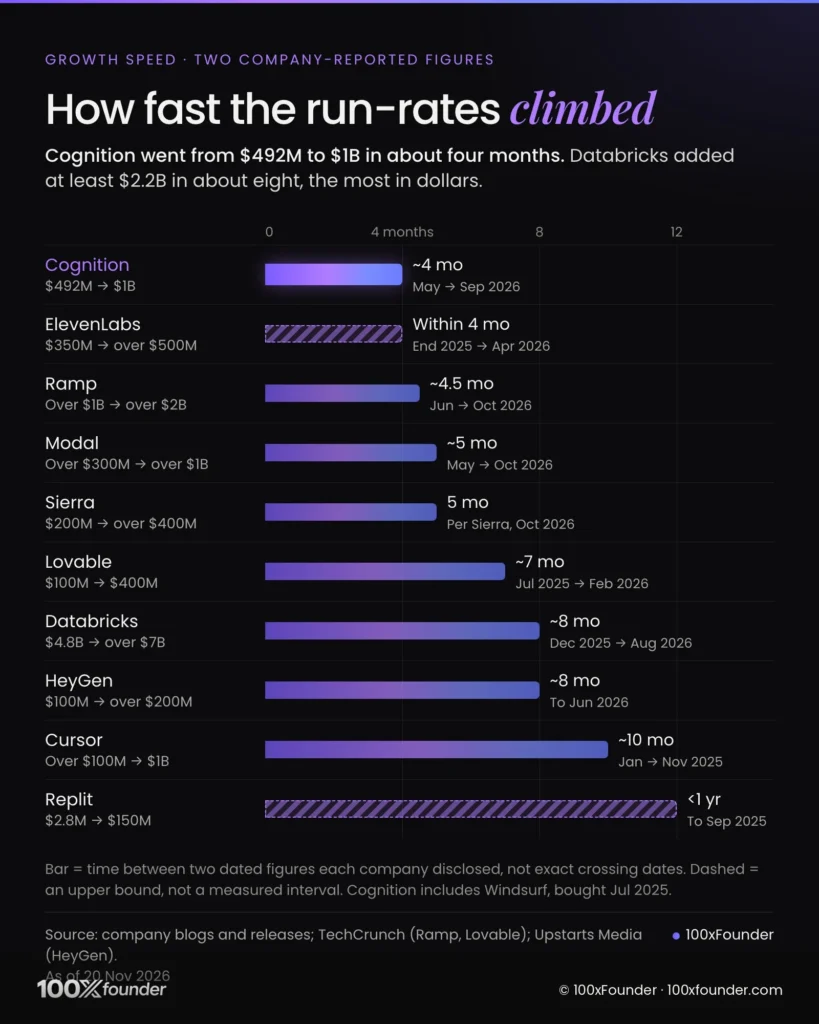
Companies choose when to announce, so these intervals run between disclosures, not exact crossing dates, and Cognition’s figure includes the acquired Windsurf.
What investors paid for that revenue
For the companies that disclosed a valuation and a revenue figure at the same time, dividing one by the other shows what investors paid per dollar of run-rate. These are our own calculations from the two sourced inputs; where a company gives a floor (“over $2 billion”), the true multiple is lower than shown.
| Company | Valuation (date) | ARR or run-rate at the time | Valuation ÷ ARR |
|---|---|---|---|
| Cognition | $26B (May 2026, pre/post not stated) | $492M | About 53x |
| Ramp | $60B (Oct 2026) | Over $2B | Up to about 30x |
| Databricks | $190B (Aug 2026) | Over $7B | Up to about 27x |
| Linear | $2.5B (Aug 2026 employee tender) | Over $100M | Up to about 25x |
| Cursor | $60B SpaceX deal (Jun 2026) | About $2.6B | About 23x |
| Gamma | $2.1B (Nov 2025) | Over $100M | Up to about 21x |
| Replit | $3B (Sep 2025) | $150M | About 20x |
| Modal | $15.75B post-money (Oct 2026) | Over $1B | Up to about 16x |
| Suno | $2.45B post-money (Nov 2025) | $200M | About 12x |
Sources: the company and news pages cited in each section above. Multiples calculated by 100xFounder on 20 November 2026.
The highest multiple went to Cognition, whose run-rate roughly doubled within four months of that round. Modal, a compute provider running on capacity from more than 20 clouds, was valued at a lower multiple than the software companies even though its run-rate roughly tripled in five months. Linear’s figure comes from an employee share sale, not new funding, and Cursor’s from an acquisition, so neither is a like-for-like venture round.
Five patterns behind the growth
The company statements point to five repeat reasons for the speed.
- Coding pays first. Cursor, Cognition, Replit and Lovable sell AI that writes software, and Linear says agents now create half the work in its tool. CNBC called coding the area where AI companies found early commercial traction.
- Usage pricing lifts revenue with adoption. Databricks, HeyGen and Lovable charge for consumption or credits, so revenue grows as customers run more agents, not only when they add seats.
- Outcome pricing is arriving. Sierra charges per resolved outcome, which ties its revenue to the customer’s own results.
- Owning the model protects margins. HeyGen credits its own models for avoiding API costs, Cognition says its own SWE-1.6 model is the most used in Devin Desktop, and Cursor says its cheaper India plan works because it relies on its own models.
- Small teams, large revenue. Using each company’s own figures from the same post, Gamma had about $2 million of ARR per person (50 staff), Lovable about $2.7 million (146 staff, February 2026), Higgsfield nearly $3 million (about 70, on a run-rate Reuters described as a projection), Modal up to about $5 million (200-plus) and ElevenLabs about $0.9 million (530).
What these ARR figures do and don’t measure
ARR and run-rate figures are a company’s current revenue pace extended over twelve months, not audited annual revenue. Our explainer on ARR, MRR, burn and other startup metrics covers the definitions.
The figures here are not all the same measure. Databricks, Cognition and Modal state a revenue run-rate, which can include usage that may not repeat. Cursor’s figure is annualised business-to-business revenue. Suno’s is annual revenue, fal’s is revenue the report does not call annualised, and Higgsfield’s run-rate was described by Reuters as a projection. Companies also state floors (“over”, “crossed”), so the real figure may be higher. Valuations differ too: Modal’s and Suno’s are post-money (including the new money), Cognition’s does not say, and Linear’s comes from a secondary sale. Treat the ranking as order of size on a given date, not a precise league table.
What this means for India
For Indian founders and software buyers, these companies matter mainly as vendors, competitors and employers; none of the Indian AI-native companies in our data set has disclosed an ARR near this ranking’s $100 million floor.
- Rupee pricing has started. Cursor launched Cursor Start, an India-only plan at ₹649 a month (about $7) billed in rupees with UPI accepted, TechCrunch reported on 27 July 2026. It excludes OpenAI and Anthropic models and Bugbot; the standard Pro plan was then $20 a month. TechCrunch said India is Cursor’s third-largest market, with users more than tripling in a year.
- Indian enterprises are already paying. ElevenLabs called India its second-largest enterprise market and named Meesho, Apna, 99acres, TVS Motor, Mahindra and Pocket FM as customers, Business Today reported on 20 February 2026; it plans to hire 100 people in India and cover all 22 official languages. Databricks named HDFC Bank, Swiggy, Zepto and Freshworks in an April 2025 release committing over $250 million to India over three years; the same release describes its new 105,000 sq ft Bengaluru R&D office.
- Jobs follow the revenue. Databricks and ElevenLabs both list open roles on our board: see Databricks jobs, ElevenLabs jobs (and our guide on how to get a job at ElevenLabs) and all AI and ML jobs.
- Indian services firms are channels. Cognition says Infosys and Cognizant have built Devin into how they deliver work for clients.
- The Indian builder to watch. Rocket, a vibe-coding startup in Surat, had $4.5 million of ARR when it raised a $15 million seed led by Salesforce Ventures, TechCrunch reported on 22 September 2025. The US was its largest market (26% of revenue) and India 10%, with paid plans from $25 a month.
What Indian teams pay to use these tools
Of the self-serve tools in this ranking, Cursor is the only one with a reported India-only rupee plan. The others showed dollar prices on the pages we loaded, and most meter usage through credits, so the monthly fee is a floor rather than the full bill. Prices below are from each company’s pricing page on 20 November 2026 (pages can show different prices by region), except Cursor Start, which is from TechCrunch’s July 2026 report.
| Tool | Free plan | Entry paid plan | How usage is metered | Rupee billing |
|---|---|---|---|---|
| Cursor | Yes | $8/month Plus; ₹649/month Cursor Start in India (TechCrunch, July 2026) | Third-party model use billed separately | Cursor Start, with UPI |
| Lovable | Yes, 5 build credits a day | $25/month Pro | 100 monthly credits; a small edit costs about 0.5 credits | None shown |
| Replit | None listed; paid plans include Free Mode usage | $20/month Core ($18 billed annually) | Includes $20 of model usage; pay-as-you-go beyond it | None shown |
| ElevenLabs | Yes, 10,000 credits | $6/month Starter | One shared credit pool; text-to-speech costs 1 credit per character | None shown |
| HeyGen | Yes, 3 watermarked videos a month | $29/month Creator ($24 billed annually) | 600 credits; cost per video varies by model and length | None shown |
Three practical points follow for buyers. First, ElevenLabs says its prices exclude taxes and Replit says tax depends on location, so the amount charged to an Indian card can be higher than the sticker price. Second, credit plans expire: Lovable’s monthly credits lapse two months after issue and HeyGen’s monthly-plan credits carry forward only one month, so buying a bigger plan “for later” rarely pays. Third, the cheapest India plan is not the full product: Cursor Start leaves out OpenAI and Anthropic models, Bugbot and Automations. Cursor says the plan is viable because it runs on its own models, which cost less to serve. Try the free tier on a real task, then size the plan to your measured usage. Track new rounds on our funding tracker.
How we compiled this
We started from our verified company-data files for 15 AI companies and re-opened the source page behind every figure on 20 November 2026: company blogs and releases first, then named news reports (CNBC, TechCrunch, Reuters, Upstarts Media, Business Today) where a company disclosed a figure to a journalist. A company is included only with a dated ARR, run-rate or annual revenue figure it stated or a named outlet attributed to it. Third-party estimates and targets are left out; where sources disagree, we use the company’s own figure. Some figures date from 2025, and companies may have disclosed newer ones since. Large AI labs without comparable dated ARR are not included.
FAQ
Which AI company has the highest ARR in 2026?
Among the companies in this ranking, Databricks has the highest disclosed figure: a revenue run-rate of more than $7 billion, announced on 13 August 2026. Cursor is second at about $2.6 billion in annualised business revenue as of early June 2026, according to company data reported by CNBC.
Which AI startup reached $1 billion ARR fastest?
On the figures here, Cursor took about ten months to go from $100 million (January 2025) to $1 billion (November 2025). Cognition reached $1 billion in September 2026, less than two years after Devin became generally available, helped by buying Windsurf. Modal went from over $300 million to over $1 billion in about five months in 2026.
What is the difference between ARR and run-rate?
ARR (annual recurring revenue) usually counts subscription revenue that repeats, expressed per year. A run-rate takes current revenue for a month or quarter and multiplies it by twelve or four, and it can include usage-based revenue that may not repeat. Both describe a pace at a point in time; neither is audited revenue for a full year.
How much are AI startups valued per dollar of ARR?
On figures disclosed at the same time, most companies here were valued at about 12 to 30 times ARR: Suno about 12x, Replit about 20x, Cursor about 23x and Databricks up to about 27x. Cognition was the outlier at about 53x its $492 million run-rate in May 2026. These are our calculations from sourced inputs, not company statements.
Is Cursor cheaper in India?
Yes. Cursor Start costs ₹649 a month, is available only to individual developers in India and is billed in rupees with UPI, TechCrunch reported in July 2026. It includes Cursor’s Composer and xAI’s Grok models and cloud agents, but not OpenAI or Anthropic models, which were on the $20-a-month Pro plan at the time.
Which of these AI tools can Indian teams pay for in rupees?
Of the self-serve tools covered here, only Cursor bills in rupees: Cursor Start costs ₹649 a month and accepts UPI, TechCrunch reported in July 2026. Lovable, Replit, ElevenLabs and HeyGen showed dollar prices on the pricing pages we loaded on 20 November 2026, and most add usage-based credits on top of the monthly fee.
Are these ARR figures audited?
No. Every figure here is a company statement, made on a blog, in a release or to a journalist. Private companies don’t publish audited accounts in these posts, and run-rates extend a recent month or quarter over a year. Use them to compare scale and direction, not as reported annual revenue.
Sources
- Databricks, “Databricks grows 80% YoY, surpasses $7B revenue run-rate”, 13 August 2026, databricks.com
- Databricks, “Databricks surpasses $4.8B revenue run-rate, growing 55% year over year”, 16 December 2025, databricks.com
- Databricks, “Databricks to invest over US$250 million in India over the next three years”, 24 April 2025, databricks.com
- CNBC, “SpaceX to buy Cursor AI parent Anysphere for $60 billion”, 16 June 2026, cnbc.com
- Cursor, Series B post, 16 January 2025, cursor.com
- Cursor, Series C post, 6 June 2025, cursor.com
- Cursor, Series D post, 13 November 2025, cursor.com
- Cursor, Pricing page, accessed 20 November 2026, cursor.com
- TechCrunch, “Cursor makes its biggest India push yet ahead of SpaceX acquisition with localized pricing”, 27 July 2026, techcrunch.com
- TechCrunch, “Ramp reaches $60B valuation as it pushes deeper into AI”, 15 October 2026, techcrunch.com
- Ramp (via GIC), “Ramp raises Series F at $44 billion valuation”, 4 June 2026, gic.com.sg
- Cognition, “$1B run rate”, 25 September 2026, cognition.com
- Cognition, Series D post, 27 May 2026, cognition.com
- Cognition, “Funding, growth, and the next frontier of AI coding agents”, 8 September 2025, cognition.com
- Cognition, Windsurf acquisition post, 14 July 2025, cognition.com
- Modal, “$1 billion annualized run rate and Series D”, 14 October 2026, modal.com
- Modal, Series C post, 21 May 2026, modal.com
- ElevenLabs, “$500M ARR and new investors”, 5 May 2026, elevenlabs.io
- Business Today, “ElevenLabs bets big on India with $100 million revenue goal, major hiring push”, 20 February 2026, businesstoday.in
- Sierra, “Our customers’ ambition is accelerating our growth”, 30 October 2026, sierra.ai
- Sierra, “Year two in review”, 6 February 2026, sierra.ai
- Upstarts Media, “Exclusive: HeyGen $200M ARR without burn”, 25 June 2026, upstartsmedia.com
- Reuters via The Star, “AI video startup Higgsfield hits $1.3 billion valuation with latest funding”, 15 January 2026, thestar.com.my
- TechCrunch via Yahoo Finance, “fal nabs $140M in fresh funding”, 10 December 2025, finance.yahoo.com
- TechCrunch, “Legally embattled AI music startup Suno raises at $2.45B valuation on $200M revenue”, 19 November 2025, techcrunch.com
- Replit, Series C funding announcement, 10 September 2025, replit.com
- Gamma (Business Wire), “Gamma surpasses $100M ARR, raises at $2.1B valuation”, 10 November 2025, financialcontent.com
- Lovable, Agent launch post, 23 July 2025, lovable.dev
- TechCrunch, “Lovable says it added $100M in revenue last month alone, with just 146 employees”, 11 March 2026, techcrunch.com
- The AI Insider, “Lovable passes $600M in annual run-rate revenue as enterprise adoption grows”, 25 September 2026, theaiinsider.tech
- Linear, “Sharing growth with the people building Linear”, 26 August 2026, linear.app
- Lovable, Pricing page, accessed 20 November 2026, lovable.dev
- Replit, Pricing page, accessed 20 November 2026, replit.com
- ElevenLabs, Pricing page, accessed 20 November 2026, elevenlabs.io
- HeyGen, Pricing page, accessed 20 November 2026, heygen.com
- TechCrunch, “Rocket.new, one of India’s first vibe-coding startups, snags $15M from Accel, Salesforce Ventures”, 22 September 2025, techcrunch.com
Related stories


Sources (36)
- Databricks 13 Aug 2026$7B+ run-rate, >80% YoY, $190B valuation, Lakebase $100M run-rate; Lakehouse $1.5B+ >100% growth; 20,000+ orgs; 1,000+ customers >$1M; positive adjusted FCF; Coatue lead, Premji Invest
- Databricks 16 Dec 2025$4.8B run-rate, >55% YoY
- CNBC 16 Jun 2026Cursor ~$2.6B annualised B2B revenue (company data to Reuters); SpaceX $60B deal
- Cursor 16 Jan 2025exceeded $100M recurring revenue
- Cursor 6 Jun 2025over $500M ARR
- Cursor 13 Nov 2025crossed $1B annualised revenue; $2.3B at $29.3B post-money; 300+ staff
- TechCrunch 15 Oct 2026Ramp $2B+ annualised revenue, 85,000 customers, $60B valuation; $1.85B round; $275B+ purchase volume +175%; AI agents, model-routing service (Aug), agent card
- Ramp (via GIC) 4 Jun 2026over $1B annualised revenue as of 1 Jun 2026; 70,000+ customers
- Cognition 25 Sep 2026$1B annualised run-rate; <2 years after Devin GA
- Cognition 27 May 2026$492M run-rate; $26B valuation; enterprise usage 10x+; Citi, Goldman, Mercedes-Benz, US Army; Infosys and Cognizant SIs; SWE-1.6 own model, most used in Devin Desktop
- Cognition 8 Sep 2025Devin $1M ARR Sep 2024 to $73M Jun 2025
- Cognition 14 Jul 2025Windsurf $82M ARR at acquisition
- Modal 14 Oct 2026$1B+ run-rate, Sandboxes ~$300M, $15.75B post-money; revenue 15x+ YoY; $750M Series D led by Accel; customers Cognition, Ramp, Linear, Suno, Runway; 200+ staff; capacity spans 20+ clouds; Suno uses Functions for music
- Modal 21 May 2026$300M+ annualised revenue
- ElevenLabs 5 May 2026$350M ARR end-2025, $500M+ in first four months of 2026, 530 staff
- Sierra 30 Oct 2026$400M+ ARR, $150M+ added in Q3, doubling timelines; outcome-based pricing; Ghostwriter 27-day retailer deployment; $100M to $200M in 6 months
- Sierra 6 Feb 2026$150M+ ARR entering year three; 1 in 4 customers $10B+ revenue; ADT, Cigna, DIRECTV, SiriusXM
- Upstarts Media 25 Jun 2026HeyGen $200M+ ARR, $100M about 8 months earlier, $74M raised, 30M users; cash-flow break-even 2026; $1.5M revenue per employee; usage credits; owns models
- Reuters (via The Star) 15 Jan 2026Higgsfield $200M run-rate, $1.3B+ valuation, launch Mar 2025; Reuters calls run-rate a projection of future revenue; ~85% usage social media marketers; ~70 staff
- TechCrunch (via Yahoo Finance) 10 Dec 2025fal $200M+ revenue as of Oct 2025 per Bloomberg
- TechCrunch 19 Nov 2025Suno $200M annual revenue per WSJ, $250M Series C, $2.45B; $8 and $24 plans; label lawsuits
- Replit 10 Sep 2025$150M annualised revenue up from $2.8M in under a year; $250M at $3B; 40M+ users; Agent 3 up to 200 minutes
- Gamma (Business Wire) 10 Nov 2025$100M+ ARR, 70M users, profitable 2+ years; $2.1B valuation; 50-person team
- Lovable 23 Jul 2025$100M ARR, 8 months since first $1M; 10M+ projects; credit pricing
- TechCrunch 11 Mar 2026Lovable $400M ARR Feb 2026; $100M Jul 2025, $200M Nov 2025, $300M Jan 2026; 146 full-time staff; $6.6B valuation Dec 2025
- The AI Insider 25 Sep 2026Lovable passed $600M annual run-rate (Fabian Hedin, HumanX Amsterdam), up from ~$500M in June; two-thirds of Fortune 500; Microsoft, Nvidia, Deutsche Telekom; $300M at $6.6B (Dec), $400M at $13.3B (Aug)
- Linear 26 Aug 2026$100M+ ARR earlier in 2026, 40,000+ paying companies, 177% NRR, cash-flow positive; $2.5B tender valuation; agents create 50% of work; used by OpenAI, Cursor, Cognition
- TechCrunch 22 Sep 2025Rocket (Surat) $4.5M ARR, $15M seed; revenue US 26%, India 10%; paid plans from $25/month
- Databricks 24 Apr 2025$250M+ India investment over 3 years; Bengaluru 105,000 sq ft R&D; Indian customers HDFC Bank, Swiggy, Zepto, Freshworks
- Cursor 20 Nov 2026Plans $0/$8/$30/$100/$200 a month; Teams $30+/user; third-party models billed separately
- TechCrunch 27 Jul 2026Cursor Start ₹649/month India-only, UPI, excludes OpenAI/Anthropic models; India third-largest market, users more than tripled; Pro $20; plan built on own lower-cost models; excludes Bugbot, Auto Mode, Automations, SDK
- Business Today 20 Feb 2026India ElevenLabs' second-largest enterprise market; customers Meesho, Apna, 99acres, TVS Motor, Mahindra, Pocket FM; 100 India hires; 22 languages
- Lovable 20 Nov 2026Free (5 daily build credits), Pro $25, Business $50; 100 monthly credits; credits expire two months after issue
- Replit 20 Nov 2026Core $20 ($18 annual) incl. $20 model usage; Pro $100; tax depends on location; pay-as-you-go
- ElevenLabs 20 Nov 2026Free 10k credits; Starter $6; Creator $22; Pro $99; TTS 1 credit per character; prices exclude taxes
- HeyGen 20 Nov 2026Free 3 watermarked videos/month; Creator $29 ($24 annual) 600 credits; Pro $49; Business $149; monthly credits carry forward one month