Databricks valuation history: every round from Series K to $190B
Databricks went from a $100B+ Series K to $134B and then $190B in August 2026. Every round, the run-rate behind it and where an IPO stands, all sourced.
 Ishaan Vardhan22 Nov 2026 · 14 min read

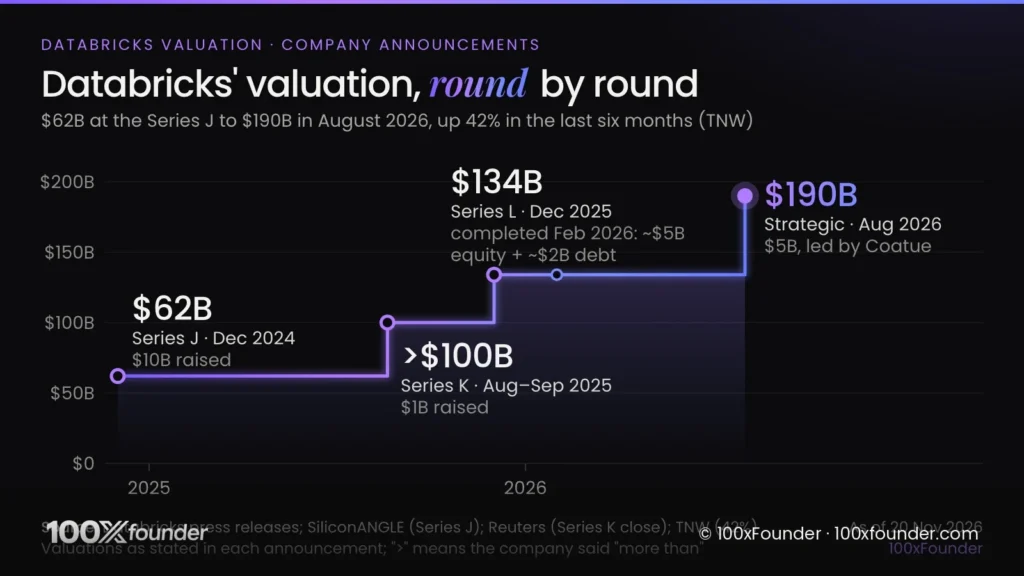
Databricks was valued at $190 billion on 13 August 2026, when it closed a $5 billion strategic round led by Coatue, according to the company’s press release. That is up from $62 billion at the December 2024 Series J, more than $100 billion at the 2025 Series K and $134 billion at the Series L, while its revenue run-rate passed $7 billion with growth above 80% year on year.
Below: every round, what Databricks sells and who pays, why the numbers moved, how it compares with Snowflake, how to read a private company’s own figures, and what it means for India. Every number is sourced and dated.
Key takeaways
- Databricks’ stated valuation went from $62 billion (Series J, December 2024) to more than $100 billion (Series K, 2025), $134 billion (Series L, 2025–26) and $190 billion (strategic round, August 2026).
- The Series L was announced in December 2025 at more than $4 billion and completed in February 2026 at about $5 billion of equity plus about $2 billion of debt capacity. The February total includes the December raise, so the two should not be added.
- The revenue run-rate rose from more than $4.8 billion (December 2025) to more than $7 billion (August 2026), and the growth rate rose at each step, to more than 80%. Snowflake’s product revenue grew 37% in its quarter to 31 July 2026.
- Databricks bills by usage, so revenue grows when existing customers run more work. It reported net retention above 140% in December 2025 and February 2026.
- India is a large R&D and sales base: Databricks committed more than $250 million over three years from April 2025, and Bengaluru’s Premji Invest joined the August 2026 round. Databricks is still private, with no IPO date.
What Databricks sells and who pays for it
Databricks sells a cloud data and AI platform that companies use to store, clean, query and analyse their data and to build AI models and agents on top of it. The company was founded in 2013 in San Francisco by the creators of the open-source projects Apache Spark, Delta Lake and MLflow, according to its About page, and it says more than 20,000 organisations use it, including 70% of the Fortune 500.
The platform is built on what Databricks calls an open lakehouse architecture: a single foundation for a company’s data and its governance, used for both analytics and AI. The product lines named in the 2025–26 funding releases are:
- Data warehousing (also called Lakehouse in the August 2026 release): SQL analytics and reporting, the part that competes most directly with Snowflake.
- Lakebase: a serverless Postgres database “built for AI agents”, the operational database apps and agents write to.
- Agent Bricks and Databricks Apps: tools for building AI agents and internal apps on company data.
- Genie: a conversational assistant, described in August 2026 as an “AI coworker”, that lets employees ask questions of business data.
- Unity AI Gateway: governance and cost controls for companies using several AI models.
The customers are mostly large companies. In August 2026 Databricks said more than 1,000 customers were spending at an annualised rate above $1 million and more than 100 above $10 million. In India, its April 2025 release named CommerceIQ, Freshworks, HDFC Bank, Swiggy, TVS Motors and Zepto as customers.
The pricing explains a lot about the revenue. Databricks’ pricing page, read on 20 November 2026, says customers pay as they go with no up-front cost, billed per second of use in Databricks Units (DBUs), a normalised measure of processing power. Larger usage commitments earn discounts. It runs on AWS, Microsoft Azure and Google Cloud; on Azure, Microsoft sets the price and bills customers directly. Because the bill follows usage, revenue rises when existing customers run more data and AI work, without a new contract.
Databricks funding rounds at a glance
Databricks has announced four funding events since August 2025: a Series K, a Series L that was announced and then completed, and a strategic round. The table lists each announcement, with the December 2024 Series J as the baseline.
| Date | Round | Amount | Valuation | Led by | Source |
|---|---|---|---|---|---|
| 17 Dec 2024 | Series J | $10B | $62B | Thrive Capital, co-led by Andreessen Horowitz, DST Global, GIC, Insight Partners and WCM | SiliconANGLE |
| 19 Aug 2025 | Series K (term sheet signed) | Not disclosed | More than $100B | Existing investors (not named) | Databricks press release |
| 8 Sep 2025 | Series K (closed) | $1B | More than $100B | Co-led by Andreessen Horowitz, Insight Partners, MGX, Thrive Capital, WCM | Reuters; SiliconANGLE; Fenwick |
| 16 Dec 2025 | Series L (announced) | More than $4B | $134B | Insight Partners, Fidelity, J.P. Morgan Asset Management | Databricks press release |
| 9 Feb 2026 | Series L (completed, includes the December raise) | About $5B equity plus about $2B debt capacity | $134B | Equity leads not restated; credit facilities led by JPMorgan Chase Bank | Databricks press release |
| 13 Aug 2026 | Strategic round | $5B | $190B | Coatue | Databricks press release; Reuters |
Figures as stated in each announcement; as of 20 November 2026. “More than” means the company used that wording.
Series K: the first round above $100 billion
Databricks’ Series K took the company past a $100 billion valuation, up from $62 billion at the Series J about nine months earlier. On 19 August 2025 Databricks said it had signed a term sheet, backed by existing investors, at more than $100 billion; it gave no amount, and CEO Ali Ghodsi said the round was over-subscribed.
The round closed on 8 September 2025 at $1 billion, according to Reuters. SiliconANGLE reported the same day that it was co-led by Andreessen Horowitz, Insight Partners, MGX, Thrive Capital and WCM Investment Management, matching the deal note from Databricks’ law firm, Fenwick, and that Databricks had raised over $20 billion in total by then.
Databricks said the money would go to Agent Bricks, its new Lakebase database, global growth, AI acquisitions and research. At $1 billion, the Series K was a tenth the size of the $10 billion Series J, so its main news was the price rather than the cash.
Series L: announced at more than $4 billion, completed at about $5 billion
The Series L valued Databricks at $134 billion and was disclosed in two steps that describe one round, not two.
Step one, 16 December 2025. Databricks said it was raising more than $4 billion at a $134 billion valuation, led by Insight Partners, Fidelity Management & Research Company and J.P. Morgan Asset Management. Other participants included Andreessen Horowitz, BlackRock-managed funds, Blackstone, Coatue, GIC, Temasek and Thrive Capital.
Step two, 9 February 2026. Databricks said it was completing more than $7 billion of investment: about $5 billion of equity at the same valuation and about $2 billion of additional debt capacity. The release calls the new names an “additional close” alongside “previously disclosed participants in the Series L round”. New equity investors included Glade Brook Capital, Goldman Sachs Alternatives, Microsoft, Morgan Stanley, Neuberger-affiliated funds, Qatar Investment Authority and UBS-associated funds. JPMorgan Chase Bank led the credit facilities with Barclays, Citi, Goldman Sachs and Morgan Stanley.
So the Series L equity is about $5 billion in total, including the December raise. The $2 billion is borrowing capacity, not equity, so it does not change the valuation. Both releases listed employee liquidity, AI research and acquisitions among the uses. The December release added Lakebase, Databricks Apps and Agent Bricks; the February one named Lakebase and Genie.
The $190 billion strategic round
The August 2026 strategic round is Databricks’ highest valuation so far: $5 billion at $190 billion, closed on 13 August 2026. Coatue led, with Blackstone, MGX, accounts advised by T. Rowe Price and new investor Sixth Street Growth. Other new investors were BOND, Clearlake Capital, Point72, Premji Invest and TPG; existing backers such as Andreessen Horowitz, Fidelity, GIC, Insight Partners and Thrive Capital also took part.
Reuters noted that the round came six months after Databricks was valued at about $134 billion, and TNW calculated the rise at 42%, closing above the $188 billion figure TNW had reported in July. Databricks said the money would go to Lakebase, Genie and Unity AI Gateway.
Revenue run-rate: from $4 billion to more than $7 billion
Databricks’ revenue run-rate rose from more than $4 billion in September 2025 to more than $7 billion in August 2026, and each funding announcement came with a new figure.
| Announced | Quarter (company’s) | Revenue run-rate | YoY growth | Customers above $1M run-rate | Source |
|---|---|---|---|---|---|
| 8 Sep 2025 | Q2 | More than $4B | 50% | More than 650 | Reuters; SiliconANGLE |
| 16 Dec 2025 | Q3 | More than $4.8B | More than 55% | More than 700 | Databricks press release |
| 9 Feb 2026 | Q4 | More than $5.4B | More than 65% | More than 800 | Databricks press release |
| 13 Aug 2026 | Q2 | More than $7B | More than 80% | More than 1,000 | Databricks press release |
As stated by the company or reported on the date shown; as of 20 November 2026.
The unusual part is that growth sped up as the company got bigger, from more than 55% to more than 65% to more than 80% across three announcements. TNW pointed out that this is rare for a company of its size. Large accounts grew too: more than 70 customers spent above $10 million a year in February 2026, and more than 100 in August 2026.

Why the numbers moved
Databricks’ releases do not explain the acceleration in one line, but they point to three drivers: customers spending more, new AI product lines adding revenue, and acquisitions that filled gaps in the product.
Existing customers spent more. Databricks reported net retention “>140%” in December 2025 and February 2026, meaning the same customer group spent over 40% more than a year earlier. With usage-based billing, that comes from more workloads on the platform, not price lists.
New product lines added revenue. In December 2025 the AI products and data warehousing each passed a $1 billion run-rate, and Lakebase was growing revenue at twice the pace of data warehousing, with thousands of customers in its first six months. By February 2026 AI products had passed $1.4 billion. In August 2026 Lakehouse, which the release calls its data warehousing product, passed $1.5 billion and was growing over 100% a year, and Lakebase passed $100 million.
Acquisitions built the AI stack. Databricks completed its purchase of MosaicML, a generative AI platform known for its MPT language models, in July 2023, to let customers train their own models on their own data. In May 2025 it agreed to buy Neon, a serverless Postgres company, saying more than 80% of databases created on Neon were set up automatically by AI agents. Lakebase is likewise described as serverless Postgres built for AI agents, and it is the product the last three rounds funded most consistently.
The growth has not come at the cost of cash: the December 2025, February 2026 and August 2026 releases each said free cash flow had been positive over the previous 12 months (“adjusted” free cash flow in August 2026).
How Databricks compares with Snowflake
Databricks is growing more than twice as fast as Snowflake on the figures each company published, though the measures are not identical. Snowflake, a listed rival in data warehousing, reports audited quarterly results; Databricks reports a self-described run-rate.
| Measure | Databricks | Snowflake |
|---|---|---|
| Latest growth | More than 80% YoY (run-rate, its Q2, announced 13 Aug 2026) | 37% YoY product revenue (quarter to 31 Jul 2026) |
| Revenue figure | More than $7B run-rate | $1.49B product revenue in the quarter; full-year guidance $6.07B |
| Customers above $1M a year | More than 1,000 | 828 |
| Net revenue retention | More than 140% (Feb 2026) | 126% |
| Valuation basis | $190B private round | Public market price |
Sources: Databricks press releases of 9 February and 13 August 2026; Snowflake’s results release of 2 September 2026. Snowflake’s $1M customers are counted on trailing 12-month product revenue; Databricks’ on annualised run-rate.
On valuation, TNW calculated Databricks’ $190 billion at roughly 27 times its $7 billion run-rate and compared it with Snowflake at about 23 times trailing revenue, while pointing out that run-rate and trailing revenue are different measures. Investors are paying a modest premium over Snowflake for a company growing faster on its own reported numbers.
How to read these numbers
Databricks’ figures are self-reported by a private company, so five caveats apply before anyone quotes them.
- Run-rate is not annual revenue. None of the releases we read defines “revenue run-rate”. It usually means a recent period’s revenue annualised, which runs ahead of trailing 12-month revenue when a company is growing fast.
- “More than” figures are floors. “>$7B” and “>80%” set a minimum and do not give the exact number.
- Pre- or post-money is not stated. The releases say “valuation” without saying whether the new money is included.
- Quarters are the company’s own. Releases cite “its Q2” or “its Q4” without naming the fiscal year, so they do not line up neatly with calendar quarters or with Snowflake’s fiscal quarters (its Q2 ended 31 July 2026).
- Round names vary. The Series L was announced and then completed, debt sits alongside equity in February 2026, and the August 2026 round has no series letter.
Is Databricks planning an IPO?
Databricks has not announced an IPO or a listing date and remains private. In September 2025 a company spokeswoman told SiliconANGLE, “We’ll go public when the timing makes sense”, and Reuters reported Ghodsi saying Databricks intended to stay cash-flow positive. In August 2026 TNW reported Ghodsi calling 2026 a bad year to go public; TNW added that SpaceX, OpenAI and Anthropic were lined up to absorb roughly $200 billion of listing capital, and that raising $5 billion privately let Databricks wait. Reuters described Databricks in August 2026 as widely seen as a candidate for a future listing.
What it means for India
India matters to Databricks as a market, an engineering base and, since August 2026, a source of capital.
For buyers. Indian companies already on the platform include HDFC Bank, Swiggy, Zepto and Freshworks, per Databricks’ April 2025 release. The pricing page shows no rupee price list; it says prices vary by region and cloud. On Azure, Microsoft bills the customer directly; elsewhere, pay-as-you-go usage is billed monthly by Databricks. Because the bill tracks usage, a team’s own usage limits and alerts are the main cost control.
For engineers and job seekers. In April 2025 Databricks committed more than $250 million in India over three years, opened a 105,000 sq ft R&D office at Bagmane Capital Park in Bengaluru, said the Bengaluru centre had passed 100 engineers in under two years with more than 100 more to be hired that year, and targeted more than 750 staff in India. Both Series L releases listed employee liquidity as a use of funds, which matters for anyone holding stock in a company with no public market. Our guide to getting a job at Databricks covers the hiring process, and open India roles from its careers page are on our Databricks jobs page.
For founders and investors. Premji Invest, which describes itself as a private equity firm with offices in Bengaluru and Menlo Park, was a new investor in the $190 billion round. For Indian SaaS and AI founders, the Neon deal and Lakebase show where a platform this size is spending: databases and tools that AI agents set up and use without a human in the loop. The company profile is on our Databricks startup page, and other rounds are in our funding tracker.
This is not investment advice. Private-company valuations are set by investors in a round and are not market prices.
How we compiled this
On 20 November 2026 we read Databricks’ press releases of 19 August 2025, 16 December 2025, 9 February 2026 and 13 August 2026, its releases on India (24 April 2025), Neon (14 May 2025) and MosaicML (19 July 2023), its About and pricing pages, and Snowflake’s results release of 2 September 2026. We also read the Reuters, SiliconANGLE, Fenwick and TNW reports and the Premji Invest page listed under Sources. Figures appear as stated, including “more than” where used. Where two announcements describe the same money, as with the Series L, we count it once. We did not total the amount raised because Databricks has not published a total for this period, and we did not convert dollar figures to rupees.
FAQ
What is Databricks’ current valuation?
Databricks’ latest stated valuation is $190 billion, announced on 13 August 2026 when it closed a $5 billion strategic round led by Coatue. That is up from $134 billion at the Series L (December 2025 to February 2026), more than $100 billion at the 2025 Series K and $62 billion at the December 2024 Series J.
How much did Databricks raise in the Series L?
About $5 billion of equity at a $134 billion valuation, plus about $2 billion of new debt capacity, according to Databricks’ 9 February 2026 release. The December 2025 announcement of “more than $4 billion” was the first part of the same round, so the two figures should not be added together.
What is Databricks’ revenue in 2026?
Databricks publishes a revenue run-rate rather than annual revenue. It passed a $5.4 billion run-rate in its Q4 (announced February 2026) and a $7 billion run-rate in its Q2 (announced August 2026), growing more than 80% year on year, according to its press releases.
Is Databricks growing faster than Snowflake?
On the companies’ own figures, yes. Databricks reported run-rate growth above 80% in August 2026, while Snowflake reported 37% product revenue growth for its quarter to 31 July 2026. The measures differ: Databricks’ run-rate is self-reported by a private company, while Snowflake’s revenue comes from its public quarterly results.
How does Databricks charge customers?
Databricks charges by usage, measured in Databricks Units and billed per second, with no up-front cost on pay-as-you-go and discounts for committed usage, according to its pricing page. On Azure, Microsoft sets the price and bills the customer directly. The pricing page lists no separate rupee pricing.
Does Databricks have an office in India?
Yes. Databricks has an R&D centre in Bengaluru and opened a 105,000 sq ft office at Bagmane Capital Park as part of a commitment, announced in April 2025, to invest more than $250 million in India over three years.
Sources
- Databricks, “Databricks is raising a Series K Investment at >$100 billion valuation”, 19 August 2025 (company press release)
- Databricks, “Databricks Grows >55% YoY, Surpasses $4.8B Revenue Run-Rate, and is Raising >$4B Series L at $134B Valuation”, 16 December 2025 (company press release)
- Databricks, “Databricks Grows >65% YoY, Surpasses $5.4 Billion Revenue Run-Rate, Doubles Down on Lakebase and Genie”, 9 February 2026 (company press release)
- Databricks, “Databricks Grows >80% YoY, Surpasses $7B Revenue Run-Rate, Scales Lakebase, Genie, and Unity AI Gateway”, 13 August 2026 (company press release)
- Databricks, “Databricks to invest over US$250 million in India over next three years”, 24 April 2025 (company press release)
- Databricks, “Databricks Agrees to Acquire Neon to Deliver Serverless Postgres for Developers + AI Agents”, 14 May 2025 (company press release)
- Databricks, “Databricks Completes Acquisition of MosaicML”, 19 July 2023 (company press release)
- Databricks, “About us” and “Pricing”, read 20 November 2026 (company pages)
- Snowflake, “Snowflake Reports Financial Results for the Second Quarter of Fiscal 2027”, 2 September 2026 (company results release, via Seeking Alpha)
- Premji Invest, India website, read 20 November 2026 (company page)
- Reuters (via Yahoo Finance), “Databricks closes $1 billion round, projects $4 billion in annualized revenue on surging AI demand”, 8 September 2025
- SiliconANGLE, “Databricks discloses latest funding round, path toward profitability”, 8 September 2025
- Fenwick, “Fenwick Represents Databricks in $1B Series K Funding at $100B+ Valuation”, 8 September 2025
- SiliconANGLE, “Databricks raising mammoth $10B funding round at $62B valuation”, 17 December 2024
- Reuters (via The Star), “AI firm Databricks valued at $190 billion as it bags $5 billion in funding”, 13 August 2026
- TNW, “Databricks closes $5 billion round at $190 billion valuation”, 13 August 2026
Related stories


Sources (17)
- Databricks 19 Aug 2025Series K term sheet, >$100B valuation, existing investors, oversubscribed, uses of funds, 15,000 customers
- Databricks 16 Dec 2025Series L >$4B at $134B, leads and participants, $4.8B run-rate >55%, AI and DW >$1B, >700 $1M customers, uses incl. employee liquidity; net retention >140%; Lakebase growing at twice the pace of data warehousing, thousands of customers in first six months
- Databricks 9 Feb 2026Series L completion ~$5B equity at $134B + ~$2B debt (>$7B), additional close participants, credit facility leads, $5.4B run-rate >65%, AI $1.4B, >800/>70 customers, uses; net retention >140%
- Databricks 13 Aug 2026$5B strategic round at $190B led by Coatue, investors, >$7B run-rate >80%, Lakehouse $1.5B, Lakebase $100M, >1,000/>100 customers, 20,000 orgs, 70% of Fortune 500, adjusted FCF
- Databricks 20 Nov 2026founded 2013 by creators of Spark, Delta Lake, MLflow; San Francisco; open lakehouse; >20,000 organisations, 70% of Fortune 500
- Reuters (via Yahoo Finance) 8 Sep 2025Series K closed at $1B, $100B valuation, >$4B run-rate, Ghodsi on staying cash-flow positive and listing
- SiliconANGLE 8 Sep 2025Series K co-leads, total raised over $20B, 50% growth, >650 $1M customers, spokeswoman IPO quote
- Fenwick 8 Sep 2025Series K $1B at $100B+ and co-leads
- SiliconANGLE 17 Dec 2024Series J $10B at $62B, co-leads
- Reuters (via The Star) 13 Aug 2026$190B round, ~$134B six months earlier, candidate for future listing
- TNW 13 Aug 202642% rise in six months, $188B July report, ~27x run-rate, Snowflake ~23x, growth acceleration, Ghodsi on 2026 IPO; Ghodsi called 2026 a bad year to go public; TNW context on SpaceX, OpenAI, Anthropic (~$200B listing capital)
- Databricks 24 Apr 2025>$250M India over 3 years, 105,000 sq ft Bagmane Capital Park office, 100+ engineers +100 more, >750 staff target, Indian customers CommerceIQ, Freshworks, HDFC Bank, Swiggy, TVS Motors, Zepto
- Databricks 14 May 2025agreement to acquire Neon (serverless Postgres); >80% of Neon databases created by AI agents
- Databricks 19 Jul 2023completed MosaicML acquisition; MPT models; customers train own LLMs on own data
- Databricks 20 Nov 2026pay-as-you-go per-second billing in DBUs, committed-use discounts, AWS/Azure/GCP, Azure priced and billed by Microsoft, no INR pricing listed
- Snowflake (via Seeking Alpha) 2 Sep 2026Q2 FY27 to 31 Jul 2026: product revenue $1.49B +37%, 828 >$1M customers, NRR 126%, FY27 product revenue guidance $6.07B
- Premji Invest 20 Nov 2026describes itself as a private equity firm; offices in Bengaluru and Menlo Park