How a startup IPO works in India, from DRHP filing to listing day
How an Indian startup IPO works: DRHP or confidential filing, SEBI review, price band, anchor book, QIB and retail quotas, T+3 listing and lock-in rules.
 Ishaan Vardhan15 Nov 2026 · 12 min read
A startup IPO in India moves from a board decision to a draft red herring prospectus (DRHP) filed with SEBI and the exchanges, SEBI’s observations, a red herring prospectus (RHP) with a price band, three to ten working days of bidding, and trading three working days after the issue closes. Most of the rules sit in SEBI’s Issue of Capital and Disclosure Requirements (ICDR) Regulations, last amended on 21 March 2026.
The process is in the news again. Zetwerk listed on 23 October 2026, Zepto has a SEBI-cleared draft but has paused its IPO, and 18 new-age companies raised ₹41,283.2 crore through IPOs in 2025, according to Inc42. This guide explains each step, using the regulations and recent filings. One crore is 10 million rupees; one lakh is 100,000.
This is a general explainer, not legal or investment advice. Founders should confirm details with their merchant bankers and lawyers, and investors should read the offer document and speak to a SEBI-registered adviser.
Key takeaways
- A company can file its draft prospectus publicly, where it stays open for comments for at least 21 days, or pre-file it confidentially with SEBI under Chapter IIA of the ICDR Regulations.
- Loss-making startups that fail SEBI’s profit test can still list, but at least 75% of the net offer must go to qualified institutional buyers (QIBs) and retail investors get at most 10%.
- Anchor investors can take up to 60% of the QIB portion a day before the issue opens; half their shares are locked in for 30 days and half for 90 days.
- Shares must list on T+3, three working days after the issue closes, under a SEBI circular of 9 August 2023.
- Pre-IPO shareholders are locked in for six months after allotment, and promoters’ minimum 20% contribution for 18 months.
The startup IPO process at a glance
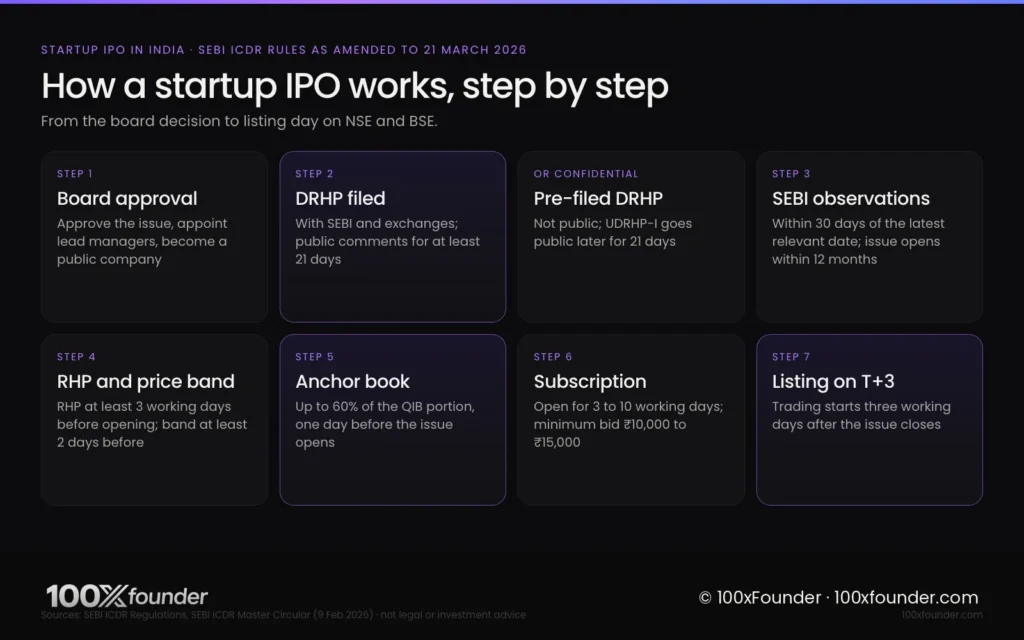
An Indian startup IPO runs through eight stages, and SEBI’s rules fix the minimum gaps between the later ones. The table sets them out.
Main-board IPO steps in India. Sources: SEBI ICDR Regulations (as amended to 21 March 2026) and SEBI ICDR Master Circular (updated 9 February 2026); checked 13 November 2026.
| Stage | What happens | Timing set by the rules |
|---|---|---|
| Board and shareholder approval | Company approves the issue, appoints lead managers, converts to a public company if needed | No fixed period |
| DRHP filing | Draft filed with SEBI and exchanges; public notice in newspapers | Notice within 2 working days; comments open at least 21 days |
| SEBI observations | SEBI asks for changes; company files an updated draft | 30 days from the later of several dates (replies, exchange approval) |
| RHP filing | Final document without the price filed with the Registrar of Companies | Issue opens at least 3 working days later |
| Price band | Floor and cap announced | At least 2 working days before opening |
| Anchor book | Large institutions allotted shares | One day before the issue opens |
| Subscription | QIBs, NIIs and retail bid | 3 to 10 working days |
| Allotment and listing | Basis of allotment, refunds, demat credit, trading | Trading starts on T+3 |
Step 1: the board decision and getting IPO-ready
An IPO starts with the board and shareholders approving the issue and the company becoming a public limited company, because a private limited company cannot offer shares to the public. Zepto is a recent example: its shareholders cleared a resolution on 21 November 2025 to convert it from a private to a public limited company, which Inc42 reported as the first step towards its IPO.
The company also appoints lead managers (SEBI-registered merchant bankers), lawyers and a registrar, and decides the mix of the issue: a fresh issue raises money for the company, while in an offer for sale (OFS) existing shareholders sell and keep the money. Groww’s 2025 IPO was mostly OFS: ₹5,572 crore of the ₹6,632 crore issue, according to Entrackr.
The board also picks the eligibility route. Regulation 6(1) of the ICDR Regulations requires net tangible assets of at least ₹3 crore, an average operating profit of at least ₹15 crore with a profit in each of the last three years, and a net worth of at least ₹1 crore. Loss-making startups that miss this test list under Regulation 6(2) instead, giving at least 75% of the net offer to QIBs.
Step 2: filing the DRHP with SEBI and the exchanges
The DRHP is the first full disclosure document, covering the business, risks, financials, shareholders, litigation and use of proceeds. On the standard route, the lead managers file it with SEBI and the exchanges and it becomes public at once.
The ICDR Regulations set three deadlines. The company must announce the filing in English, Hindi and regional newspapers within two working days. The draft stays open for public comments for at least 21 days. SEBI may then issue observations within 30 days from the latest of the filing date, the lead managers’ replies to its queries, information from other regulators or the exchanges’ in-principle approval, so each round of questions restarts the clock.
The company then files an updated draft showing every change. Under Regulation 44, the issue must open within 12 months of SEBI’s observations.
The confidential pre-filing route
The confidential pre-filing route lets a company get SEBI’s comments without making its draft public, so it can drop or delay the IPO without a public record of the details. SEBI added it as Chapter IIA of the ICDR Regulations with effect from 21 November 2022, and it applies only to the main board.
The pre-filed draft “shall not be available in the public domain”, and the newspaper notice may say only that the company has pre-filed. After SEBI’s observations, the company files an updated DRHP-I (UDRHP-I), which is public and open for comments for at least 21 days, followed by a UDRHP-II and the RHP. The company has 16 months from SEBI’s observations to file the UDRHP-I and 18 months to open the issue.
Groww pre-filed in late May 2025, won SEBI’s clearance about three months later, Inc42 reported, and listed on 12 November 2025. Zepto pre-filed in December 2025 for a planned issue of about ₹11,000 crore, according to Business Today, and filed its UDRHP-I with a fresh issue of up to ₹8,010 crore in June 2026, Inc42 reported. In August 2026 Zepto said it had paused the IPO and “intends to list within the timeframe provided by SEBI for its approved UDRHP”, according to Inc42. Our Zepto IPO tracker follows the latest filings.
Step 3: RHP, price band and the anchor book
The red herring prospectus is the final offer document without a final price, filed with the Registrar of Companies at least three working days before the issue opens. The price band must be announced at least two working days before opening. Under Regulation 29, the cap of the band can be at most 120% of the floor price and must be at least 105% of it. Lenskart’s band, for instance, was ₹382 to ₹402 a share, according to Inc42.
The anchor book is an allotment to large institutions one day before the public issue opens, covering up to 60% of the QIB portion. Since 1 December 2025, 40% of the anchor portion is reserved: 33.33% for domestic mutual funds and 6.67% for life insurers and pension funds. Lenskart raised ₹3,268.4 crore from 147 anchor investors at ₹402 a share on 30 October 2025, a day before its issue opened, according to Inc42.
Step 4: subscription and investor quotas
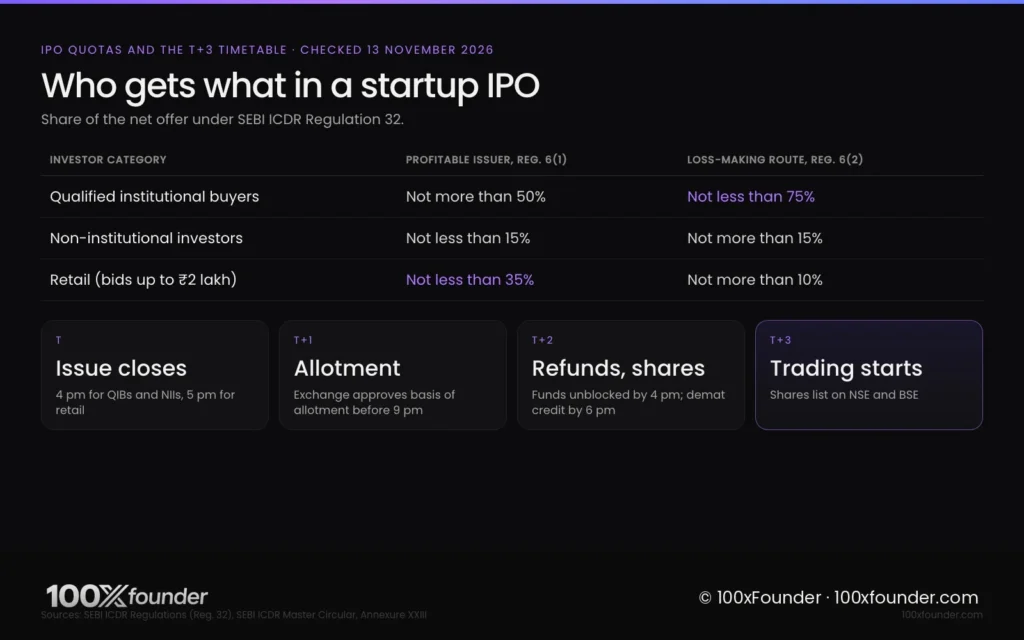
During subscription, three investor categories bid within fixed shares of the net offer, and the split depends on whether the company passed the profit test. The ICDR Regulations require the issue to stay open for at least three and at most ten working days, and the minimum application must be worth ₹10,000 to ₹15,000.
Net offer quotas in a book-built main-board IPO. Source: SEBI ICDR Regulations, Regulation 32, as amended to 21 March 2026; checked 13 November 2026.
| Investor category | Profitable issuer, Reg. 6(1) | Issuer without the profit record, Reg. 6(2) |
|---|---|---|
| Qualified institutional buyers (QIBs) | Not more than 50% | Not less than 75% |
| Non-institutional investors (NIIs) | Not less than 15% | Not more than 15% |
| Retail individual investors | Not less than 35% | Not more than 10% |
A retail individual investor is anyone who bids for up to ₹2 lakh. The NII portion is split again: one third for bids above ₹2 lakh and up to ₹10 lakh, and two thirds for bids above ₹10 lakh.
Demand varies by category. Groww’s issue was subscribed 17.6 times overall, with QIBs at 22.02 times, NIIs at 14.2 times and retail at 9.43 times, according to Entrackr. PhysicsWallah’s ₹3,480 crore issue drew just 1.8 times, Entrackr reported.
Step 5: allotment and listing on NSE and BSE in T+3
Every public issue in India must now list on T+3, meaning trading starts on the third working day after the issue closes (T). A SEBI circular dated 9 August 2023 cut the gap from six working days to three, and SEBI’s ICDR master circular, updated on 9 February 2026, sets out the day-by-day timetable.
- T (issue closing day): bidding closes at 4 pm for QIBs and NIIs and 5 pm for retail.
- T+1: rejections are finalised and the exchange approves the basis of allotment before 9 pm.
- T+2: unsuccessful bidders’ funds are unblocked by 4 pm and shares are credited to demat accounts by 6 pm.
- T+3: the shares start trading on NSE and BSE.
Recent listings show the timetable in practice. Meesho priced at ₹111 and opened at ₹162.50 on NSE on 10 December 2025, according to Entrackr. Zetwerk’s issue ran from 15 to 19 October 2026 and its shares debuted on 23 October at ₹159.25 on NSE against an issue price of ₹151, then closed the day at ₹138.25, Inc42 reported. Lenskart opened below its ₹402 issue price, at ₹395 on NSE on 10 November 2025, Entrackr reported.
Mainboard vs SME platform
Small companies can list on the SME platforms, NSE Emerge and BSE SME, which have lower entry bars but much higher minimum bids. The key difference is size: Chapter IX of the ICDR Regulations allows an SME IPO only if post-issue paid-up capital is at most ₹25 crore, and the draft is filed with the SME exchange rather than reviewed by SEBI as on the main board.
Main board vs SME platform. Sources: SEBI ICDR Regulations (Chapters II and IX), NSE Emerge and BSE SME eligibility pages; checked 13 November 2026.
| Rule | Main board | SME platform |
|---|---|---|
| Size limit | None | Post-issue paid-up capital up to ₹25 crore |
| Draft filed with | SEBI and exchanges | SME exchange |
| Profit test | Reg. 6(1) record, or 75% QIB route | Operating profit (EBITDA) of ₹1 crore in 2 of the last 3 years |
| Offer for sale | No ICDR cap of this kind | At most 20% of the issue; sellers can sell at most 50% of their holding |
| Minimum application | ₹10,000 to ₹15,000 | Two lots, above ₹2 lakh |
The exchanges add conditions. NSE Emerge wants positive free cash flow to equity in two of the last three years and a three-year track record. BSE SME asks for net tangible assets of ₹3 crore and a leverage ratio of no more than 3:1.
Lock-ins for promoters and pre-IPO investors
Lock-ins stop insiders from selling straight after listing. Under Regulation 14 of the ICDR Regulations, promoters must hold at least 20% of the post-issue capital as their minimum contribution, and Regulation 16 locks that 20% for 18 months from allotment, or three years if most of the fresh money goes to capital expenditure. Promoter shares above the minimum are locked for six months, or one year in the capital expenditure case.
Regulation 17 locks the entire pre-issue capital held by non-promoters for six months from allotment. Shares held by Category I or II alternative investment funds, venture capital funds and foreign venture capital investors are exempt from that blanket rule, but must have been held for at least six months from the date the fund bought them.
Lock-in expiries can move prices. Lenskart’s ended on 8 May 2026 and Groww’s on 12 May, and Groww’s shares fell about 7% as early investors sold about ₹5,326 crore of stock, according to PL Capital, citing Moneycontrol.
How long a startup IPO takes
A startup IPO usually takes six months to more than a year from the first filing to listing, because SEBI’s review time is open-ended and companies often wait for a better market. The public part is short: the issue can open three working days after the RHP, run three to ten working days and list on T+3.
Groww took under six months; Zepto, which pre-filed in December 2025, was still unlisted in November 2026. For a running list of which startups are raising and listing, see our funding tracker and the list of Indian unicorns.
Bottom line
For founders, the big choices are the eligibility route, whether to pre-file confidentially and how much of the issue is fresh money rather than an investor exit. Loss-making startups can list, but they depend on institutions more than retail. For investors, the RHP, category-wise subscription and the lock-in calendar say more than listing-day gains. We cover new filings in startup news.
FAQ
How long does it take for a startup to list on NSE after filing a DRHP?
There is no fixed period. SEBI’s 30-day review clock restarts with each query, and the issue must open within 12 months of SEBI’s observations, or 18 months on the confidential route. Groww took under six months from its confidential filing in May 2025 to listing on 12 November 2025.
What is the difference between a DRHP, a UDRHP and an RHP?
The DRHP is the first draft filed with SEBI and the exchanges. A UDRHP is the updated draft filed after SEBI’s observations; on the confidential route, UDRHP-I is the first public version, open for comments for at least 21 days. The RHP is the final document without the price, filed before the issue opens.
Can a loss-making startup do an IPO in India?
Yes. A company that fails the profit and asset tests in Regulation 6(1) of SEBI’s ICDR Regulations can list under Regulation 6(2) if it uses book building and allots at least 75% of the net offer to institutions. Retail investors then get at most 10%.
When can pre-IPO investors sell their shares?
Most pre-IPO shareholders are locked in for six months from allotment under Regulation 17 of the ICDR Regulations. Venture funds and Category I or II AIFs are exempt but must have held the shares for at least six months. Promoters’ minimum 20% contribution is locked for 18 months.
How much of an IPO can retail investors get?
For a company that passes SEBI’s profit test, at least 35% of the net offer is reserved for retail investors, meaning those bidding up to ₹2 lakh. For a company listing under the 75% institutional route, retail gets at most 10%.
Sources
- SEBI, “Securities and Exchange Board of India (Issue of Capital and Disclosure Requirements) Regulations, 2018 [Last amended on March 21, 2026]”, checked 13 November 2026. Link
- SEBI, “Master Circular for SEBI (Issue of Capital and Disclosure Requirements) Regulations, 2018”, updated 9 February 2026. Link
- NSE, “Eligibility Criteria: Public Issues Emerge”, checked 13 November 2026. Link
- BSE SME, “Criteria for New Listing”, checked 13 November 2026. Link
- Inc42, “Market Scorecard: 18 Startups Raised INR 41K Cr Via IPOs In 2025”, 15 December 2025. Link
- Inc42, “Zepto Turns Into A Public Entity, Eyes June 2026 IPO”, 6 December 2025. Link
- Business Today, “Rs 11,000 crore IPO plan: Zepto files confidential papers with Sebi”, 28 December 2025. Link
- Inc42, “Zepto Files UDRHP, Plans ₹8,010 Cr Fresh Issue”, 8 June 2026. Link
- Inc42, “Zepto To Now Re-Attempt IPO By May 2027: Report”, 1 August 2026. Link
- Inc42, “SEBI Clears Groww’s IPO, Expected To Raise Up To $1 Bn”, 28 August 2025. Link
- Entrackr, “Groww’s IPO debuts with 14% listing gain”, 12 November 2025. Link
- Inc42, “IPO-Bound Lenskart Nets INR 3,268 Cr From Anchor Investors”, 30 October 2025. Link
- Entrackr, “Lenskart makes tepid market debut; stock opens below issue price”, 10 November 2025. Link
- Entrackr, “PhysicsWallah lists at Rs 145 with 33% premium on stock exchange”, 18 November 2025. Link
- Entrackr, “Meesho debuts on stock exchanges at 46% premium to issue price”, 10 December 2025. Link
- Inc42, “Zetwerk Makes NSE Debut At 5.5% Premium After ₹5,012 Cr IPO”, 23 October 2026. Link
- PL Capital, “Startup IPO Lock-Ins Expire: ₹2.3 Lakh Crore of Shares Eligible for Trading by August”, 14 May 2026. Link
Related stories


Sources (17)
- SEBI 21 Mar 2026Reg 6(1)/(2) eligibility; Reg 14 20% promoter contribution; Reg 16 lock-in 18 months/6 months (3y/1y capex); Reg 17 six-month lock-in, VC/AIF exemption; Reg 25 30-day observations; Reg 26 21-day comments, 2-working-day notice; Reg 29 price band 105-120%, 2 working days; Reg 32 quotas, 60% anchor, NII split; Reg 44 12 months, 3 working days after RHP; Reg 46 3-10 working days; Reg 47 ₹10k-15k; retail ≤₹2 lakh; Ch IIA pre-filing (not public, 30 days, UDRHP-I 21 days, 16/18 months); Sch XIII anchor one day before, 40% reservation from 1.12.2025, lock-in 30/90; Ch IX SME ₹25 crore, EBITDA ₹1 crore, OFS 20%/50%, two lots above ₹2 lakh
- SEBI 9 Feb 2026T+3 listing (from T+6), Annexure XXIII timetable; UPI for retail via intermediaries
- NSE 13 Nov 2026Emerge: ₹25 crore cap, 3-year track record, EBITDA ₹1 crore 2 of 3 years, positive net worth, positive FCFE 2 of 3 years, OFS limits
- BSE SME 13 Nov 2026Net worth ₹1 crore for 2 years, NTA ₹3 crore, 3-year track record, leverage ≤3:1
- Inc42 15 Dec 202518 new-age companies raised ₹41,283.2 crore via IPOs in 2025
- Inc42 6 Dec 2025Zepto shareholders cleared conversion to public limited company on 21 Nov 2025
- Business Today 28 Dec 2025Zepto pre-filed confidential DRHP, ~₹11,000 crore planned
- Inc42 8 Jun 2026Zepto UDRHP: fresh issue up to ₹8,010 crore
- Inc42 1 Aug 2026Zepto paused IPO; intends to list within SEBI timeframe for approved UDRHP
- Inc42 28 Aug 2025SEBI cleared Groww's confidential filing ~3 months after late-May filing
- Entrackr 12 Nov 2025Groww ₹6,632 crore issue (₹1,060 crore fresh, ₹5,572 crore OFS), 17.6x; QIB 22.02x, NII 14.2x, retail 9.43x; debut 12 Nov 2025
- Inc42 30 Oct 2025Lenskart anchor ₹3,268.4 crore from 147 anchors at ₹402; band ₹382-402; issue 31 Oct-4 Nov
- Entrackr 10 Nov 2025Lenskart listed 10 Nov 2025 at ₹395 on NSE vs ₹402
- Entrackr 18 Nov 2025PhysicsWallah ₹3,480 crore issue, 1.8x overall, retail 1.05x
- Entrackr 10 Dec 2025Meesho issue price ₹111, NSE open ₹162.50, anchor ₹2,440 crore from 125 investors
- Inc42 23 Oct 2026Zetwerk issue 15-19 Oct 2026, debut 23 Oct at ₹159.25 vs ₹151, closed ₹138.25
- PL Capital 14 May 2026Lock-in expiries: Lenskart 8 May, Groww 12 May, Pine Labs 13 May 2026, ~₹1.43 lakh crore; Groww fell ~7%, ₹5,326 crore sold (citing Moneycontrol)