Cursor funding and valuation history: every round to the $60B SpaceX deal
Every Cursor round from the 2023 seed to the $29.3B Series D and the $60B SpaceX deal, the revenue behind each step, and what it means for Indian developers.
 Ishaan Vardhan22 Nov 2026 · 17 min read

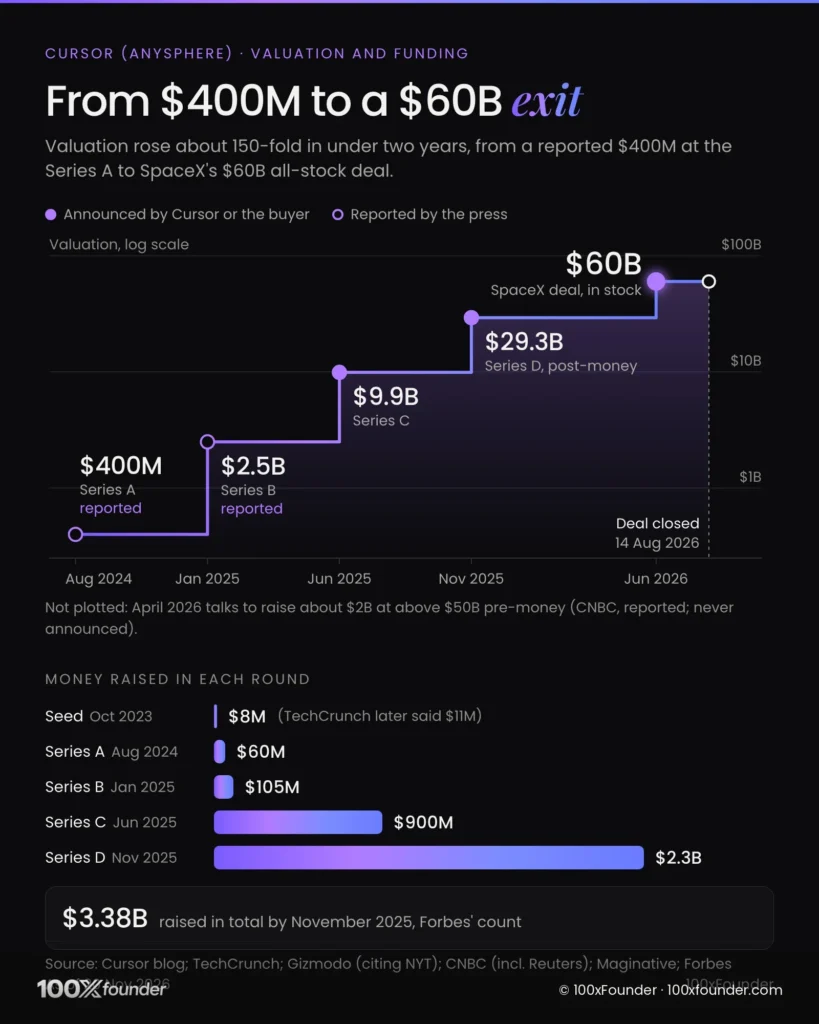
Anysphere, the company behind the AI code editor Cursor, had raised about $3.4 billion in private funding by November 2025, by Forbes’ count, ending with a $2.3 billion Series D at a $29.3 billion post-money valuation. SpaceX then agreed in June 2026 to buy it for $60 billion in stock, and Cursor said on 14 August 2026 that the acquisition was complete.
Revenue is what carried each step. Cursor said it had passed $100 million in recurring revenue in January 2025, $500 million in ARR in June 2025 and $1 billion in annualised revenue in November 2025; by June 2026 it had roughly $2.6 billion in annualised business revenue, according to company data shared with Reuters and reported by CNBC. Below: every round with its source, why the numbers moved, how to read them, and what the SpaceX era means for developers and founders in India.
Key takeaways
- Cursor announced four rounds on its own blog: Series A $60 million (22 August 2024), Series B $105 million (16 January 2025), Series C $900 million at $9.9 billion (6 June 2025) and Series D $2.3 billion at $29.3 billion post-money (13 November 2025).
- SpaceX agreed on 16 June 2026 to acquire Anysphere for $60 billion through a stock-based merger; Cursor said the deal was complete on 14 August 2026.
- Company-stated revenue rose from over $100 million (January 2025) to roughly $2.6 billion annualised (June 2026), and the valuation stayed at roughly 20 to 30 times those revenue figures at each step.
- India is Cursor’s third-largest market, TechCrunch reported, and in July 2026 Cursor launched a ₹649-a-month, rupee-billed plan for Indian users.
- Cognition, the Devin and Windsurf owner, was valued at $48 billion in September 2026 on almost $900 million run rate, a higher multiple than SpaceX paid for Cursor.
- After the deal, OpenAI said it would end Cursor’s access to its models, while Anthropic said it would keep supporting Claude in Cursor, CNBC reported.
What Cursor sells and who pays for it
Cursor is an AI-first code editor: developers write code in it while models suggest the next edit, answer questions about the codebase and, increasingly, run agents that carry out whole tasks. Four MIT friends started Anysphere in 2022, and Cursor is the company’s single product, according to Forbes. Michael Truell is the chief executive; the other co-founders named by Forbes are Aman Sanger, Sualeh Asif and Arvid Lunnemark.
Two groups pay. Individual developers buy monthly subscriptions, and companies buy team seats with central billing and single sign-on, or enterprise seats that add audit logs and controls over which models and repositories staff can use, according to Cursor’s pricing page read on 20 November 2026. On that page the paid individual tiers are Plus ($8 a month, introductory, Grok models only), Premium ($30), Super ($100) and Ultra ($200), with Teams from $30 per user and custom-priced Enterprise. Usage comes from a pool that refreshes weekly; third-party models are billed separately at API list price on Premium and above.
The company side grew fast. Cursor said in June 2025 that more than half of the Fortune 500 used it, naming NVIDIA, Uber and Adobe, and Forbes reported in November 2025 that about 50,000 teams at companies including Shopify and PayPal used it.
Cursor funding rounds at a glance
The table separates what Cursor announced itself from what outlets reported from unnamed sources. Where a valuation appears only in press reports, the source is named in the row.
| Date | Event | Amount | Valuation | Investors named | Source |
|---|---|---|---|---|---|
| Oct 2023 | Seed | $8 million (TechCrunch later said $11 million) | Not disclosed | OpenAI Startup Fund (led), Nat Friedman, Arash Ferdowsi, angels | Maginative, 11 Oct 2023 |
| 22 Aug 2024 | Series A | $60 million | $400 million post-money (reported) | Andreessen Horowitz and Thrive Capital (co-leads, per TechCrunch), OpenAI, Jeff Dean, Noam Brown, founders of Stripe, GitHub, Ramp and Perplexity | Cursor blog; valuation from TechCrunch, 9 Aug 2024, citing two sources |
| 16 Jan 2025 | Series B | $105 million | $2.5 billion (reported) | Thrive Capital, Andreessen Horowitz, Benchmark, existing investors | Cursor blog; valuation from the New York Times via Gizmodo |
| 6 Jun 2025 | Series C | $900 million | $9.9 billion | Thrive, Accel, Andreessen Horowitz, DST | Cursor blog |
| 13 Nov 2025 | Series D | $2.3 billion | $29.3 billion post-money | Accel, Thrive, Andreessen Horowitz (returning); Coatue, NVIDIA, Google (new) | Cursor blog |
| Apr 2026 | Round in talks (not announced) | About $2 billion | Above $50 billion pre-money (reported) | Andreessen Horowitz (to co-lead), NVIDIA, Thrive | CNBC, 19 Apr 2026 |
| 21 Apr 2026 | SpaceX option | $60 billion option, or $10 billion for joint work | n/a | SpaceX | Gizmodo, 21 Apr 2026 |
| 16 Jun 2026 | Acquisition agreed | $60 billion in stock | $60 billion (deal price) | SpaceX | CNBC, 16 Jun 2026 |
| 14 Aug 2026 | Acquisition complete | Terms not restated | n/a | SpaceX | Cursor blog |
Data as of 20 November 2026. “Reported” means the figure comes from news reports, not the company. Lead investors are shown only where the source names them; Cursor’s own posts list investors without naming a lead.
2023 to 2024: seed money and a $60 million Series A
Anysphere’s first institutional money was an $8 million seed led by the OpenAI Startup Fund, announced in October 2023, with former GitHub CEO Nat Friedman and Dropbox co-founder Arash Ferdowsi among the angels, according to Maginative. Maginative said the seed took Anysphere’s total funding to $11 million; TechCrunch later described the 2023 seed itself as $11 million and said Neo led a pre-seed, so outlets give different seed figures.
Cursor’s own Series A post, dated 22 August 2024, announced $60 million from Andreessen Horowitz, Thrive Capital and OpenAI, plus Google’s Jeff Dean, OpenAI researcher Noam Brown and founders of Stripe, GitHub, Ramp, Perplexity and OpenAI. It said Cursor had more than 40,000 customers and described the work behind the product: models that predict a developer’s next edit, retrieval across billions of files and fast code rewrites. The post gave no valuation; TechCrunch had reported two weeks earlier, citing two people familiar with the deal, that the round valued the company at $400 million post-money.
Revenue was still small. Forbes reported that annual recurring revenue went from $1 million in 2023 to $100 million in about 12 months.
Series B: $105 million in January 2025
Cursor announced a $105 million Series B on 16 January 2025 from Thrive Capital, Andreessen Horowitz and Benchmark, plus existing investors, according to its Series B post. The post did not give a valuation; the New York Times put it at $2.5 billion, according to a Gizmodo report that cited it.
The same post said the business had passed $100 million in recurring revenue, that millions of programmers used Cursor as their editor and that its own models edited more than a billion characters a day. The money was for hiring and for research on systems, models and the product. In the same post, Cursor described itself as an applied research lab whose goal is to automate coding.
Series C: $900 million at $9.9 billion
Cursor’s Series C, announced on 6 June 2025, raised $900 million at a $9.9 billion valuation from Thrive, Accel, Andreessen Horowitz and DST, according to the company’s Series C post. That was about four times the reported Series B valuation, five months later.
What changed in between was the customer base. The post said annual recurring revenue had passed $500 million and that more than half of the Fortune 500 used Cursor. The company’s stated revenue floor rose fivefold in those five months, a little faster than the valuation.
Series D: $2.3 billion at $29.3 billion post-money
Cursor’s last private round was a $2.3 billion Series D at a $29.3 billion post-money valuation, announced on 13 November 2025. Accel, Thrive and Andreessen Horowitz returned, and Coatue, NVIDIA and Google joined.
The post said Cursor had crossed $1 billion in annualised revenue and had more than 300 engineers, researchers, designers and operators, and that its in-house models generated more code than almost any other LLM. Forbes estimated that each of the four co-founders held about 4.5%, making each a billionaire, and reported that Arvid Lunnemark had left in October 2025 to start an AI research company.
What moved the numbers: a pricing reset and in-house models
Two product changes came between the Series C and the Series D. The first was pricing. On 16 June 2025 Cursor added a $200-a-month Ultra plan with 20 times the usage of Pro, aimed at heavy users who wanted predictable costs, and moved Pro from a fixed request count to compute-based limits that include at least $20 of model use a month at API prices, according to its post announcing the tier. Under the old Pro plan, users got 500 requests a month, with Sonnet requests counting as two.
The change was badly received. On 4 July 2025 Cursor said in a follow-up post that the changes had not been communicated clearly and offered refunds for unexpected usage charges between 16 June and 4 July. Its explanation was cost: newer models use more tokens on long tasks, and the hardest requests cost “an order of magnitude more” than simple ones, so Pro users who ran past their included usage could buy more frontier-model use at cost. The pricing page today still bills third-party models at API list price on top of the plan fee.
The second was building its own model. Cursor released Composer, an agent model for software engineering, on 29 October 2025, two weeks before the Series D, and said its internal benchmarks showed it generating about four times faster than similar models. Forbes noted that running its own model could reduce Cursor’s reliance on the costly third-party models it pays for, and Cursor’s Asia-Pacific head later said the ₹649 Indian plan described below is viable because it runs on Cursor’s own, cheaper models rather than OpenAI or Anthropic ones.
The road to SpaceX: from a $50 billion round to a $60 billion sale
In April 2026 Cursor was in talks to raise about $2 billion at a valuation above $50 billion before the new money, according to CNBC, which cited a person familiar with the matter and said Bloomberg News first reported the fundraising. No closing announcement for that round appeared on Cursor’s blog.
On 21 April 2026 SpaceX said it had an option to buy Cursor for $60 billion later in the year, or to pay $10 billion for the two companies’ joint work instead, according to Gizmodo. SpaceX’s announcement said the work would pair Cursor’s product with its Colossus training supercomputer, which it described as a million H100 equivalents.
SpaceX said on 16 June 2026, days after its own stock market listing, that it would acquire Anysphere for $60 billion through a stock-based merger with a SpaceX subsidiary called X67, CNBC reported, crediting Reuters. A filing set a $10 billion termination fee payable by SpaceX in some circumstances and a $4 billion fee if the deal failed on antitrust grounds. Because the price was paid in stock, the cash from SpaceX’s IPO was not funding it.
Cursor said on 14 August 2026 that it had officially been acquired. Its post said Cursor would gain access to what it called the largest GPU fleet in the world and could therefore offer customers more capable models at a lower price, and it mentioned Grok 4.6, released that week. The post did not restate the price or say anything about changes to privacy, plans or governance. TechCrunch reported the close the next day.
Revenue growth behind each valuation
Cursor’s company-stated revenue grew up to about 26 times between January 2025 and June 2026, from over $100 million to about $2.6 billion annualised. The four data points come from different kinds of statement, so they are not exactly like for like.
| As of | Revenue figure | How it was described | Valuation at the time | Source |
|---|---|---|---|---|
| Jan 2025 | Over $100 million | Recurring revenue | $2.5 billion (reported) | Cursor blog, Series B post |
| Jun 2025 | Over $500 million | ARR | $9.9 billion | Cursor blog, Series C post |
| Nov 2025 | Over $1 billion | Annualised revenue | $29.3 billion post-money | Cursor blog, Series D post |
| Jun 2026 | About $2.6 billion | Annualised business-to-business revenue | $60 billion (deal price) | CNBC, citing company data shared with Reuters |
Figures as the source stated them; the first three are floors. Table as of 20 November 2026.
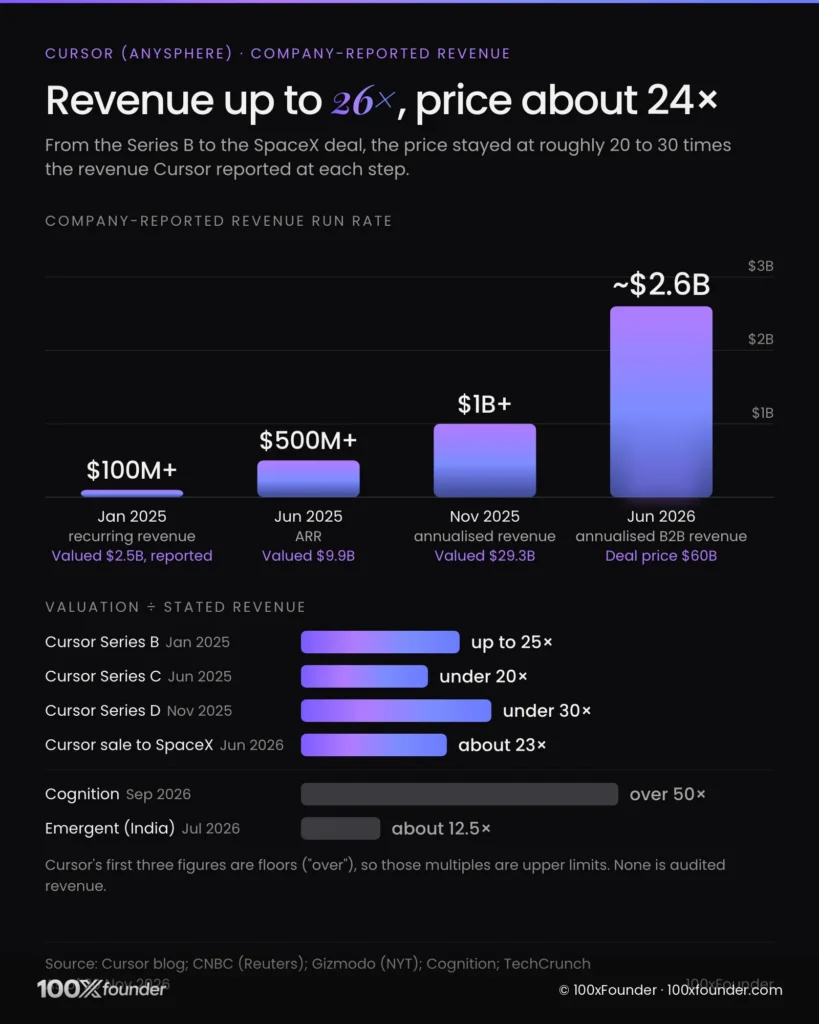
Set against revenue, the price stayed in a narrow band. The $2.5 billion reported Series B valuation was at most 25 times the $100 million floor; the $9.9 billion Series C valuation was under 20 times the $500 million floor; the $29.3 billion Series D valuation was under 30 times the $1 billion floor; and the $60 billion deal price was about 23 times the $2.6 billion annualised figure. Investors did not pay a steadily rising multiple: the valuation rose about 24 times from the Series B to the sale, while stated revenue rose up to about 26 times.
How Cursor compares with other AI coding companies
Cursor was not the only AI coding company priced on fast revenue growth, and the comparison shows how buyers valued it. Cognition, which makes the Devin coding agent and agreed in July 2025 to buy the Windsurf editor’s business, brand and team when Windsurf had $82 million in ARR and more than 350 enterprise customers, raised over $2 billion at a $48 billion valuation on 8 September 2026, led by Andreessen Horowitz and Accel, according to Cognition’s own announcement. It said its run rate had grown from $492 million to almost $900 million since May. That valuation is more than 50 times its stated run rate, against about 23 times for Cursor’s $60 billion sale.
The closest Indian comparison is Emergent, an Indian AI coding startup with most of its roughly 200 staff in Bengaluru, whose platform lets entrepreneurs and small businesses build apps and handles hosting, testing and debugging for them. It raised a $130 million Series C at a $1.5 billion post-money valuation in July 2026, led by Creaegis with Khosla Ventures, SoftBank’s Vision Fund 2, Lightspeed and Y Combinator, and had a $120 million annualised run rate and more than 200,000 paying customers, according to TechCrunch. That is about 12.5 times run rate. The customers differ too: Emergent’s chief executive told TechCrunch it targets entrepreneurs and small and medium-sized businesses, and set it apart from developer-focused tools such as Cursor.
How to read these numbers
- Revenue is self-reported and defined loosely. Cursor used “recurring revenue”, “ARR” and “annualised revenue” in different posts, and the June 2026 figure covers business-to-business revenue only. None of these is audited revenue; run-rate figures take a recent month or period and multiply it out to a year.
- Floors, not exact figures. “Over $500 million” could mean $510 million or $700 million, so any multiple built on it is an upper limit.
- Pre-money and post-money. The Series D figure is post-money (it includes the $2.3 billion raised). The April 2026 talks were reported at above $50 billion pre-money, so the two are not directly comparable.
- A stock deal is not cash. SpaceX paid in its own shares, so the $60 billion figure depends on how SpaceX stock was valued at signing.
- Total raised is a third-party figure. The $3.38 billion total comes from Forbes; Cursor has not published a total.
What it means for developers and founders in India
India is Cursor’s third-largest market and the one with the largest share of heavy users, and the user base there more than tripled in a year, TechCrunch reported on 27 July 2026, quoting Simon Green, Cursor’s head of Asia Pacific and Japan. Cursor launched Cursor Start for India at ₹649 a month (about $7, TechCrunch said), tax inclusive and billed in rupees by card or UPI, according to its changelog dated 28 July 2026. TechCrunch reported that it includes Cursor’s Composer 2.5 and Grok 4.5 models, cloud agents and the iOS app, but not OpenAI or Anthropic models, Bugbot code review or Auto mode, and Green said Cursor would use checks, including against VPN use, to keep the plan to individual users in India. Green said the plan was not a loss leader because it runs on Cursor’s own, cheaper models. The global pricing page we loaded on 20 November 2026 showed dollar prices only, so check the in-app price from an Indian account before you pay.
For buyers, the ownership change shows up in model access. OpenAI said on 28 August 2026 that it would end developers’ access to its models in Cursor, proposing 12 November 2026 as the shutoff date, because it could not be confident SpaceX would use its technology within its terms, CNBC reported. Truell said OpenAI models served about 5% of Cursor’s traffic, and Anthropic co-founder Tom Brown said Anthropic would keep adding compute for Claude in Cursor. If your team depends on one model family, check that it is still available in the plan you buy.
For hiring, Cursor hired its first salesperson in India, expected another leader to join in Delhi, was building a government affairs office and hiring three technical support staff, and was expanding in Bengaluru, Chennai, Hyderabad and Mumbai, TechCrunch reported. Enterprise sales in India were still early, with adoption coming mostly from individual developers, startups and universities. Openings at other AI companies hiring in India are on our AI and ML jobs board.
For founders building developer tools, Cursor’s record shows three things: a product individuals pay for can turn into enterprise revenue within about a year; owning your models protects margins and lets you offer cheaper local plans, as Cursor Start does; and depending on another company’s models carries risk, as the OpenAI shutoff shows.
Why it matters
Cursor went from a reported $400 million valuation in August 2024 to a $60 billion sale in June 2026, a 150-fold rise in under two years, and the private-round path ended with a strategic buyer that owns compute rather than another round. Our guide to the best AI for coding compares Cursor with Claude Code, Copilot and Codex, what Reddit developers use collects user views, and we covered the Cursor security breach separately. Other rounds are in our funding tracker.
How we compiled this
We read Cursor’s Series A, Series B, Series C, Series D, Ultra plan, pricing clarification, Composer and “Joining SpaceX” posts, its Cursor Start changelog entry and its pricing page on 20 November 2026, and took every company-stated round, investor list, customer count, pricing change and revenue figure from them. Earlier rounds, reported valuations, the SpaceX terms, the India plan and the OpenAI dispute come from TechCrunch, Maginative, Gizmodo, CNBC and Forbes, and the rival figures from Cognition’s own posts and TechCrunch, all read the same day; figures from unnamed sources are marked “reported”. The revenue multiples are simple divisions of the stated valuation by the stated revenue figure at the same date. We did not calculate a total raised; the $3.38 billion total is Forbes’ figure.
FAQ
How much funding did Cursor raise before the SpaceX deal?
Forbes put Anysphere’s total funding at $3.38 billion in November 2025. That covers a 2023 seed (reported as $8 million or $11 million) and four rounds Cursor announced itself: $60 million in August 2024, $105 million in January 2025, $900 million in June 2025 and $2.3 billion in November 2025. A $2 billion round discussed in April 2026 was not announced as closed.
What was Cursor’s last valuation before it was acquired?
Cursor’s last announced private valuation was $29.3 billion post-money, from its $2.3 billion Series D on 13 November 2025. In April 2026 CNBC reported talks at above $50 billion before the new money, but Cursor did not announce that round. SpaceX then agreed to buy Anysphere for $60 billion in June 2026.
Who invested in Cursor?
Investors named in Cursor’s own posts include Andreessen Horowitz and Thrive Capital (from the Series A onward), OpenAI (Series A), Benchmark (Series B), Accel and DST (Series C), and Coatue, NVIDIA and Google (Series D). The OpenAI Startup Fund led the 2023 seed, according to Maginative.
Did SpaceX pay cash for Cursor?
No. The $60 billion acquisition was a stock-based merger between Anysphere and a SpaceX subsidiary, X67, according to CNBC’s 16 June 2026 report. A filing set a $10 billion termination fee in some circumstances and a $4 billion fee if antitrust problems blocked the deal. Cursor said the acquisition was complete on 14 August 2026.
How much does Cursor cost in India?
Cursor launched Cursor Start for India in July 2026 at ₹649 a month, payable by card or UPI, TechCrunch reported. It includes Cursor’s Composer model and xAI’s Grok, and leaves out OpenAI and Anthropic models. The global pricing page, read on 20 November 2026, lists Plus at $8, Premium at $30 and Ultra at $200 a month, before taxes.
Why did Cursor change its pricing in 2025?
In June 2025 Cursor moved Pro from 500 requests a month to compute-based limits with at least $20 of model use at API prices, and added a $200 Ultra plan. On 4 July 2025 it apologised for unclear communication, offered refunds for surprise charges and said the hardest requests cost far more to serve than simple ones.
What is Cursor’s annual revenue?
The latest figure we found is roughly $2.6 billion in annualised business-to-business revenue, from company data shared with Reuters and reported by CNBC on 16 June 2026. Cursor’s own posts gave over $100 million (January 2025), over $500 million ARR (June 2025) and over $1 billion annualised (November 2025).
Can I still use ChatGPT models in Cursor?
OpenAI said in August 2026 that it would end developers’ access to its models in Cursor, proposing a 12 November 2026 shutoff, CNBC reported; Cursor said OpenAI models served about 5% of its traffic. Anthropic said it would keep supporting Claude in Cursor. Check the model list in your Cursor account for what is available now.
Sources
- Cursor blog, “Series A and Magic” (cursor.com/blog/series-a), 22 August 2024
- Cursor blog, “Series B and Automating Code” (cursor.com/blog/series-b), 16 January 2025
- Cursor blog, “Series C and Scale” (cursor.com/blog/series-c), 6 June 2025
- Cursor blog, “Series D” (cursor.com/blog/series-d), 13 November 2025
- Cursor blog, Ultra plan announcement (cursor.com/blog/new-tier), 16 June 2025
- Cursor blog, pricing clarification (cursor.com/blog/june-2025-pricing), 4 July 2025
- Cursor blog, “Composer” (cursor.com/blog/composer), 29 October 2025
- Cursor changelog, “Cursor Start” (cursor.com/changelog/cursor-start), 28 July 2026
- Cognition blog, Series E (cognition.com/blog/series-e), 8 September 2026
- Cognition blog, Windsurf acquisition (cognition.com/blog/windsurf), 14 July 2025
- Cursor blog, “Joining SpaceX” (cursor.com/blog/joining-spacex), 14 August 2026
- Cursor, pricing page (cursor.com/pricing), read 20 November 2026
- CNBC (Reuters), “SpaceX to buy Cursor AI parent Anysphere for $60 billion“, 16 June 2026
- CNBC, “AI startup Cursor in talks to raise $2 billion funding round at valuation of over $50 billion“, 19 April 2026
- CNBC, “OpenAI to end Cursor’s access to its models after SpaceX acquisition“, 29 August 2026
- Gizmodo, “SpaceX obtains option to buy Cursor for $60 billion“, 21 April 2026
- TechCrunch, “Cursor makes its biggest India push yet ahead of SpaceX acquisition with localized pricing“, 27 July 2026
- TechCrunch, “SpaceX officially closes its Cursor acquisition“, 15 August 2026
- TechCrunch, “Anysphere, a GitHub Copilot rival, has raised $60M Series A at $400M valuation from a16z, Thrive, sources say“, 9 August 2024
- Maginative, “Anysphere Raises $8M to Build Cursor, an AI-Powered IDE“, 11 October 2023
- Forbes Australia, “Four cofounders of popular AI coding tool Cursor are now billionaires“, 28 November 2025
- TechCrunch, “Indian AI coding startup Emergent becomes a unicorn just over a year after launch”, 15 July 2026
Related stories

Sources (22)
- Cursor 16 Jan 2025Series B $105M; Thrive, a16z, Benchmark; over $100M recurring revenue; millions of programmers; use of funds; models edit over a billion characters a day; applied research lab
- Cursor 6 Jun 2025Series C $900M at $9.9B; Thrive, Accel, a16z, DST; over $500M ARR; over half of Fortune 500
- Cursor 13 Nov 2025Series D $2.3B at $29.3B post-money; investors; $1B annualised revenue; 300+ staff; in-house models; post-money
- Cursor 14 Aug 2026Officially acquired by SpaceX; process began with April partnership; GPU fleet, cheaper models; Grok 4.6 example; no pricing/privacy changes stated
- Cursor 16 Jun 2025Ultra $200/month, 20x Pro usage, for power users wanting predictability; Pro moved to compute limits with at least $20 of API-priced inference; option to keep 500 requests
- Cursor 4 Jul 2025Cursor (post by Andrew & Jason): changes not communicated clearly; refunds for 16 Jun-4 Jul charges; old Pro 500 requests, Sonnet counts as two; hardest requests cost an order of magnitude more; extra frontier use at API pricing
- Cursor 29 Oct 2025Composer agent model; about four times faster generation than similar models on internal benchmarks; trained with RL in Cursor tools
- CNBC (Reuters) 16 Jun 2026$60B stock-based merger with X67; Q3 close expected; $10B and $4B termination fees; ~$2.6B annualised B2B revenue; IPO cash not used
- CNBC 19 Apr 2026Talks to raise ~$2B at over $50B pre-money; a16z to co-lead; NVIDIA, Thrive; Bloomberg News first reported
- Gizmodo 21 Apr 2026$60B option or $10B for joint work; SpaceX post: Cursor product plus Colossus (million H100 equivalents); NYT-reported $2.5B Series B valuation
- TechCrunch 15 Aug 2026Close reported; $60B price
- TechCrunch 9 Aug 2024Series A over $60M at $400M post-money, co-led by a16z and Thrive, Patrick Collison; $11M seed; Neo pre-seed
- Maginative 11 Oct 2023$8M seed led by OpenAI Startup Fund; Nat Friedman, Arash Ferdowsi
- Forbes Australia 28 Nov 2025Founded 2022 by four MIT friends; founders billionaires, 4.5% stakes; $3.38B total raised; co-founder left Oct 2025; founder names; Cursor only product; ARR $1M (2023) to $100M in ~12 months; ~50,000 teams incl. Shopify, PayPal; Composer launched Oct 2025
- Cursor 22 Aug 2024Series A $60M; a16z, Thrive, OpenAI, Jeff Dean, Noam Brown, founders of Stripe/GitHub/Ramp/Perplexity/OpenAI; 40,000+ customers; next-edit models
- Cursor 20 Nov 2026Plus $8 (Grok only), Premium $30, Super $100, Ultra $200, Teams $30+/user, Enterprise custom; weekly pool; third-party models at API price; USD only
- TechCrunch 27 Jul 2026Cursor Start Rs 649/month, card/UPI, Composer 2.5 + Grok 4.5, no OpenAI/Anthropic; India third-largest market, users tripled; hiring in Delhi, Bengaluru, Chennai, Hyderabad, Mumbai; Simon Green
- CNBC 29 Aug 2026OpenAI ending model access, proposed 12 Nov 2026 shutoff; Truell: ~5% of traffic; Anthropic (Tom Brown) to keep supporting Claude
- Cursor 28 Jul 2026Cursor Start ₹649/month tax inclusive, billed in INR, UPI or card, developers in India, Grok and Composer
- Cognition 8 Sep 2026Over $2B at $48B; a16z and Accel; run rate $492M to almost $900M since May; Devin
- Cognition 14 Jul 2025Definitive agreement to acquire Windsurf IP, brand, business and team; $82M ARR; 350+ enterprise customers
- TechCrunch 15 Jul 2026Emergent $130M Series C at $1.5B post-money led by Creaegis; Khosla, SoftBank VF2, Lightspeed, YC; $120M annualised run rate; 200,000+ paying customers; ~200 staff mostly Bengaluru; SMB/entrepreneur focus