Cursor security breach: Fireworks key led to tampered Claude Code
Cursor says a key exposed by Fireworks AI let an attacker copy data and plant a tampered Claude Code extension. Who is affected and the steps to take now.
 Ishaan Vardhan16 Nov 2026 · 7 min read
Cursor said on Friday, 13 November 2026, that an attacker used a Cursor-issued access key exposed by its inference vendor Fireworks AI to copy coding-agent data, reach some internal tools and plant a tampered copy of Anthropic’s Claude Code extension in its marketplace cache, which up to 5,000 users may have received on 29 October. Cursor says customer code repositories, its production systems, the Cursor app and users in Privacy Mode were not affected, but developers who installed Claude Code versions 2.1.312 or 2.1.313 that day need to clean their machines, not just update.
Key takeaways
- The entry point was a key Cursor had issued to Fireworks; Cursor says the “key was exposed by Fireworks” and was used to copy a shared, read-only data bucket.
- Less than 0.01% of Cursor customers had API credentials exposed, and coding-agent traces were exposed for less than 0.05% of users not in Privacy Mode, according to Cursor.
- A tampered Anthropic.claude-code extension, versions 2.1.312 and 2.1.313, was available for about 11 hours on 29 October and tried to install an SSH backdoor.
- Uninstalling the extension may not remove the malware; Cursor publishes a remediation script and a list of indicators.
- Cursor has moved all inference off Fireworks and rotated its internal credentials.
What happened, step by step
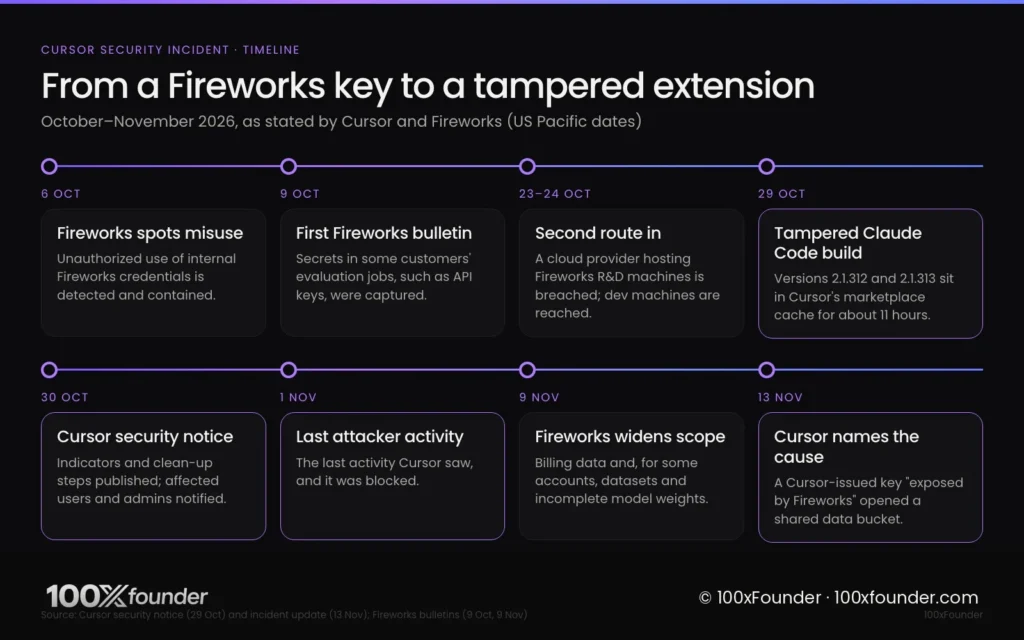
The Cursor incident began with a key, not a flaw in the editor. Cursor’s incident update says an attacker obtained an access key Cursor had issued to Fireworks, a third-party inference vendor, and used it to copy data from a read-only storage bucket the two companies shared. That bucket held limited coding-agent traces, mostly from 2025, from sessions outside Privacy Mode that Cursor was allowed to use for model training. Some traces contained credentials that had not been redacted.
With those credentials, the attacker reached some of Cursor’s SaaS tools and took archived non-production code repositories, limited customer support data and emails, usage metrics and contact details, summaries of some coding-agent conversations, and some credentials users had sent to Cursor support.
On 29 October the attacker used a stolen credential to place malicious copies of the Claude Code extension on the cache that serves Cursor’s VS Code extension marketplace. Cursor saw the last attacker activity on 1 November and blocked it.
What Fireworks has said
Fireworks AI has disclosed two routes into its systems in October, but its public bulletins do not name Cursor. Its first bulletin, published on 9 October, said it found unauthorized use of internal Fireworks credentials on 6 October and that environment variables used in evaluation jobs, including API keys and tokens stored as secrets, were captured in a limited number of customer accounts. An update dated 9 November added that a third-party cloud provider hosting Fireworks research machines had a security incident on 23 October, and that the attacker used it the next day to reach Fireworks development machines.
That update widened the exposed data to billing information and, for certain customers, some datasets and incomplete model weights; payment card numbers were not affected. Cursor has not said which intrusion exposed its key. The Register reported on 10 November, citing Bloomberg, that Fireworks was working with customers including Cursor to assess the impact.
The malicious Claude Code extension
The tampered extension was Anthropic.claude-code, versions 2.1.312 and 2.1.313, for macOS and Windows, according to Cursor’s security notice. It was in the marketplace between about 2:27am and 1:35pm Pacific time on 29 October, roughly 11 hours. Cursor says at most 5,000 users who requested those cached versions that day may have received it.
Once installed, the extension sent host details such as username, Git email and public IP address to the attacker, tried to add an attacker-controlled SSH key and open a reverse SSH tunnel, and set up persistence. Cursor says the tunnel step would fail in most cases because it needs admin rights, but warns that the limited data collection “does not rule out later credential access over the backdoor.”
Anthropic did not publish this copy and it was not a vulnerability in Anthropic’s product, Cursor says, and the Open VSX marketplace source never carried the malware. Anthropic’s Felix Rieseberg said on X that the versions on Anthropic’s official channels were not affected, The Register reported on 30 October.
What was not affected, according to Cursor
Cursor says the incident did not reach its production systems, the Cursor app, its official updates or its release signing keys. Prompts and code of users in Privacy Mode, customer code repositories, live traffic and active inference requests, other marketplace extensions and plugins, and Cloud Agents were also unaffected, according to the update.
Checklist: how to tell if you are affected
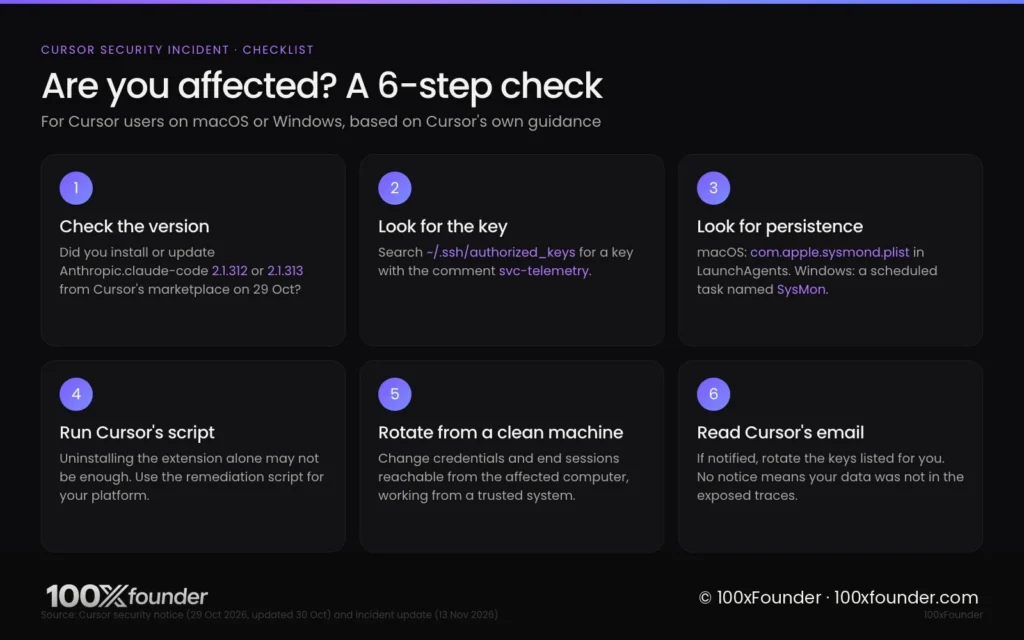
Anyone who installed or updated Claude Code in Cursor on 29 October should treat that machine as possibly compromised. These steps follow Cursor’s guidance:
- Check the version. See whether Anthropic.claude-code 2.1.312 or 2.1.313 was installed from Cursor’s marketplace that day.
- Look for the attacker’s key. Search ~/.ssh/authorized_keys for a key with the comment svc-telemetry; on Windows, Cursor’s PowerShell check covers both key files.
- Look for persistence. On macOS, com.apple.sysmond.plist in LaunchAgents; on Windows, a scheduled task named SysMon.
- Run Cursor’s remediation script. Use remediate-macos.sh as your normal user or remediate-windows.ps1 from an elevated PowerShell, and decide whether to rebuild the machine.
- Rotate credentials from a clean device. Change API keys, Git and cloud tokens, CI/CD secrets and SSH keys reachable from the affected computer, then review repository activity, CI runs and API billing for anything you did not start.
- Read Cursor’s email. If notified, rotate every credential listed; team admins received lists of specific keys.
Security teams can search logs for the attacker IP 134.209.82.225 and the other indicators in Cursor’s notice.
What Cursor and Fireworks have done
Cursor says it deactivated the Fireworks key, moved all inference off Fireworks, rotated every exposed credential and then all internal ones, rebuilt the extension marketplace, added secret scanning across its repositories, redeployed production infrastructure and brought in external forensics experts. Fireworks says it revoked and replaced credentials, isolated affected systems, notified law enforcement, engaged Palo Alto Networks’ Unit 42 and paused self-serve dataset uploads and downloads during its investigation.
A note for Indian companies
Indian startups whose systems or customer data were touched should check their reporting duties now. CERT-In’s directions of 28 April 2022 require service providers, intermediaries, data centres and body corporates to report listed cyber incidents to CERT-In within 6 hours of noticing them. Under the DPDP Rules 2025, a data fiduciary must tell the Data Protection Board and each affected person about a personal data breach, with a detailed report to the Board within 72 hours, according to AZB & Partners; the Data Security Council of India’s brief lists that rule as taking effect on 13 May 2027. This is general information, not legal advice; confirm with a qualified lawyer.
Why it matters
Cursor’s own app and signing keys held, yet a key sitting with a vendor still led to a backdoor on developers’ laptops. For Indian teams using AI coding tools, the lesson is to keep secrets out of agent sessions and treat editor extensions like any other dependency. For choosing tools, see our guide to the best AI for coding and what Reddit developers use.
FAQ
Was my code stolen in the Cursor breach?
Cursor says customer code repositories were not affected and Privacy Mode prompts and code were not exposed. The copied bucket held limited coding-agent traces, mostly from 2025, from sessions outside Privacy Mode; traces were exposed for less than 0.05% of those users.
Is it enough to update or uninstall the Claude Code extension?
No. Cursor says the payload drops standalone persistence scripts that keep running after the extension is removed, so affected users should run Cursor’s remediation script and rotate credentials from a trusted device.
Was the official Claude Code extension from Anthropic compromised?
No. The tampered build sat only in the cache serving Cursor’s marketplace; Cursor says Anthropic did not publish it and the Open VSX source never carried it.
How do I know whether my Cursor API keys were exposed?
Cursor says it contacted every affected customer directly, and less than 0.01% had API credentials exposed. If you were not notified, Cursor says your data was not in the exposed traces.
Does Cursor still use Fireworks AI?
No. Cursor says it moved all inference traffic off Fireworks and cut its access to shared datasets.
Sources
- Cursor, “Security incident update”, 13 November 2026. Link
- Cursor, “Security notice: malicious Anthropic.claude-code extension”, 29 October 2026, updated 30 October 2026. Link
- Fireworks AI, “October 2026 security incident”, 9 October 2026. Link
- Fireworks AI, “October 2026 security incident update”, 9 November 2026. Link
- The Hacker News, “Cursor says stolen Fireworks AI key led to trojanized Claude Code extension incident”, 15 November 2026. Link
- The Register, “Anthropic: That Claude Code extension compromise… couldn’t be us”, 30 October 2026. Link
- The Register, “Fireworks AI gets burned twice as customer data exposure widens”, 10 November 2026. Link
- CERT-In, “Directions under sub-section (6) of section 70B of the IT Act, 2000”, 28 April 2022. Link
- AZB & Partners, “India’s Digital Personal Data Protection framework comes into effect”, 19 November 2025. Link
- Data Security Council of India, “Insight brief on DPDP Rules”, November 2025. Link
Related stories



Sources (10)
- Cursor 13 Nov 2026Key issued to Fireworks 'exposed by Fireworks'; read-only bucket with coding-agent traces mostly from 2025, non-Privacy Mode; <0.01% customers API credentials; <0.05% users traces; data accessed via SaaS tools; 29 Oct extension on marketplace cache; at most 5,000 users; ~11 hours; Anthropic not at fault; Open VSX clean; last activity 1 Nov; not-affected list; Cursor's response; notified users; admins got key lists
- Cursor 29 Oct 2026Anthropic.claude-code 2.1.312/2.1.313, macOS and Windows, 2:27am-1:35pm PT; data collected; SSH backdoor and persistence; tunnel needs admin; 'does not rule out later credential access'; IOCs (svc-telemetry, com.apple.sysmond.plist, SysMon, 134.209.82.225); remediation scripts; uninstall may not suffice; security@cursor.com; updated 30 Oct
- Fireworks AI 9 Oct 2026Detected 6 Oct unauthorized use of internal credentials; environment variables in evaluation jobs incl. API keys and tokens captured in limited customer accounts
- Fireworks AI 9 Nov 2026Cloud provider incident 23 Oct, dev machines reached 24 Oct; metadata, billing, some datasets and incomplete model weights; cards not stored; Unit 42; law enforcement; credential rotation; dataset uploads paused; no mention of Cursor
- The Hacker News 15 Nov 2026Independent report of Cursor's update: Fireworks key, bucket contents, percentages, 5,000 users, 11 hours, Cursor's actions
- The Register 30 Oct 2026Felix Rieseberg (Anthropic) on X: official channels not affected; Cursor's marketplace shutdown
- The Register 10 Nov 2026Fireworks working with customers including Cursor to assess impact (citing Bloomberg)
- CERT-In 28 Apr 2022Report cyber incidents to CERT-In within 6 hours; applies to service providers, intermediaries, data centres, body corporate
- AZB & Partners 19 Nov 2025DPDP Rules: breach intimation to Board and each affected data principal without delay; detailed report within 72 hours
- Data Security Council of India 17 Nov 2025Rule 7 breach intimation effective 13 May 2027 (18 months from publication)