HeyGen revenue and AI video startups’ funding, valuations compared
fal is now valued at $16B, Higgsfield at $5.4B and HeyGen passed $200M ARR. Funding, revenue, growth and what it means for Indian buyers, with sources.
 Ishaan Vardhan22 Nov 2026 · 15 min read

The most valuable AI video company on this list is now fal, valued at $16 billion in November 2026, followed by Higgsfield at $5.4 billion (August 2026), Runway at $5.3 billion (February 2026), Synthesia at $4 billion (January 2026), Krea at $500 million (April 2025) and HeyGen at “over $500 million” (June 2024). On revenue, Higgsfield reports a $700 million annualised run rate, fal more than $800 million in annualised revenue, HeyGen more than $200 million in ARR and Synthesia $150 million in ARR; Runway and Krea have not published a figure.
Those numbers measure different things, were reported at different times and mostly come from the companies themselves. Below we lay out every figure we could source, explain what each company sells and who pays for it, why the numbers moved, how they compare, and what it means if you are building or buying AI video in India.
Key takeaways
- fal, which runs other companies’ image, video and audio models for developers, went from $4.5 billion (December 2025) to $8 billion (April 2026) to $16 billion (November 2026), according to Bloomberg as cited by TechCrunch.
- Higgsfield’s company-reported run rate rose from about $20 million in August 2025 to $200 million in January 2026 and $700 million in August 2026, and its valuation went from over $1.3 billion to $5.4 billion in about seven months.
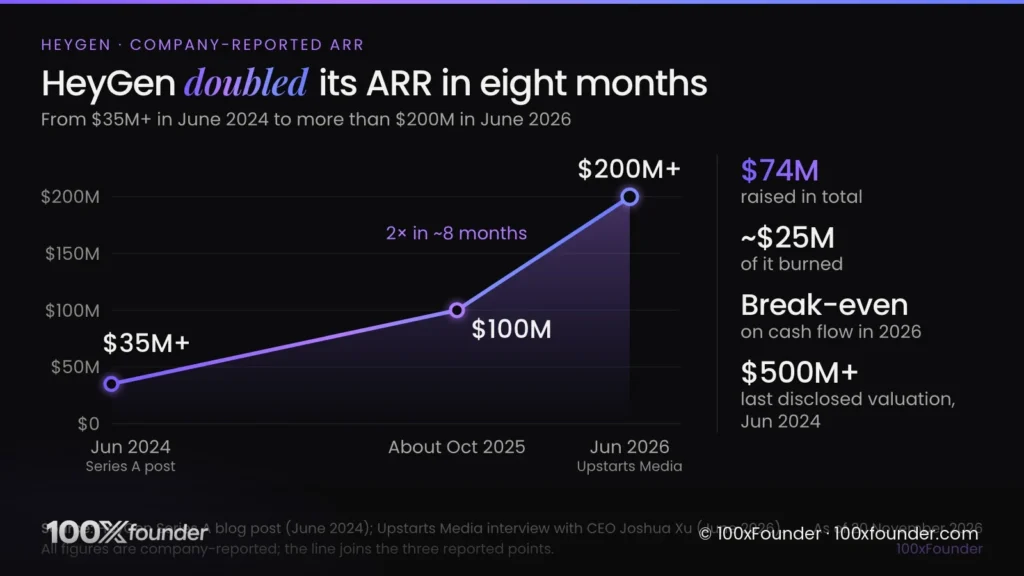
- HeyGen doubled ARR from $100 million to more than $200 million in about eight months and was cash-flow break-even in 2026, but its last disclosed valuation is still from June 2024.
- Synthesia, the enterprise training-video specialist, reported $150 million in ARR in January 2026 and expects to pass $200 million during the year.
- HeyGen, Synthesia and Runway list prices only in US dollars; none of their pricing pages showed rupee prices on 20 November 2026.
Funding and valuation: the six companies side by side
The table lists the latest reported round and the latest disclosed valuation for each company. A dash means no figure appears in the sources we read; we do not fill gaps with estimates.
| Company | What it sells | Latest reported round | Latest disclosed valuation | Source |
|---|---|---|---|---|
| fal (San Francisco) | Hosting and running image, video and audio models for developers | $1.3B Series F, Nov 2026, led by Bessemer Venture Partners ($1.65B across Series E and F) | $16B (Nov 2026) | TechCrunch citing Bloomberg, 3 Nov 2026 |
| Higgsfield (San Francisco) | Video and image generation for marketers and brands, on its own and third-party models | $400M Series B, Aug 2026, led by DST Global | $5.4B (Aug 2026) | SiliconANGLE and The Next Web, 17 Aug 2026 |
| Runway (New York) | Video-generation and world models for media, advertising and gaming | $315M Series E, Feb 2026, led by General Atlantic | $5.3B (Feb 2026) | TechCrunch, 10 Feb 2026 |
| Synthesia (London) | AI avatar video for corporate training and communications | $200M Series E, Jan 2026, led by GV | $4B (Jan 2026) | Synthesia; CNBC, 26 Jan 2026 |
| Krea (San Francisco) | One workspace for many image and video models | $47M Series B, Apr 2025, led by Bain Capital Ventures | $500M post-money (Apr 2025) | TechCrunch, 7 Apr 2025 |
| HeyGen (Los Angeles) | AI avatars, voice clones and video translation for small businesses and creators | $60M Series A, Jun 2024, led by Benchmark | Over $500M (Jun 2024) | HeyGen blog, Jun 2024 |
Data as of 20 November 2026. Runway’s and Krea’s valuations come from people familiar with the deals, as TechCrunch reported; fal’s $16 billion figure comes from Bloomberg’s reporting.
Revenue on record and how fast it grew
Only four of the six have put a revenue figure on record, and each uses a different measure. The second column matters as much as the number.
| Company | Latest figure | What it measures | Earlier figure | Source |
|---|---|---|---|---|
| fal | More than $800M (earlier in 2026) | Annualised revenue, as reported by Bloomberg | Passed $200M revenue by Oct 2025 | Bloomberg via TechCrunch |
| Higgsfield | $700M (Aug 2026) | Annualised run rate, company-reported | $200M (Jan 2026); about $20M (Aug 2025) | The Next Web; Reuters via The Star |
| HeyGen | More than $200M (Jun 2026) | ARR, company-reported | $100M (about Oct 2025); $35M+ (Jun 2024) | Upstarts Media; HeyGen |
| Synthesia | $150M (Jan 2026) | ARR, stated by its CFO | Over $100M (Apr 2025) | CNBC; Synthesia |
| Runway | — | No figure published | Targeted $300M annualised in 2025 (a goal, not a result) | TechCrunch, Apr 2025 |
| Krea | — | No figure published | — | TechCrunch, Apr 2025 |

HeyGen: $200 million ARR on $74 million raised
What it sells. HeyGen makes “digital twin” videos: you record yourself once, and its models generate new videos of you (or a stock avatar) speaking any script, in other languages too. Its core customers are small business owners, real estate agents, personal trainers and online course instructors, according to Upstarts Media, though the company says its users span 85% of the Fortune 100. It counts more than 30 million users and about 120 million videos in over 250 languages.
The numbers. HeyGen’s Series A announcement in June 2024 said ARR had grown from $1 million to more than $35 million in just over a year, with more than 40,000 paying business customers and profits since the second quarter of 2023. Chief executive Joshua Xu told Upstarts Media in June 2026 that ARR had passed $200 million, up from $100 million eight months earlier. HeyGen has raised $74 million in total from investors including Benchmark, BOND, Conviction, SV Angel and Thrive Capital, has burned only about $25 million of it and was cash-flow break-even in 2026 up to the report.
Why the numbers moved. Upstarts Media’s report points to four reasons. HeyGen focuses on one person delivering a message rather than the cinematic and advertising video where Runway, Higgsfield, OpenAI and Google compete, which let it train on 1% to 2% of the available video data. It owns its full stack, which lets it tune inference and avoid paying for outside API calls for features such as voice. Pricing is usage-based and scales with the credits a user needs, with the aim of not losing money on each generation. And the team is lean: HeyGen reports $1.5 million in revenue per full-time employee and $2.70 of revenue per dollar raised.
Why the valuation looks small. The “over $500 million” mark was set in June 2024, when ARR was about $35 million. No priced round has been reported since, so the figure predates both the $100 million and $200 million milestones. A low last valuation here says more about how little HeyGen has needed to raise than about what investors would pay today. For the product, see our HeyGen profile.
Higgsfield: from $20 million to $700 million in a year
What it sells. Higgsfield is a browser platform that generates and edits video, images and audio, launched in March 2025. It focuses on post-training models and also plugs in third-party ones, pairing its own (such as the Soul 2.0 image model) with others’ (such as Google’s Veo 3.1) and offering character and scene consistency, according to SiliconANGLE and Reuters. In January social media marketers accounted for about 85% of usage. Our listing covers its Higgsfield Miracle editing product.
The numbers. In January 2026 Higgsfield raised an $80 million Series A extension at more than $1.3 billion and reported a $200 million run rate, Reuters reported. In August it raised a $400 million Series B led by DST Global at $5.4 billion, with Goldman Sachs, Intel Capital, Tribe Capital, Mirae Asset Capital and NTT Docomo Ventures among the investors, according to The Next Web. The company said its run rate had reached $700 million, up from about $20 million a year earlier.
Why the numbers moved. The customer mix changed. Business customers were less than a quarter of revenue in January and supplied most of it by August, The Next Web reported, and Higgsfield says it serves hundreds of Fortune 500 companies (360 in SiliconANGLE’s report, 390 in The Next Web’s). Brands such as Dollar Shave Club use it to produce several marketing videos a day. An agent product called Supercomputer, launched in May, saw usage grow 42-fold in three months, and the platform passed 30 million users in 238 countries and territories, with the US as its largest market.
The risks. Higgsfield depends on models it does not own, and chief executive Alex Mashrabov said compute is scarce, so part of the Series B pays for compute reservations, The Next Web reported. A run rate is a projection from a recent period, not a year of booked sales.
fal: the infrastructure layer is worth the most
What it sells. fal hosts and runs image, video and audio models so that app makers do not have to manage GPUs themselves. Its catalogue includes video models such as Kling, Seedance and Wan and image models including one from Krea, and its customers include Adobe, Shopify, Canva and Quora. When an app like a video editor or e-commerce tool adds “generate a clip”, the model may be running on fal.
The numbers. fal raised a $125 million Series C in July 2025 and a $140 million Series D led by Sequoia at $4.5 billion in December 2025, when Bloomberg reported it had passed $200 million in revenue, according to TechCrunch. In 2026 it was valued at $8 billion in April, then announced a Series E led by Sequoia and a $1.3 billion Series F led by Bessemer Venture Partners at $16 billion, $1.65 billion across the two, with Nvidia, Sound Ventures and T. Rowe Price also investing, according to TechCrunch, citing Bloomberg. Bloomberg also reported that fal passed $800 million in annualised revenue earlier this year.
Why the numbers moved. Demand for inference, meaning running models that are already trained, is surging, especially from customers using open-source models. The catch, TechCrunch reported from people familiar with inference companies’ finances, is that gross margins in this business stay thin because compute is expensive to buy or lease. Rivals Baseten, Fireworks AI and Modal are raising large rounds too.
Runway: seven rounds and a bet on world models
What it sells. Runway trains its own video models. Its latest, Gen 4.5, makes HD video from text with native audio, multi-shot generation and character consistency, and it outperformed Google’s and OpenAI’s video models on several benchmarks, according to TechCrunch. Its base is media, entertainment and advertising, with use growing in gaming and robotics. It released its first world model (a system that builds an internal picture of an environment so it can plan) in December 2025.
The numbers. Runway’s $315 million Series E in February 2026, led by General Atlantic, nearly doubled its valuation to $5.3 billion. Nvidia, Fidelity, AllianceBernstein, Adobe Ventures, Mirae Asset, Emphatic Capital, Felicis, AMD Ventures and Premji Invest took part. Earlier rounds, per its Wikipedia entry, were a $2 million seed (2018), $8.5 million Series A (2020), $35 million Series B (2021), $50 million Series C (2022), a $141 million Series C extension (June 2023) at $1.5 billion and a $308 million Series D (April 2025), after which Crunchbase put total funding at $536.5 million, TechCrunch reported.
What is missing. Runway has not published revenue. In April 2025 it hoped to reach $300 million in annualised revenue that year, TechCrunch reported, citing The Information; that was a target rather than a result. Investors are paying for its models and its world-model research, which the 2026 money funds along with a team of about 140 people and extra compute through a CoreWeave deal.
Synthesia: steady enterprise growth in training video
What it sells. Synthesia turns scripts and slides into avatar-led training and communication videos for large companies. It said in April 2025 that more than 65,000 businesses used it, and TechCrunch names Bosch, Merck and SAP as clients. The 2026 money goes into AI agents that let employees question company knowledge and practise through role-play.
The numbers. Synthesia announced over $100 million in ARR in April 2025 alongside an investment from Adobe Ventures. On 26 January 2026 it raised a $200 million Series E led by GV at $4 billion, up from $2.1 billion a year earlier, and finance chief Daniel Kim told CNBC ARR had reached $150 million and should pass $200 million during 2026. It also ran an employee share sale through Nasdaq’s private-market service at the same $4 billion price. Synthesia has more than 500 staff.
Why it differs. Synthesia grows more slowly than Higgsfield or HeyGen, but its revenue leans on large enterprises rather than creators and small businesses. More than 70% of the Fortune 100 were customers in April 2025, up from 40% two years earlier, the company said.
Krea: $83 million and a quieter 2026
Krea announced $83 million across three rounds on 7 April 2025: a $3 million pre-seed and seed, a $33 million Series A and a $47 million Series B led by Bain Capital Ventures, according to TechCrunch. Sources close to the deal put the valuation at $500 million post-money; the report does not say Krea confirmed it. Founded by Victor Perez and Diego Rodriguez, it puts many image and video models behind one interface, mostly for individuals and small teams so far, and TechCrunch named creators at Perplexity, Pixar, LEGO and Samsung among its users. It has published no revenue, and we found no reported round since.
How the figures compare
A valuation-to-revenue multiple is only meaningful when both numbers come from the same period and the same report, so we calculate it only where that holds:
- Higgsfield: $5.4 billion on a $700 million run rate, both August 2026, is under 8 times, as The Next Web noted.
- fal: $16 billion on more than $800 million in annualised revenue, both reported by Bloomberg in November 2026 (the revenue figure dates from earlier in the year), is 20 times or a little less.
- Synthesia: $4 billion on $150 million ARR, both from 26 January 2026, is about 27 times.
We do not calculate one for HeyGen, whose valuation is two years older than its revenue figure, or for Runway and Krea, which have no revenue on record.
Growth tells a different story. Higgsfield’s run rate rose about 35-fold in a year. HeyGen’s ARR doubled in about eight months. Synthesia’s rose about 50% in roughly nine months, from over $100 million in April 2025 to $150 million in January 2026. The pattern: investors paid the highest multiple for Synthesia’s slower but enterprise-heavy revenue, and the lowest for Higgsfield’s fastest, newest revenue, which is also the most exposed to the models it rents.
What it means for Indian founders and buyers
You will pay in dollars. On 20 November 2026 HeyGen’s pricing page, viewed with an India English locale, showed only dollar prices: Creator at $29 a month ($24 billed annually), Pro at $49 and Business at $149 plus $20 per extra seat. Synthesia’s Starter is $19 a month ($14 billed annually) and Pro $89 ($59 annually). Runway’s Standard is $15 a month ($12 annually), Pro $35 and Max $95. None of the three pages shows rupee pricing, so budget for card foreign-exchange charges and confirm tax treatment with your accountant. Our best AI video generators guide compares these tools in more detail.
Indian languages are covered, unevenly. HeyGen lists Hindi, Bangla, Telugu, Malayalam, Punjabi, Urdu and Indian English voices. Synthesia lists 140+ languages and dubbing in 70+. Check your exact language and accent on a free plan before buying a yearly one.
Indian capital is already in the category. Premji Invest, which has offices in Bengaluru and Menlo Park and says it grows capital that supports philanthropy, invested in Runway’s February 2026 round. None of the six companies reported an India office or India revenue in the sources we read.
Lessons for builders. Three points stand out. First, a narrow use case can scale fast and cheaply: HeyGen chose one kind of video and reached $200 million ARR on $25 million of burn. Second, if you build on rented models, as Higgsfield partly does, your margins depend on someone else’s pricing and GPU supply. Third, the infrastructure layer (fal) is where the largest valuation sits, which suggests investors expect many apps to keep calling a few model hosts. Our funding tracker logs new rounds as they are announced.
Caveats before you quote these numbers
- ARR, run rate and revenue differ. ARR counts recurring subscriptions; a run rate annualises a recent month or quarter; revenue is what was actually booked. fal’s $200 million (2025) is revenue; its $800 million (2026) is annualised revenue, both as reported by Bloomberg.
- Most figures are self-reported. These are private companies; no audited accounts back the HeyGen, Higgsfield or Synthesia figures quoted here.
- Pre- or post-money is often unstated. Krea’s $500 million is post-money. The reports we read do not say whether Higgsfield’s $5.4 billion or fal’s $16 billion is pre- or post-money.
- Round names vary. Higgsfield’s $80 million January round (at over $1.3 billion) was a Series A extension; fal announced its Series E and F together. Compare amounts and dates, not letters.
- Valuations age. HeyGen’s and Krea’s figures are 29 and 19 months old.
How we compiled this
On 20 November 2026 we read each company’s funding announcement or the report that first carried it: HeyGen’s Series A post and Upstarts Media’s June 2026 interview; Synthesia’s April 2025 and January 2026 posts, plus TechCrunch’s and CNBC’s January 2026 reports; TechCrunch on Runway (April 2025, February 2026), Krea (April 2025) and fal (December 2025, November 2026); Reuters via The Star, SiliconANGLE and The Next Web on Higgsfield; fal’s November 2026 blog post; Wikipedia for Runway’s and HeyGen’s older rounds; and the HeyGen, Synthesia and Runway pricing pages. Every figure appears in one of those pages. Where a company has not disclosed revenue or a valuation, we leave the cell blank.
FAQ
What is HeyGen’s revenue in 2026?
HeyGen’s annual recurring revenue passed $200 million in June 2026, chief executive Joshua Xu told Upstarts Media. It was $100 million about eight months earlier and more than $35 million in June 2024. HeyGen has raised $74 million in total and was cash-flow break-even in 2026. These are company-reported figures.
Which AI video company has the highest valuation?
Among these six, fal at $16 billion (November 2026, per Bloomberg via TechCrunch). Among companies that make video products for end users, Higgsfield at $5.4 billion (August 2026) narrowly leads Runway at $5.3 billion (February 2026).
Is Higgsfield bigger than HeyGen?
On reported figures, yes. Higgsfield reported a $700 million annualised run rate and a $5.4 billion valuation in August 2026. HeyGen reported more than $200 million in ARR in June 2026, and its last disclosed valuation is over $500 million from June 2024. HeyGen, though, says it is cash-flow break-even; Higgsfield has not said.
Does Synthesia publish its revenue?
Not on a schedule. It announced over $100 million in ARR in April 2025, and its finance chief told CNBC ARR was $150 million in January 2026, with $200 million expected during the year.
Can I pay for HeyGen, Synthesia or Runway in rupees?
Not on their pricing pages as of 20 November 2026. All three list prices in US dollars only, so Indian buyers pay by international card or another dollar method. Annual billing lowers the monthly price on all three.
Why is fal valued higher than the video apps?
fal sells the computing that many apps use to run image and video models, and Bloomberg reported more than $800 million in annualised revenue. Investors are betting on the platform many apps rely on, though inference margins stay thin because compute is costly, TechCrunch reported.
Sources
- Upstarts Media, “Exclusive: HeyGen’s AI Video Reaches $200M In ARR, Without The Burn”, 25 June 2026
- HeyGen, “HeyGen Secures $60M Series A to Power AI Video Generation for Business Growth” (heygen.com), June 2024
- HeyGen, pricing page and Indian text-to-speech page (heygen.com), read 20 November 2026
- Wikipedia, “HeyGen”, read 20 November 2026
- Synthesia, “Synthesia surpasses $100 million in annual recurring revenue and secures strategic investment from Adobe Ventures” (synthesia.io), 15 April 2025
- Synthesia, “Synthesia raises $200 million Series E at $4 billion valuation” (synthesia.io), 26 January 2026
- Synthesia, pricing page (synthesia.io), read 20 November 2026
- TechCrunch, “Synthesia hits $4B valuation, lets employees cash in”, 26 January 2026
- CNBC, “Nvidia and Alphabet VC arms back AI startup Synthesia at $4 billion valuation”, 26 January 2026
- TechCrunch, “AI video startup Runway raises $315M at $5.3B valuation, eyes more capable world models”, 10 February 2026
- TechCrunch, “Runway, best known for its video-generating AI models, raises $308M”, 3 April 2025
- Wikipedia, “Runway (company)”, read 20 November 2026
- Runway, pricing page (runway.com), read 20 November 2026
- Reuters via The Star, “AI video startup Higgsfield hits $1.3 billion valuation with latest funding”, 15 January 2026
- SiliconANGLE, “Higgsfield raises $400M at $5.4 billion valuation to scale video and image generation platform”, 17 August 2026
- The Next Web, “Higgsfield raised $400mn at $5.4bn, four times its January valuation”, 17 August 2026
- TechCrunch, “Krea raises $83M to be the one-stop shop for GenAI creatives”, 7 April 2025
- TechCrunch via Yahoo Finance, “Fal nabs $140M in fresh funding led by Sequoia, tripling valuation to $4.5B”, 10 December 2025
- TechCrunch, “AI inference startup Fal doubles its valuation to $16B as demand surges”, 3 November 2026
- fal, “The work and the people behind the build” (fal.ai), November 2026
- Premji Invest, India home page (premjiinvest.com), read 20 November 2026
Related stories
Sources (22)
- Upstarts Media 25 Jun 2026HeyGen $200M ARR, $100M eight months earlier, $74M raised, $25M burned, break-even, $10M ARR, $2.70 per $1, $1.5M per employee, 30M users, 120M videos, 250 languages, 85% Fortune 100, message-first strategy, 1-2% data
- HeyGen 20 Jun 2024$60M Series A led by Benchmark, over $500M valuation, $1M to $35M+ ARR, profitable since Q2 2023, 40,000+ paying business customers
- Wikipedia (citing Bloomberg, Forbes) 20 Nov 2026Series A date (Bloomberg, 20 June 2024), $5.6M from Conviction Nov 2023, founders
- Synthesia 26 Jan 2026$200M Series E at $4B, GV lead, investors, Nasdaq employee secondary, founded 2017, London, 90%+ Fortune 100, 2M+ users, agents focus
- TechCrunch 10 Feb 2026Runway $315M Series E at $5.3B, investors incl. Premji Invest, world models, ~140 staff
- TechCrunch 3 Apr 2025Runway $308M Series D led by General Atlantic, $536.5M raised per Crunchbase, $300M annualised revenue target
- Wikipedia 20 Nov 2026Runway seed, Series A, B, C and C extension amounts and dates; $1.5B valuation June 2023
- Reuters (via The Star) 15 Jan 2026Higgsfield $80M Series A extension, over $1.3B, $200M run rate, founded 2023, March 2025 launch, 85% social marketers, ~$10M ARR in weeks, 70 to 300 staff, third-party models
- TechCrunch 7 Apr 2025Krea $83M across $3M, $33M, $47M; Bain Capital Ventures lead; $500M post-money; founders; users; investors
- TechCrunch (via Yahoo Finance), citing Bloomberg 10 Dec 2025fal $140M Series D at $4.5B led by Sequoia, ~3x Series C $125M July 2025, $200M revenue by October, customers, founders
- fal 1 Nov 2026Series E led by Sequoia and Series F led by Bessemer with Nvidia, amounts not disclosed; model catalogue (Kling, Seedance, Wan, Krea)
- HeyGen 20 Nov 2026Plans in USD only (page in English India locale): Creator $29/mo ($24 annual), Pro $49, Business $149 + $20/seat; no INR
- HeyGen 20 Nov 2026Indian voices: Hindi, Bangla, Telugu, Malayalam, Punjabi, Urdu, Indian English
- Synthesia 15 Apr 2025Over $100M ARR, Adobe Ventures investment, 70%+ of Fortune 100 (40% two years earlier), 65,000+ businesses
- Synthesia 20 Nov 2026Starter $19/mo ($14 annual), Pro $89/mo ($59 annual), 140+ languages, dubbing 70+; USD only
- TechCrunch 26 Jan 2026Valuation up from $2.1B, $100M ARR April 2025, Bosch/Merck/SAP, 500+ staff, Nasdaq private-market secondary
- CNBC 26 Jan 2026CFO Daniel Kim: $150M ARR, expects to pass $200M in 2026; $2.1B Jan 2025
- Runway 20 Nov 2026Standard $15/mo ($12 annual), Pro $35 ($28), Max $95 ($76); USD only
- SiliconANGLE 17 Aug 2026$400M Series B at $5.4B led by DST Global, investors, Soul 2.0, Veo 3.1, Supercomputer 42x, 30M users in 238 countries, 360 Fortune 500
- The Next Web 17 Aug 2026$700M run rate Aug 2026 from ~$20M a year earlier, under 8x multiple, business share of revenue, 390 of Fortune 500, Dollar Shave Club, compute scarcity (reservations), model dependence
- TechCrunch (citing Bloomberg) 3 Nov 2026fal $1.3B Series F led by Bessemer at $16B, $8B in April, $1.65B across E and F, $800M+ annualised revenue, thin inference margins, rivals
- Premji Invest 20 Nov 2026Offices in Bangalore and Menlo Park; "growing capital that supports philanthropy"