Gemini 4 Hydrogen: API price, 1M context and cost in rupees
Gemini 4 Hydrogen costs $1.50 input and $7.50 output per million tokens. What changed from 3.8 Flash, India availability and costs in rupees for common jobs.
 Ishaan Vardhan18 Nov 2026 · 11 min read · Updated 27 Nov 2026
Gemini 4 Hydrogen is Google’s new fast, lower-cost model for coding and agent work, released on 12 November 2026 with a 1 million-token context window and a list price of $1.50 per million input tokens and $7.50 per million output tokens, according to Google’s announcement. At ₹93.70 to the dollar, that is about ₹141 per million input tokens and ₹703 per million output tokens, and Indian developers can use it today on the Gemini API, in Google AI Studio and in the Gemini app.
This guide covers what Hydrogen is, what changed from Gemini 3.8 Flash, the full price table, what a few common jobs cost in rupees, and how it compares on price with the Claude and OpenAI models we track. We read Google’s three launch posts, the Gemini API pricing page, the model card, the models list and the API changelog on 15 November 2026.
Key takeaways
- What it is: Gemini 4 Hydrogen (model ID gemini-4-hydrogen) is the speed-and-cost tier of the Gemini 4 family, which Google calls its “daily driver for agentic workflows”.
- Price: $1.50 input and $7.50 output per million tokens on the standard paid tier, flat across the whole 1M context; Batch and Flex cost half. A free tier exists.
- Versus Gemini 3.8 Flash: Google reports about 2.5x faster task completion and 57% on Terminal-Bench 4.1 against 18.2%, but Hydrogen costs twice 3.8 Flash’s 2026 price. From 1 January 2027 the two cost the same.
- In India: India is on the Gemini API’s list of available regions, and the Gemini app offers Hydrogen in its model menu; Google AI Plus at ₹399 a month lists it.
- Typical cost: 1,000 short customer-support replies come to about ₹632 on Hydrogen at standard rates, or about ₹316 through the Batch API.
What is Gemini 4 Hydrogen?
Gemini 4 Hydrogen is a Gemini 4 model built for fast, everyday coding and agentic tasks, announced on 12 November 2026 by Koray Kavukcuoglu, chief AI architect at Google, on Google’s blog.
The Gemini API changelog lists Hydrogen as generally available from 12 November 2026, on the free tier and at paid prices of $1.50 and $7.50 per million tokens. The same changelog makes it the default model for the Antigravity agent in Gemini Managed Agents. Google’s models page recommends Hydrogen for new projects and describes Gemini 3.8 Flash as a previous-generation Flash model.
Specifications from the model card
Hydrogen accepts text, images, video, audio and PDF files and replies in text only, according to Google’s model card for gemini-4-hydrogen. Its context window is 1,048,576 tokens, shared between input and output. Output is capped at 65,536 tokens per normal request, and can run to the full window with what Google calls long decode.
The model card lists support for code execution, computer use, file search, function calling, grounding with Google Search and Google Maps, structured outputs, URL context and implicit context caching. It does not support image or audio generation, explicit context caching or the Live API, so real-time voice apps still need a separate Live model. Thinking comes in four levels: low, medium, high (the default) and a new xhigh level.
What changed from Gemini 3.8 Flash
Gemini 4 Hydrogen replaces Gemini 3.8 Flash as Google’s recommended fast model, and Google’s launch post gives four headline differences. Every figure below is Google’s own, measured at Hydrogen’s default high thinking level unless stated.
- Speed: Hydrogen finishes tasks about 2.5 times faster than Gemini 3.8 Flash.
- Coding in a terminal: Hydrogen scores 57% on Terminal-Bench 4.1, against 18.2% for Gemini 3.8 Flash.
- Accuracy: Google says Hydrogen cuts fabricated claims by more than five times.
- Partner tests: early partners reported runs 2 to 2.8 times faster and 12% to 23% fewer tokens on complex graph, SQL and data-heavy workflows.
Google also compares Hydrogen with its own heavier model. On the Artificial Analysis Intelligence Index, Hydrogen scores 51 at high thinking and 54 at xhigh, against 50 for Gemini 4 Argon, according to the launch post. These are vendor-reported results; independent testing over the coming weeks will show how they hold up on real workloads.
For teams already on Gemini 3.8 Flash, the move is mostly a model-string change, but the API changelog points to a separate migration guide. Teams still on Gemini 2.5 have a deadline: from 1 December 2026, requests to gemini-2.5-pro are routed to Gemini 3.8 Flash and requests to gemini-2.5-flash to Gemini 3.5 Flash-Lite, billed at those models’ rates, according to the 2 November changelog entry.
Gemini 4 Hydrogen API price
Gemini 4 Hydrogen costs $1.50 per million input tokens and $7.50 per million output tokens on the paid standard tier, and output pricing includes the model’s thinking tokens, according to the Gemini API pricing page checked on 15 November 2026. The launch post says the price is flat across the full context window, so a 900,000-token prompt is billed at the same rate per token as a short one.
| Hydrogen tier | Input / 1M tokens | Output / 1M tokens | Cached input / 1M | In rupees (input / output) |
|---|---|---|---|---|
| Standard | $1.50 | $7.50 | $0.075 | ₹141 / ₹703 |
| Batch | $0.75 | $3.75 | $0.0375 | ₹70 / ₹351 |
| Flex | $0.75 | $3.75 | $0.0375 | ₹70 / ₹351 |
| Priority | $2.70 | $13.50 | $0.135 | ₹253 / ₹1,265 |
Source: Gemini API pricing page, 15 November 2026. Rupee figures at ₹93.70 per US dollar, the rupee’s close on 11 November 2026 as reported by PTI; rounded, before any taxes.
Two extras matter for most apps. Grounding answers in Google Search is free for the first 5,000 requests a month, shared across Gemini 3 and later models, and then costs $14 per 1,000 requests, with a cap of 1,500 a day, according to the pricing page. That works out to about ₹1.31 per grounded request once the free allowance runs out.
The free tier covers input, output and caching at no charge, but the pricing page says content sent on the free tier is used to improve Google’s products, while content on the paid standard tier is not. For an Indian startup handling customer data under the Digital Personal Data Protection Act, that difference alone is a reason to keep production traffic on a paid key.
How it compares with other Gemini models on price
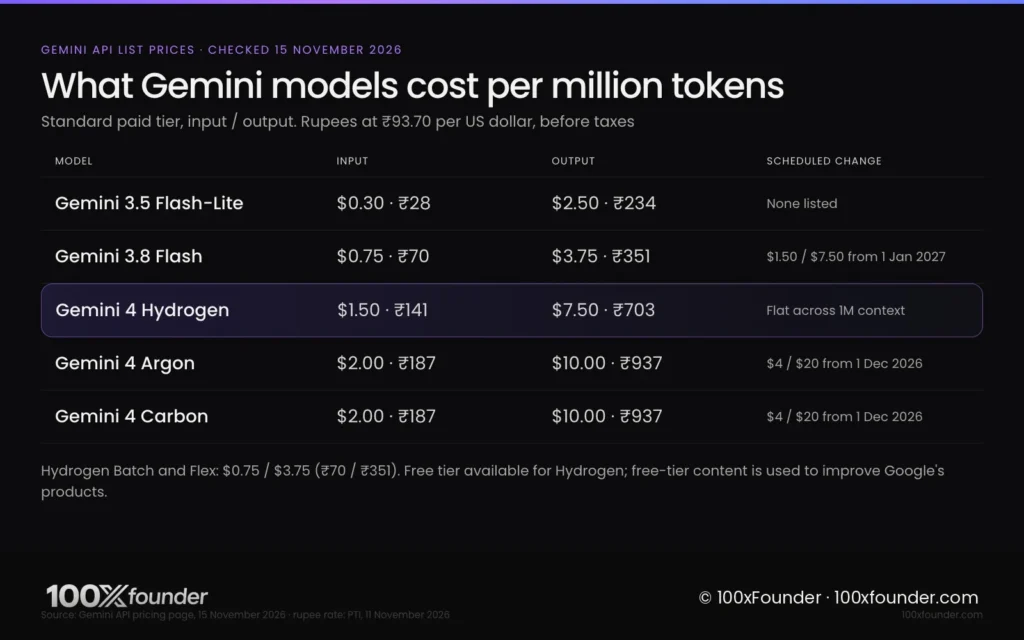
Gemini 4 Hydrogen sits between Gemini 3.5 Flash-Lite and the two heavier Gemini 4 models on price, and a scheduled change to Gemini 3.8 Flash makes the comparison shift in January. All figures below are standard paid-tier list prices per million tokens from the pricing page on 15 November 2026.
| Model | Input / 1M | Output / 1M | Note |
|---|---|---|---|
| Gemini 3.5 Flash-Lite | $0.30 | $2.50 | Cheapest current text model |
| Gemini 3.8 Flash | $0.75 | $3.75 | Rises to $1.50 / $7.50 from 1 January 2027 |
| Gemini 4 Hydrogen | $1.50 | $7.50 | Flat across 1M context |
| Gemini 4 Argon | $2.00 | $10.00 | Rises to $4.00 / $20.00 from 1 December 2026; no free tier |
| Gemini 4 Carbon | $2.00 | $10.00 | Rises to $4.00 / $20.00 from 1 December 2026; no free tier |
Source: Gemini API pricing page, 15 November 2026.
The practical reading is this. Until 31 December 2026, Gemini 3.8 Flash is half Hydrogen’s price, so a team with a working 3.8 Flash pipeline and no quality problems can wait. From 1 January 2027, the pricing page lists Gemini 3.8 Flash at the same $1.50 and $7.50 as Hydrogen, and at that point there is no price reason to stay on the older model. Argon and Carbon double their introductory prices from 1 December, which makes Hydrogen’s near-Argon index score, if it holds up, the bigger saving for teams that were using Argon for routine work.
What common tasks cost in rupees
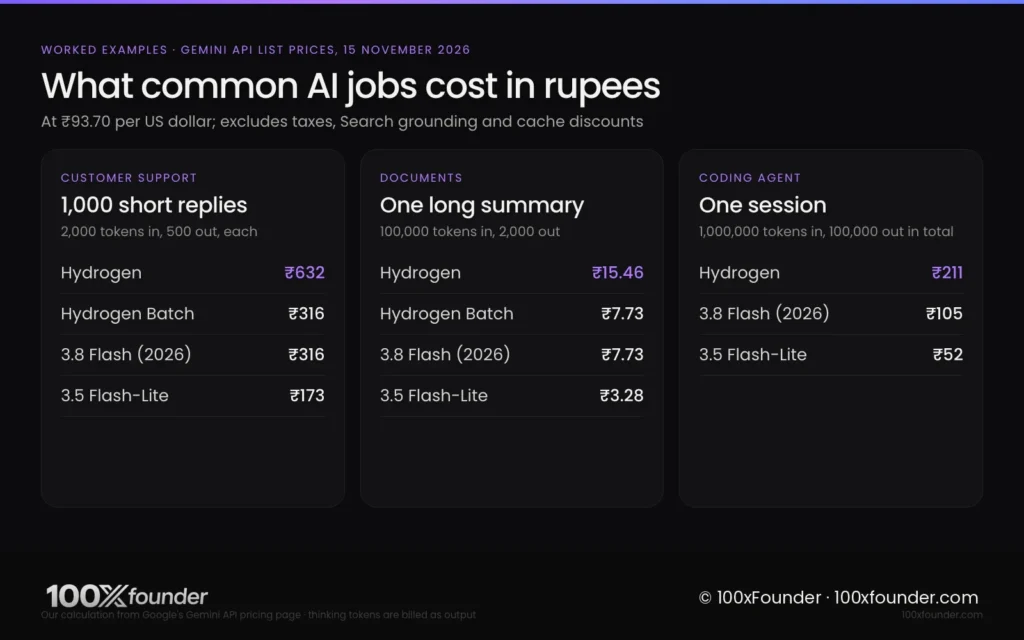
A typical short AI task on Gemini 4 Hydrogen costs well under one rupee, and a long-document job costs about ₹15, based on the list prices above at ₹93.70 per dollar. The token counts below are our worked examples, not Google’s figures; your own counts depend on prompt length and on how much the model thinks, since thinking tokens are billed as output.
| Task (tokens in / out) | Hydrogen | Hydrogen Batch | 3.8 Flash (2026 price) | 3.5 Flash-Lite |
|---|---|---|---|---|
| 1,000 support replies (2,000 / 500 each) | ₹632 | ₹316 | ₹316 | ₹173 |
| One long document summary (100,000 / 2,000) | ₹15.46 | ₹7.73 | ₹7.73 | ₹3.28 |
| One coding-agent session (1,000,000 / 100,000 total) | ₹211 | Not suited | ₹105 | ₹52 |
Our calculation from the Gemini API pricing page (15 November 2026) at ₹93.70 per US dollar; excludes taxes, Search grounding and cache discounts.
Three things move these numbers. First, Batch and Flex halve the price for work that can wait, such as overnight tagging of a product catalogue. Second, cached input on Hydrogen is billed at $0.075 per million tokens, a twentieth of the normal input rate, and Hydrogen caches repeated context automatically, which helps coding agents that resend the same files every turn. Third, the xhigh thinking level can lift quality but also adds billed output tokens, so it is worth testing whether high is enough before switching a whole workload.
Where Gemini 4 Hydrogen is available, including India
Gemini 4 Hydrogen is available on the Gemini API and in Google AI Studio on every tier, and Google’s list of available regions for the API includes India, so Indian developers can sign up and call it with a normal Google account. Google’s launch post lists these surfaces:
- Gemini API and Google AI Studio: all tiers, including free.
- Android Studio: included for app developers.
- Google Antigravity: for paid Google AI Pro and Ultra subscribers; Antigravity’s orchestrator can switch between Carbon and Hydrogen within one session.
- Gemini app: in the model menu; free users get Hydrogen when automatic model selection picks it for a prompt.
- Google Search: Hydrogen now powers Search for all users globally, according to Google’s Search post of 12 November.
- Gemini for business and Gemini in Google Sheets: for eligible business subscriptions, and in Sheets starting with AI Pro and Ultra subscribers.
For consumers in India, Google’s Gemini subscriptions page, checked on 15 November 2026, lists Gemini 4 Hydrogen under Google AI Plus at ₹399 a month, Google AI Pro at ₹1,950 a month and Google AI Ultra from ₹6,500 a month. Antigravity access starts at AI Pro. The launch posts we read do not mention Vertex AI, so enterprise teams buying through Google Cloud should check the Vertex model list separately.
Hydrogen against Claude and OpenAI models on price
On list price alone, Gemini 4 Hydrogen costs less than Anthropic’s Claude Sonnet 5.5 and more than OpenAI’s gpt-6.1-terra, based on each vendor’s own pricing page on 15 November 2026. This table compares list prices only; each vendor reports benchmarks on its own test sets, so quality needs testing on your own prompts.
| Model | Vendor | Input / 1M | Output / 1M |
|---|---|---|---|
| Gemini 4 Hydrogen | $1.50 | $7.50 | |
| Claude Sonnet 5.5 | Anthropic | $2.00 | $10.00 |
| Claude Haiku 5.5 (prompts up to 100,000 tokens) | Anthropic | $0.10 | $0.50 |
| gpt-6.1-terra (up to 272K input) | OpenAI | $1.00 | $5.00 |
| gpt-6-luna | OpenAI | $0.10 | $0.50 |
Sources: Anthropic Claude API pricing and OpenAI API pricing pages, 15 November 2026; standard tier, before taxes.
Hydrogen’s clearest edges in that table are its flat price across a full 1M-token window, where OpenAI lists higher long-context rates above 272K input tokens and Claude Haiku 5.5 charges more above 100,000 tokens, and its built-in Google Search and Maps grounding. For simple, high-volume jobs, the smallest models from all three vendors are far cheaper. If you are weighing open models you host yourself, our guide to open-weight versus closed AI models covers that trade-off, and our comparison of Indian AI models covers Sarvam, BharatGen and others built for Indian languages.
What it means for Indian developers and startups
For Indian startups, Gemini 4 Hydrogen is mainly a cheaper route to near-frontier coding and agent quality, and unlike Argon and Carbon it has a free tier for testing.
- Budget in dollars, not rupees: the API is priced in US dollars, so a weaker rupee raises the bill. At ₹93.70, every $100 of usage is about ₹9,370 before tax.
- Use Batch for back-office work: catalogue tagging, invoice extraction and report drafting rarely need instant answers, and Batch halves the price.
- Keep personal data off the free tier: free-tier content is used to improve Google’s products, according to the pricing page.
- Plan the 2.5 migration now: apps still calling Gemini 2.5 models are rerouted on 1 December 2026, and the changelog lists breaking changes, including thinking_level replacing thinking_budget.
- Test Indian-language prompts yourself: Google’s launch material gives no Indian-language results, so run your own Hindi, Tamil or Hinglish samples before switching.
Developers who want to see which tools working programmers prefer can read our round-up of what Reddit developers use for coding, and engineers looking for roles that use these models can browse our AI and ML jobs.
Bottom line
Gemini 4 Hydrogen gives developers a Gemini 4 model at $1.50 and $7.50 per million tokens, with a 1M-token window, a free tier and Google’s own figures showing a large step up from Gemini 3.8 Flash in speed and coding. For Indian teams the timing is simple: 3.8 Flash stays cheaper until the end of December, Argon and Carbon get dearer from 1 December, and from January Hydrogen and 3.8 Flash cost the same. Testing Hydrogen on the free tier this month, with non-sensitive data, is the low-cost way to decide.
FAQ
How much does the Gemini 4 Hydrogen API cost in India?
Gemini 4 Hydrogen costs $1.50 per million input tokens and $7.50 per million output tokens on the standard paid tier, according to Google’s pricing page on 15 November 2026. At ₹93.70 per dollar, that is about ₹141 and ₹703. The API bills in US dollars, so the rupee cost moves with the exchange rate, and taxes are extra.
Is Gemini 4 Hydrogen free to use?
Yes, with limits. The Gemini API has a free tier for Hydrogen covering input, output and caching, and free users of the Gemini app can get Hydrogen through automatic model selection. Google’s pricing page says free-tier API content is used to improve its products, so keep personal or confidential data on a paid key.
What is the context window of Gemini 4 Hydrogen?
Gemini 4 Hydrogen has a 1,048,576-token context window shared by input and output, according to Google’s model card. A normal request can return up to 65,536 output tokens, and long decode can extend output to the full window. Google’s launch post says pricing is flat across the whole window.
Is Gemini 4 Hydrogen better than Gemini 3.8 Flash?
Google reports that Hydrogen finishes tasks about 2.5 times faster, scores 57% on Terminal-Bench 4.1 against 18.2% for 3.8 Flash, and makes more than five times fewer fabricated claims. Those are Google’s figures. Hydrogen costs twice 3.8 Flash’s 2026 price, but the two are priced the same from 1 January 2027.
Sources
- Google, “Introducing Gemini 4 Hydrogen for Agentic Workflows”, 12 November 2026, blog.google.
- Google, “Gemini 4 Hydrogen: everyday coding and agentic workflows for developers”, 12 November 2026, blog.google/innovation-and-ai/technology/developers-tools/build-with-gemini-4-hydrogen/.
- Google, “Google Search gets a major upgrade with Gemini 4 Hydrogen”, 12 November 2026, blog.google.
- Google AI for Developers, “Gemini Developer API pricing”, aistudio.google.com/docs/pricing, checked 15 November 2026.
- Google AI for Developers, “Gemini 4 Hydrogen” model card, aistudio.google.com/docs/models/gemini-4-hydrogen, checked 15 November 2026.
- Google AI for Developers, “Models”, aistudio.google.com/docs/models, checked 15 November 2026.
- Google AI for Developers, “Release notes” (changelog), aistudio.google.com/docs/changelog, entries of 2, 10 and 12 November 2026.
- Google AI for Developers, “Available regions for Google AI Studio and Gemini API”, aistudio.google.com/docs/available-regions, checked 15 November 2026.
- Google, “Gemini subscriptions” (India), gemini.google/subscriptions, checked 15 November 2026.
- Anthropic, “Pricing”, platform.claude.com/docs/en/about-claude/pricing, checked 15 November 2026.
- OpenAI, “API pricing”, developers.openai.com/api/docs/pricing, checked 15 November 2026.
- Telangana Today (PTI), “Rupee rises to 93.70 against US dollar as domestic markets strengthen”, 11 November 2026.
Related stories
Sources (12)
- Google 12 Nov 2026Release, author, daily driver positioning, 2.5x faster than 3.8 Flash, Terminal-Bench 4.1 57% vs 18.2%, >5x fewer fabricated claims, partner 2-2.8x faster and 12-23% fewer tokens, AA index 51/54 vs Argon 50, other benchmarks, 1M context, flat $1.50/$7.50, four thinking levels, availability surfaces
- Google 12 Nov 2026Developer availability: Gemini API in AI Studio, Android Studio, Gemini for business, Antigravity for AI Pro/Ultra
- Google 12 Nov 2026Hydrogen available globally in Google Search for all users
- Google AI for Developers 15 Nov 2026Hydrogen, 3.8 Flash, 3.5 Flash-Lite, Argon, Carbon prices by tier and scheduled changes; free tier and data use; Search grounding 5,000 free/month then $14 per 1,000, 1,500/day cap
- Google AI for Developers 15 Nov 2026Model ID, inputs/outputs, 1,048,576 context, 65,536 default max output, long decode, supported and unsupported capabilities, thinking levels
- Google AI for Developers 15 Nov 2026Hydrogen recommended for new projects; 3.8 Flash described as previous-generation
- Google AI for Developers 12 Nov 2026Hydrogen GA 12 Nov, default for Antigravity agent in Managed Agents; Carbon GA 10 Nov; Gemini 2.5 reroutes 1 Dec and breaking changes
- Google AI for Developers 15 Nov 2026India listed as an available region
- Google 15 Nov 2026India prices: AI Plus ₹399, AI Pro ₹1,950, AI Ultra from ₹6,500; Hydrogen listed on plans; Antigravity from AI Pro
- Anthropic 15 Nov 2026Claude Sonnet 5.5 $2/$10; Haiku 5.5 $0.10/$0.50 up to 100K, higher above
- OpenAI 15 Nov 2026gpt-6.1-terra $1/$5 short context up to 272K; gpt-6-luna $0.10/$0.50; higher long-context rates
- Telangana Today (PTI) 11 Nov 2026Rupee closed at 93.70 per US dollar (provisional)