AI model API pricing, Nov 2026: Claude, GPT, Gemini and Grok compared
Per-million-token API prices for Claude Fable 5.2, Opus 5.5, GPT-6.2 Astra, Gemini 4 and Grok 4.7, with batch rates, cost per task and the 1 Dec Carbon change.
 Ishaan Vardhan28 Nov 2026 · 10 min read
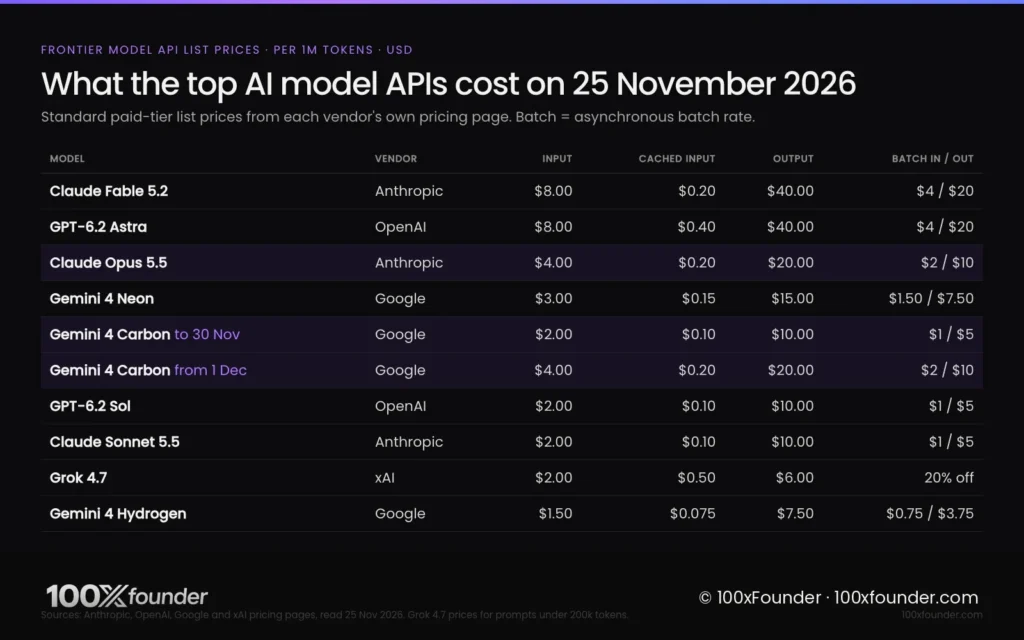
The frontier AI model APIs cost between $1.50 and $8 per million input tokens and between $6 and $40 per million output tokens on 25 November 2026, according to the pricing pages of Anthropic, OpenAI, Google and xAI read that day. The most expensive tier is Claude Fable 5.2 and GPT-6.2 Astra at $8 input and $40 output, Claude Opus 5.5 sits at $4 and $20, and Gemini 4 Carbon moves from $2 and $10 to $4 and $20 on 1 December 2026.
This page puts every current frontier model in one table: list price for input, cached input, output and batch, plus what one example task costs on each. Every price comes from the vendor’s own pricing or model page, read on 25 November 2026. The cost-per-task figures are our own arithmetic on those list prices, and the method is shown so you can rerun it with your own token counts.
Key takeaways
- Top tier: Claude Fable 5.2 and GPT-6.2 Astra both list at $8 per million input tokens and $40 per million output tokens, per Anthropic’s and OpenAI’s pricing pages on 25 November 2026.
- Middle tier: Claude Opus 5.5 costs $4 and $20, Gemini 4 Neon $3 and $15, and GPT-6.2 Sol and Claude Sonnet 5.5 $2 and $10.
- Cheapest of the group: Grok 4.7 at $2 input and $6 output, and Gemini 4 Hydrogen at $1.50 and $7.50.
- One dated change: Gemini 4 Carbon and Gemini 4 Argon double on 1 December 2026, from $2 and $10 to $4 and $20, per Google’s pricing page.
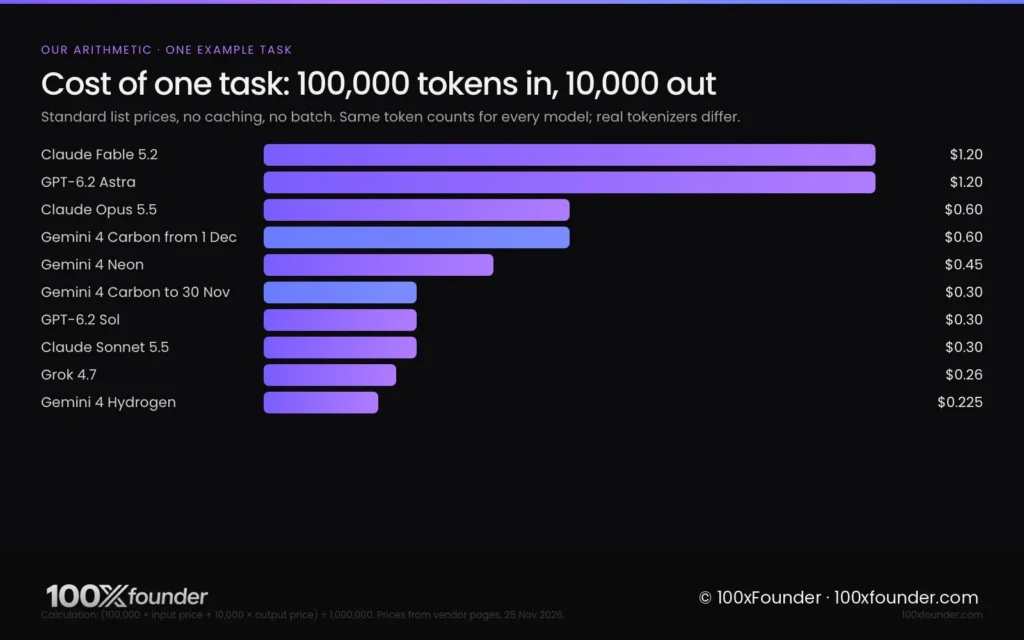
- Example task: 100,000 input tokens and 10,000 output tokens cost $1.20 on Fable 5.2 or GPT-6.2 Astra, $0.60 on Opus 5.5 and $0.225 on Gemini 4 Hydrogen at standard list prices (our arithmetic).
The master price table
The current list prices for frontier model APIs, per million tokens in US dollars, are in the table below, taken from each vendor’s own pricing page on 25 November 2026. “Frontier” here means each vendor’s top general-purpose models plus the strongest model in its next tier down, which is what most teams compare when they choose a default.
| Model | Vendor | Input | Cached input | Output | Batch input / output | Cost per task |
|---|---|---|---|---|---|---|
| Claude Fable 5.2 | Anthropic | $8.00 | $0.20 | $40.00 | $4 / $20 | $1.20 |
| GPT-6.2 Astra | OpenAI | $8.00 | $0.40 | $40.00 | $4 / $20 | $1.20 |
| Claude Opus 5.5 | Anthropic | $4.00 | $0.20 | $20.00 | $2 / $10 | $0.60 |
| Gemini 4 Neon | $3.00 | $0.15 | $15.00 | $1.50 / $7.50 | $0.45 | |
| Gemini 4 Carbon (to 30 Nov) | $2.00 | $0.10 | $10.00 | $1 / $5 | $0.30 | |
| Gemini 4 Carbon (from 1 Dec) | $4.00 | $0.20 | $20.00 | $2 / $10 | $0.60 | |
| GPT-6.2 Sol | OpenAI | $2.00 | $0.10 | $10.00 | $1 / $5 | $0.30 |
| Claude Sonnet 5.5 | Anthropic | $2.00 | $0.10 | $10.00 | $1 / $5 | $0.30 |
| Grok 4.7 (prompts under 200k) | xAI | $2.00 | $0.50 | $6.00 | 20% off standard | $0.26 |
| Gemini 4 Hydrogen | $1.50 | $0.075 | $7.50 | $0.75 / $3.75 | $0.225 |
Gemini 4 Argon, which Google’s changelog listed as generally available on 13 October 2026, carries the same prices as Gemini 4 Carbon on Google’s pricing page, including the 1 December increase. Google’s Batch and Flex tiers share one price for every Gemini 4 model. xAI’s Grok 4.7 model page states a 20% Batch API discount rather than a separate price list.
Which models count as each vendor’s flagship
Each of the four vendors names its top model differently, and the names do not line up by price.
Anthropic
Anthropic’s newest models are Claude Fable 5.2 and Claude Mythos 5.2, announced on 9 November 2026, according to Anthropic’s newsroom. Both list at $8 and $40, but Anthropic’s pricing page marks Mythos 5.2 as limited availability, open only to organizations verified through programs such as its Cyber Verification Program. Claude Opus 5.5, announced on 22 September 2026, costs half as much at $4 and $20, and Claude Sonnet 5.5, announced on 28 September 2026, costs $2 and $10. Our Claude Fable 5.2 explainer covers that launch in detail.
OpenAI
OpenAI calls GPT-6.2 Astra its “flagship model for complex reasoning and coding” on its models page, and GPT-6.2 Sol the go-to model for everyday work. OpenAI’s product news page lists “Introducing GPT-6.2 Astra and Sol” on 17 November 2026. GPT-6.2 Sol costs the same $2 and $10 as GPT-6.1 Sol, and GPT-6.1 Terra stays at $1 and $5; our GPT-6.1 Terra and Sol pricing guide covers those two models.
Google’s model chooser does not name a single flagship among the Gemini 4 models. It describes Neon as built for complex, interactive software engineering and dense knowledge work, Carbon as built for long-horizon asynchronous work and deep verification, and Hydrogen as fast and cost-efficient for everyday coding and agents. Google’s changelog lists general availability for Carbon on 10 November, Hydrogen on 12 November and Neon on 18 November 2026. The Hydrogen details are in our Gemini 4 Hydrogen API pricing article.
xAI
xAI’s model list describes Grok 4.7 as “the most capable model we’ve built”, and its model page calls it a frontier model for coding, agentic tasks and knowledge work. Grok 4.7 has a 500,000-token context window, per the same page, smaller than the 1 million tokens Google lists for each Gemini 4 model and the 1.05 million OpenAI lists for GPT-6.2 Astra.
What one task costs on each model
One task of 100,000 input tokens and 10,000 output tokens costs between $0.225 and $1.20 at standard list prices across the ten rows above, by our arithmetic. That workload is roughly an agent step that reads a long document or a medium codebase slice and writes a page of output. The formula is simple: input tokens times the input price, plus output tokens times the output price, divided by one million.
At 1,000 such tasks a month, the bill runs from $225 on Gemini 4 Hydrogen to $1,200 on Claude Fable 5.2 or GPT-6.2 Astra. Claude Opus 5.5 comes to $600, Gemini 4 Neon to $450, and GPT-6.2 Sol and Claude Sonnet 5.5 to $300 each. Gemini 4 Carbon goes from $300 in November to $600 in December for the same volume.
| Model | Standard, per 1,000 tasks | Batch, per 1,000 tasks |
|---|---|---|
| Claude Fable 5.2 | $1,200 | $600 |
| GPT-6.2 Astra | $1,200 | $600 |
| Claude Opus 5.5 | $600 | $300 |
| Gemini 4 Carbon (from 1 Dec) | $600 | $300 |
| Gemini 4 Neon | $450 | $225 |
| Gemini 4 Carbon (to 30 Nov) | $300 | $150 |
| GPT-6.2 Sol | $300 | $150 |
| Claude Sonnet 5.5 | $300 | $150 |
| Grok 4.7 | $260 | $208 |
| Gemini 4 Hydrogen | $225 | $112.50 |
Two caveats matter more than the table suggests. First, the same text does not produce the same token count on every model: Anthropic’s pricing page says Claude 4.7 and later models use a tokenizer that produces approximately 30% more tokens for the same text. Second, reasoning models bill their thinking as output; Google’s pricing page says every token the model processes is billed, including thinking tokens. A model with a low output price can still cost more per task if it thinks longer.
How caching and batch change the bill
Prompt caching cuts the price of repeated input by 75% to 97.5% across these vendors, and batch processing cuts the whole bill by 20% to 50%.
Anthropic charges cache hits at 0.05 times the base input price on Opus 5.5 and Sonnet 5.5 and 0.025 times on Fable 5.2, according to its pricing page, so Opus 5.5 and Fable 5.2 both read cached input at $0.20 per million tokens. Anthropic also charges for writing to the cache: 1.25 times base input for a 5-minute cache and 2 times for a 1-hour cache. OpenAI lists cached input at $0.40 for GPT-6.2 Astra and $0.10 for GPT-6.2 Sol. Google lists context caching at $0.15 for Neon and $0.075 for Hydrogen. xAI lists cached input at $0.50 for Grok 4.7, a quarter of its input price.
Batch processing halves the price at Anthropic, OpenAI and Google, per their pricing pages; xAI’s Grok 4.7 page states 20%. Anthropic says the batch and caching discounts can be combined. In our example, if 90,000 of the 100,000 input tokens were cache hits, Opus 5.5 would cost $0.04 for fresh input, $0.018 for cached input and $0.20 for output, or about $0.26 a task instead of $0.60 (our arithmetic, ignoring the one-time cache write).
Long prompts, speed tiers and data residency
Long prompts cost more on OpenAI and xAI but not on Anthropic’s or Google’s frontier models. OpenAI’s pricing page applies long-context rates above 272,000 input tokens, which take GPT-6.2 Astra to $16 input and $60 output per million. xAI bills a Grok 4.7 request at $4 input and $12 output for all of its tokens once the prompt reaches 200,000 tokens. Anthropic’s page says Claude 4.6 and later models, except Haiku 5.5, include the full 1 million-token context window at standard pricing, and Google’s page lists no context-length threshold for Gemini 4 models.
Faster processing costs extra everywhere. Anthropic’s fast mode costs $8 input and $40 output for Opus 5.5 and $16 and $80 for Fable 5.2. OpenAI’s Fast tier, which its pricing page says was renamed from Priority on 30 July 2026, costs $16 and $80 for GPT-6.2 Astra. Google’s Priority tier costs $5.40 and $27 for Gemini 4 Neon.
Pinning data to a region adds about 10%. Anthropic applies a 1.1 times multiplier to US-only inference on Claude 4.6 and later models, and OpenAI adds a 10% uplift on regional processing endpoints for models released on or after 5 March 2026, per their pricing pages.
Announced price changes and their dates
Five price changes or notices appear on the vendors’ own pricing pages as of 25 November 2026. Gemini 4 Carbon’s increase on 1 December is the one that changes the ranking.
- 1 December 2026, Google: Gemini 4 Carbon and Gemini 4 Argon double on every tier. Standard goes from $2 and $10 to $4 and $20, Batch and Flex from $1 and $5 to $2 and $10, and cached input from $0.10 to $0.20. Neon and Hydrogen do not change. Our Gemini 4 Carbon price explainer covers the before-and-after bill.
- 30 November 2026, OpenAI: promotional pricing for GPT-5.6 Sol ends, per OpenAI’s pricing page, which does not say which rates the promotion covers.
- 28 February 2027 and 1 March 2027, OpenAI: Ultrafast processing for GPT-6.2 Astra and Sol costs 3 times standard through 28 February 2027 and 6 times standard from 1 March 2027.
- No date set, OpenAI: the Flex tier is winding down; OpenAI says no Flex will be added to new models, and GPT-6.2 Astra and Sol have no Flex price.
- Cancelled, Anthropic: Claude Sonnet 5’s $2 and $10 introductory pricing became the standard price, and the increase to $3 and $15 once scheduled for 1 September 2026 will not happen, per Anthropic’s pricing page.
Which frontier model API is cheapest right now
Gemini 4 Hydrogen is the cheapest model in this table at $1.50 input and $7.50 output per million tokens, and Grok 4.7 has the lowest output price at $6. Among the top-priced models, Claude Opus 5.5 at $4 and $20 is half the list price of Claude Fable 5.2 and GPT-6.2 Astra.
From 1 December 2026, Gemini 4 Carbon’s list price will match Claude Opus 5.5 exactly at $4 and $20, and GPT-6.2 Sol and Claude Sonnet 5.5 will be the cheapest models in the $2 input band. Output-heavy workloads, where the model writes more than it reads, favour Grok 4.7’s $6 output price; input-heavy agent work that reuses the same context favours the vendors with the deepest cache discounts, which on today’s pages are Anthropic and Google.
Bottom line
List prices for frontier models now cluster in three bands: $8 and $40 for the top models from Anthropic and OpenAI, $3 to $4 input for Opus 5.5, Gemini 4 Neon and, from December, Gemini 4 Carbon, and $1.50 to $2 input for the efficient tier. The gap between the most and least expensive model in our example task is about five times. Caching, batch processing and token efficiency can move a real bill by more than that, so the cost per task on your own prompts is the number worth measuring. These prices change often; this page reflects the vendors’ pages on 25 November 2026, and more AI pricing coverage is in our news section.
FAQ
What is the cheapest frontier AI model API right now?
Gemini 4 Hydrogen is the cheapest frontier model in our table at $1.50 per million input tokens and $7.50 per million output tokens, according to Google’s pricing page on 25 November 2026. Grok 4.7 has the lowest output price at $6 per million tokens for prompts under 200,000 tokens, per xAI’s documentation.
How much does Claude Opus 5.5 cost per million tokens?
Claude Opus 5.5 costs $4 per million input tokens and $20 per million output tokens on the Claude API, according to Anthropic’s pricing page on 25 November 2026. Cache hits cost $0.20 per million tokens, and the Batch API halves the price to $2 input and $10 output.
Is GPT-6.2 Astra more expensive than Claude Opus 5.5?
Yes. GPT-6.2 Astra lists at $8 per million input tokens and $40 per million output tokens on OpenAI’s pricing page, double Claude Opus 5.5’s $4 and $20. GPT-6.2 Astra is priced the same as Claude Fable 5.2, Anthropic’s newest top model.
Is Gemini 4 Carbon getting more expensive?
Yes. Google’s pricing page shows Gemini 4 Carbon moving from $2 input and $10 output per million tokens to $4 and $20 on 1 December 2026. Batch, Flex, Priority and cached input prices double on the same date, and Gemini 4 Argon changes the same way.
How do I work out what an AI API task will cost?
Multiply your input tokens by the input price and your output tokens by the output price, add them and divide by one million. A task of 100,000 input and 10,000 output tokens costs $0.60 on Claude Opus 5.5 at $4 and $20. Count tokens with each vendor’s own tokenizer, because the same text can produce different counts.
Sources
- Anthropic, “Pricing”, Claude API documentation, read 25 November 2026
- Anthropic, “Newsroom”, read 25 November 2026
- OpenAI, “Pricing”, API documentation, read 25 November 2026
- OpenAI, “Models”, API documentation, read 25 November 2026
- OpenAI, “Product releases”, read 25 November 2026
- Google, “Gemini Developer API pricing”, read 25 November 2026
- Google, “Choosing a model”, read 25 November 2026
- Google, “Release notes”, read 25 November 2026
- xAI, “Models and pricing”, read 25 November 2026
- xAI, “Grok 4.7”, read 25 November 2026
Related stories

Sources (10)
- Anthropic 25 Nov 2026Claude Fable 5.2, Mythos 5.2, Opus 5.5, Sonnet 5.5 prices, cache multipliers, batch, fast mode, long context, data residency, tokenizer +30%, Sonnet 5 price note
- Anthropic 25 Nov 2026Launch dates: Fable 5.2/Mythos 5.2 9 Nov, Opus 5.5 22 Sep, Sonnet 5.5 28 Sep 2026
- OpenAI 25 Nov 2026GPT-6.2 Astra/Sol, GPT-6.1 prices, batch, long-context >272K, Fast tier rename 30 Jul, Ultrafast dates, GPT-5.6 Sol promo to 30 Nov, Flex wind-down, regional uplift
- OpenAI 25 Nov 2026GPT-6.2 Astra described as flagship; 1.05M context
- OpenAI 25 Nov 2026Introducing GPT-6.2 Astra and Sol, 17 Nov 2026
- Google 25 Nov 2026Gemini 4 Neon, Carbon, Argon, Hydrogen prices; 1 Dec 2026 change; batch/flex/priority; thinking tokens billed
- Google 25 Nov 2026Gemini 4 model roles and 1M context
- Google 25 Nov 2026GA dates: Argon 13 Oct, Carbon 10 Nov, Hydrogen 12 Nov, Neon 18 Nov 2026
- xAI 25 Nov 2026Grok 4.7 prices and long-context rule; described as most capable model
- xAI 25 Nov 2026Grok 4.7 500k context, 20% batch discount, frontier model description