OpenAI says the matrix multiplication exponent is exactly 9/4
An OpenAI preprint posted 24 Nov claims multiplying n×n matrices needs about n^2.25 steps, settling a 1969-era question. What is proven, and what is not yet.
 Ishaan Vardhan25 Nov 2026 · 7 min read
OpenAI posted a preprint on Tuesday, 24 November 2026, titled The matrix multiplication exponent is nine fourths, which claims that multiplying two n × n matrices needs on the order of n2.25 scalar multiplications over every field, and no fewer, according to the paper in OpenAI’s public math repository. If the proof holds, it would settle one of the best-known open questions in theoretical computer science, and OpenAI’s repository says the result came from an unreleased internal model rather than a human research team.
For founders and engineers the practical message is narrower than the headline: the paper proves a limit, not a faster way to run today’s GPUs. What it does show is how far a frontier AI model can now be pushed on open research problems, and how much checking those results still need.
Key takeaways
- OpenAI’s 24 November preprint claims the matrix multiplication exponent ω equals exactly 9/4 (2.25) over every field.
- The 9/4 upper bound came from an earlier OpenAI paper dated 2 October 2026; outside researchers have since written it up independently on arXiv.
- The new part is the matching lower bound. It has not been peer reviewed, and only part of it is machine-checked in Lean.
- OpenAI says an unnamed internal model produced the results, using about three hours of ChatGPT Pro thinking compute per result on average.
- Nothing here makes GPU matrix maths faster today; the algorithms that reach 2.25 are theoretical.
What OpenAI’s matrix multiplication paper claims
OpenAI’s preprint claims that the exponent of square matrix multiplication, written ω, is exactly 9/4 over every field. The abstract states that for each n of at least 2, an arithmetic circuit multiplying two n × n matrices needs at least n9/4/2 multiplication or division gates, even when additions are free.
The proof works by contradiction. The paper argues that any method beating the 9/4 exponent could be used to compress certain tensor networks so far that it would break a known lower bound for checking whether the entries in several independent lists are all distinct. The paper itself says the upper bound “was known” and that its contribution is the matching lower bound. The paper is credited to “OpenAI” with no individual authors.
How the matrix multiplication record moved before this
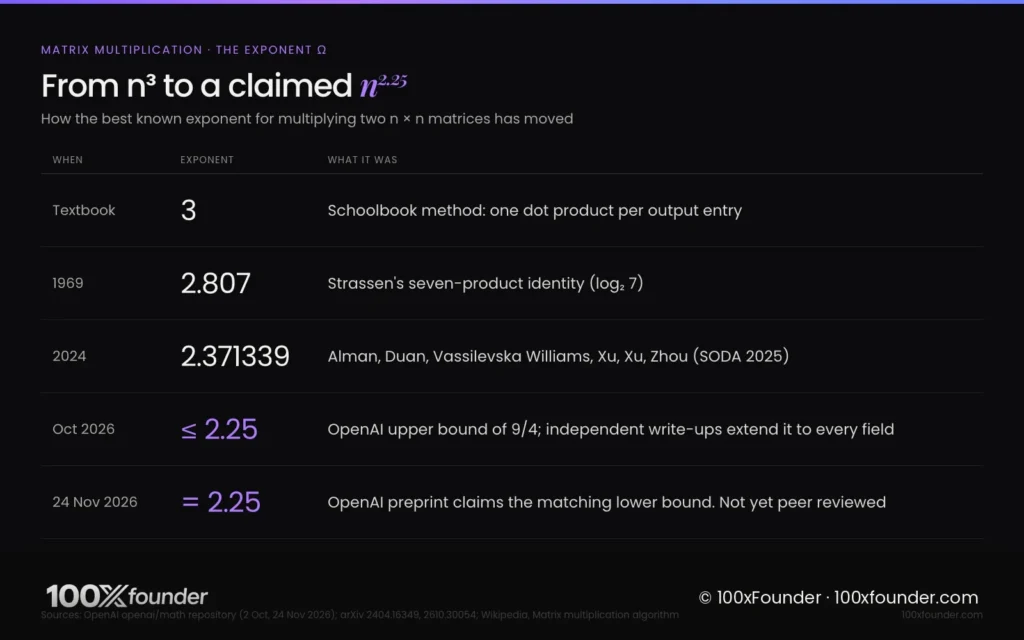
The matrix multiplication exponent has fallen slowly for more than half a century. The schoolbook method uses about n3 operations. Volker Strassen’s 1969 algorithm brought that to roughly n2.807, and the best published bound before OpenAI’s work was ω < 2.371339, from Alman, Duan, Vassilevska Williams, Xu, Xu and Zhou (arXiv, April 2024, published at SODA 2025).
OpenAI’s earlier paper, “An Upper Bound of 9/4 for the Matrix Multiplication Exponent”, dated 2 October 2026 in the same repository, pushed the upper bound to 9/4 over the complex numbers. Within weeks, outside researchers posted their own expositions on arXiv: Alimzhan Amanov, Maxim van den Berg and Jeroen Zuiddam extended it to every field (21 October); Rafael Pass gave a constructive, elementary proof (20 October); and Mahmut Levent Doğan, Vladimir Lysikov, Keiya Sakabe and Michael Walter published a further exposition (6 November). The new preprint cites that work and claims the floor now meets the ceiling.
What has been verified, and what has not
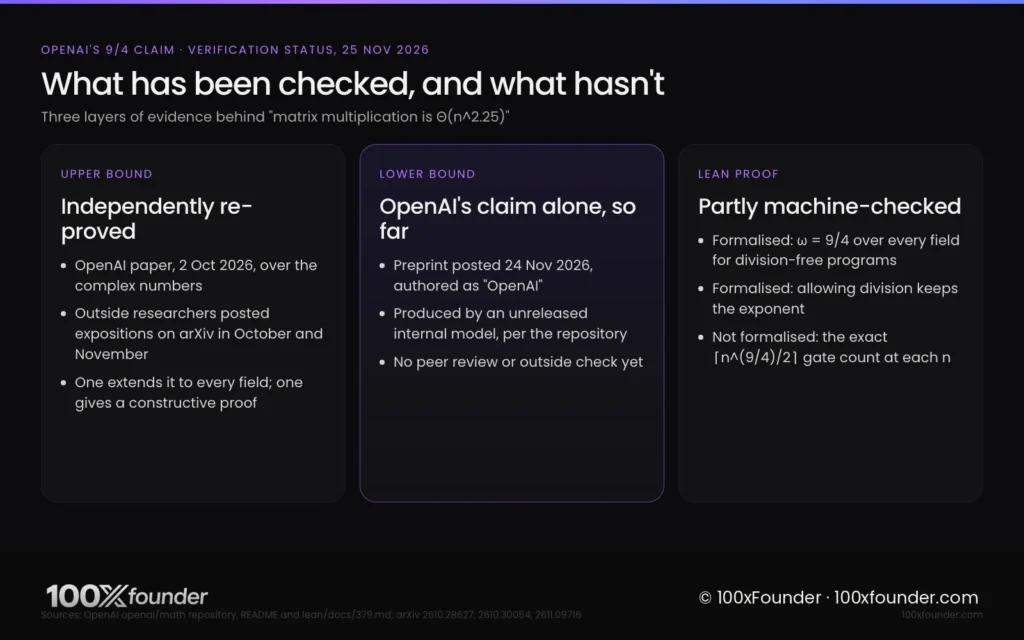
The 9/4 upper bound has been re-derived by independent researchers, but the new lower bound is, for now, OpenAI’s claim alone. The preprint is not peer reviewed, and no outside mathematician had published a check of it by the morning of 25 November.
OpenAI did ship a partial machine check. According to the repository’s Lean formalisation notes, the Lean proof assistant verifies that ω = 9/4 over every field for division-free programs, and that allowing division does not change the exponent. The paper’s sharper statement, the exact gate count of ⌈n9/4/2⌉ at every size n, “remains unformalized”, the notes say.
The repository’s README is also candid about its status: it calls the manuscripts “raw research data” rather than polished papers, warns that some unformalised results “could have issues”, and says OpenAI defers to the math community on credit and precedence.
How an AI model produced the result
OpenAI says the vast majority of results in the repository came from one unreleased internal model, using about three hours of ChatGPT Pro thinking compute per result on average. The README says the model was posed roughly 4,000 open problems, and the catalogue now holds 730 manuscripts in 375 families, with about 42% of top-line results formalised in Lean.
The matrix paper is one of nine manuscripts OpenAI added on 24 November, according to the repository’s history log. The same batch includes claimed results on strongly polynomial linear programming, which OpenAI says answers Smale’s ninth problem, a disproof of the polynomial Hirsch conjecture for bounded simple rational polytopes, and an exponential bound for sunflowers. Each is a major claim in its field, and each will need the same outside scrutiny.
Why the 9/4 result is trending
The preprint reached the top of Hacker News within hours, with more than 700 points and 400 comments by the morning of 25 November, and was covered by Interesting Engineering and OfficeChai. Much of the discussion turned on two points: whether the result changes anything practical (commenters noted it proves optimality, not a usable algorithm) and how much weight to give a proof that a model wrote and that humans have not yet fully checked.
What it means for founders and AI teams
The 9/4 result does not change the cost of AI compute today. Production GPU libraries rely on the schoolbook method or a few levels of Strassen-style tricks, and the algorithms that approach exponent 2.25 are “galactic”: they only pay off at matrix sizes far beyond real workloads, as both Interesting Engineering and OfficeChai note.
The bigger signal is about capability. A lab is now publishing hundreds of research manuscripts produced by a model at a few hours of compute each, with formal proofs attached to a large share. For deep-tech and research-heavy startups, that points to AI as a working research assistant on hard maths and algorithms, with machine-checked proofs as the trust layer. It also sets a verification bar: a claim that is not formalised or independently reviewed is still a claim. Teams building on OpenAI’s platform can follow its hiring and roles on our OpenAI jobs page, and more AI coverage is on our news page.
FAQ
What is the matrix multiplication exponent?
The matrix multiplication exponent, ω, is the smallest power s for which two n × n matrices can be multiplied in about ns arithmetic steps. The schoolbook method gives 3, Strassen’s 1969 algorithm about 2.807, and the best bound before OpenAI’s 2026 work was 2.371339. OpenAI’s 24 November 2026 preprint claims the true value is exactly 2.25.
Did an AI really prove matrix multiplication is n^2.25?
OpenAI says an unreleased internal model produced the result, and its repository credits the paper to “OpenAI” without human authors. Part of the proof is machine-checked in Lean: ω = 9/4 over every field for division-free programs. The full lower bound has not been peer reviewed or independently verified as of 25 November 2026.
Will this make GPUs or AI models faster?
Not in practice. The paper proves a lower limit, and the algorithms that reach the 2.25 exponent only help at enormous matrix sizes. GPU libraries still use the schoolbook method or a few levels of Strassen’s algorithm, so the result does not change AI training or inference costs today.
Where can I read OpenAI’s matrix multiplication paper?
The preprint, “The matrix multiplication exponent is nine fourths”, dated 24 November 2026, is in the preprints folder of OpenAI’s public openai/math repository on GitHub, alongside the 2 October 2026 upper-bound paper. The repository’s lean folder holds the formal proofs and notes on what each one covers.
Sources
- OpenAI, “The matrix multiplication exponent is nine fourths”, preprint, 24 November 2026 (openai/math on GitHub).
- OpenAI, openai/math README: how the results were produced, 730 manuscripts, ~4,000 problems, ~42% formalised, accessed 25 November 2026.
- OpenAI, openai/math history log, entry for 24 November 2026.
- OpenAI, openai/math Lean notes for family 379 (lean/docs/379.md), accessed 25 November 2026.
- OpenAI, “An Upper Bound of 9/4 for the Matrix Multiplication Exponent”, 2 October 2026 (openai/math).
- Amanov, van den Berg and Zuiddam, “Multiplying matrices via polynomials: exposition and barriers”, arXiv 2610.30054, 21 October 2026.
- Rafael Pass, “Matrix Multiplication from Polynomial Packings”, arXiv 2610.28627, 20 October 2026.
- Doğan, Lysikov, Sakabe and Walter, “Tensor value and the 9/4 bound for matrix multiplication”, arXiv 2611.09716, 6 November 2026.
- Alman, Duan, Vassilevska Williams, Xu, Xu and Zhou, “More Asymmetry Yields Faster Matrix Multiplication”, arXiv 2404.16349, 2024 (SODA 2025).
- Interesting Engineering, “Matrix solved? OpenAI claims exact 2.25 exponent in decades-old math problem”, 24 November 2026.
- OfficeChai, “OpenAI Says It Has Pinned Down The Exact Speed Limit For Matrix Multiplication: 9/4”, 25 November 2026.
- Hacker News, “Matrix Multiplication is Θ(n^2.25)”, discussion, 24–25 November 2026.
Related stories



Sources (12)
- OpenAI 24 Nov 2026Title, date, abstract: omega = 9/4 over every field; n^(9/4)/2 gate lower bound; proof via list-distinctness lower bound; upper bound credited to OpenAI and Amanov et al.; author 'OpenAI'
- OpenAI 25 Nov 2026Unnamed internal model; ~3h ChatGPT Pro thinking compute per result; ~4,000 problems; 730 manuscripts in 375 families; ~42% formalised; 'raw research data'; unformalised results could have issues; defers on credit
- OpenAI 24 Nov 2026Nine manuscripts added 24 Nov incl. matrix exponent, strongly polynomial LP (Smale's ninth), Hirsch conjecture disproof, sunflowers
- OpenAI 24 Nov 2026Lean scope: omega=9/4 for division-free programs over every field; division preserves exponent; per-n gate bound unformalised
- arXiv 21 Oct 2026Amanov, van den Berg, Zuiddam exposition; omega <= 9/4 over every field
- arXiv 20 Oct 2026Rafael Pass constructive proof of omega <= 9/4
- arXiv 6 Nov 2026Dogan, Lysikov, Sakabe, Walter exposition of the 9/4 upper bound
- arXiv 25 Apr 2024Previous best bound omega < 2.371339 (Alman et al., SODA 2025)
- Wikipedia 25 Nov 2026Strassen 1969 exponent log2 7 ~ 2.807; prior record 2.371339; galactic algorithms
- Interesting Engineering 24 Nov 2026Coverage of the claim; theoretical, no faster GPU multiplication; Oct 2 upper bound paper
- OfficeChai 25 Nov 2026Coverage; GPUs use schoolbook or a few Strassen levels; no practical speedup
- Hacker News 25 Nov 2026Trend signal: 700+ points, 400+ comments; debate on practicality and verification