Can you still use GPT in Cursor? OpenAI cutoff and alternatives
OpenAI extended Cursor's GPT access past 12 Nov to 25 Nov 2026. What still works, how to use your own API key, and Cursor alternatives with current prices.
 Ishaan Vardhan25 Nov 2026 · 11 min read

Yes, for now: as of 25 November 2026, Cursor still lists OpenAI’s GPT-5 to GPT-5.6 models, because OpenAI extended Cursor’s access past the original 12 November 2026 cutoff, and a Cursor support engineer said on 16 November that access runs through 25 November. No end date after 25 November had been published when we checked Cursor’s forum, Cursor’s docs and OpenAI’s help center on 25 November, so the safe plan is the one OpenAI itself recommends: your own OpenAI API key for local Chat and Agent, or the Codex extension inside Cursor.
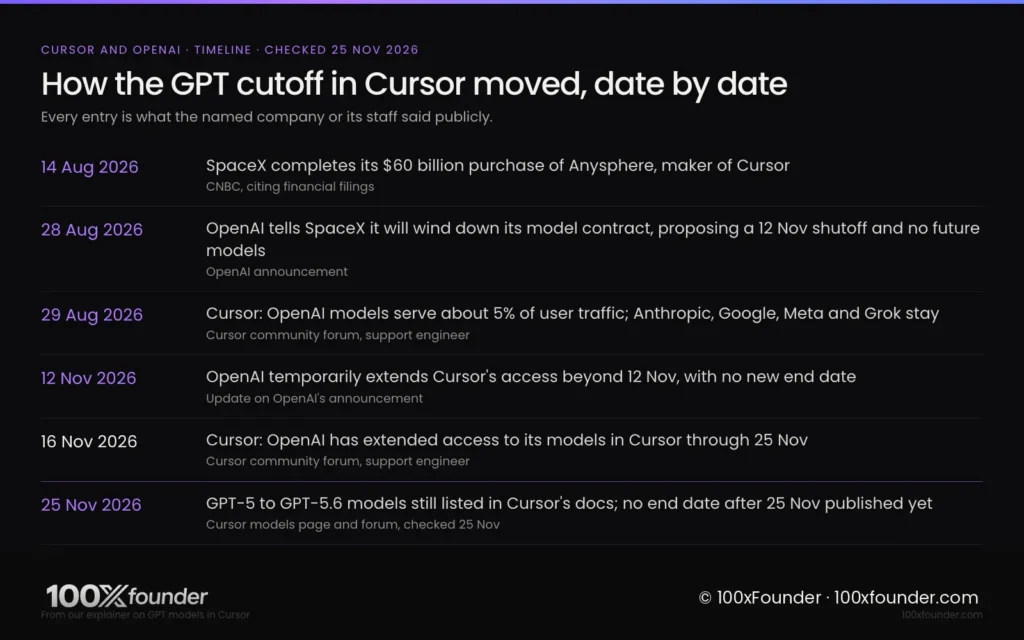
Checked on: 25 November 2026. What changed: OpenAI proposed a 12 November shutoff on 28 August, extended it on 12 November, and Cursor said the extension runs through 25 November.
Key takeaways
- OpenAI announced on 28 August 2026 that it would wind down its contract supplying models to Cursor, proposing 12 November 2026 as the shutoff date, after SpaceX bought Cursor’s maker.
- On 12 November OpenAI added an update saying it had temporarily extended Cursor’s access beyond 12 November; on 16 November Cursor’s forum staff said access runs through 25 November.
- OpenAI says it will not give Cursor future models. Cursor’s model list on 25 November tops out at GPT-5.6, while OpenAI’s own Codex plans already list GPT-6 models.
- After any cutoff, GPT still works in Cursor through your own OpenAI API key (local Chat and Agent only), the Codex IDE extension, or a gateway such as Amazon Bedrock or Azure.
- Anthropic, Google, Meta and Grok models stay in Cursor through direct partnerships, according to Cursor’s support team.
What happened between OpenAI and Cursor?
OpenAI decided to stop supplying its models to Cursor because SpaceX bought Cursor’s parent company. SpaceX completed its $60 billion acquisition of Anysphere, the company that makes Cursor, on 14 August 2026, according to CNBC, which cited financial filings.
On 28 August 2026, OpenAI published a post titled “Our decision on Cursor following its acquisition by SpaceX.” In it, OpenAI said it had notified SpaceX that it intended to wind down the contract providing OpenAI models to Cursor, with a proposed shutoff date of 12 November 2026. OpenAI said its agreement with Cursor allowed cancellation within a limited window after a change of control, and that it was giving the maximum notice the contract allows.
OpenAI’s stated reason was trust. The post says OpenAI cannot be confident that SpaceX will use its technology within OpenAI’s terms of service, and it points to past contract disputes involving Elon Musk’s companies. The post also claims that Musk admitted under oath that xAI, now part of SpaceX, violated OpenAI’s terms of service. These are OpenAI’s claims, presented in its own post.
OpenAI also said it would not provide future models to Cursor, and it named its next model, Astra, as one reason it felt a new responsibility over how its models are used.
How did Cursor respond?
Cursor said OpenAI models were a small share of its traffic and that its other model partners were unaffected. On 29 August 2026, a Cursor community support engineer wrote on Cursor’s forum that OpenAI models serve about 5% of total Cursor user traffic, that Cursor was speaking with OpenAI to resolve the issue, and that models from Anthropic, Google, Meta and Grok would continue through direct partnerships.
CNBC reported the same 5% figure from a post on X by Cursor chief executive Michael Truell. CNBC also reported that Anthropic co-founder Tom Brown wrote on X that Cursor had been a trusted Anthropic partner since Sonnet 3.5.
Did the 12 November cutoff happen?
No. The 12 November 2026 cutoff did not take effect on that date. OpenAI added an update to its announcement on 12 November saying it had temporarily extended Cursor’s access to its models beyond 12 November and would share more as it became available. It gave no new end date.
Cursor then gave a date. On 16 November 2026, the same Cursor support engineer wrote on the forum: “As a result of productive ongoing discussions, OpenAI has extended access to its models in Cursor through November 25.” He added that Cursor would share more updates on ongoing access ahead of 25 November.
When we checked on 25 November, no newer statement from either company had appeared on OpenAI’s announcement page, OpenAI’s help article or that Cursor forum thread. OpenAI’s help article still says an official termination date will be shared once both companies confirm it, and that Cursor may choose to end access sooner. Treat 25 November as the latest confirmed date, not a final one.
Which GPT models are still in Cursor?
Cursor’s models page, checked on 25 November 2026, still lists OpenAI models from GPT-5 to GPT-5.6. The list includes GPT-5, GPT-5 Mini, the GPT-5 and GPT-5.1 Codex models, GPT-5.2, GPT-5.3 Codex, GPT-5.4, GPT-5.5, and GPT-5.6 Luna, Sol and Terra. Most of them are marked “Hidden by default,” and the page gives no end-of-life date for any of them.
Newer OpenAI models are missing. OpenAI’s Codex pricing page lists GPT-6.1 Sol and GPT-6 Luna for ChatGPT Plus, but neither appears on Cursor’s list. A Cursor community ambassador wrote on the forum on 18 November that newer models will not be added to Cursor for now, which matches OpenAI’s statement that Cursor gets no future models.
The rest of Cursor’s lineup is unchanged. The same models page lists Anthropic’s Claude models up to Opus 5.5 and Sonnet 5.5, Google’s Gemini models up to the Gemini 4 family, Cursor’s own Composer 2.5, and Grok 4.5 to 4.7, which Cursor describes as jointly trained by Cursor and SpaceXAI. Plan prices and the weekly usage pool are covered in our Cursor pricing explainer.
How do you keep using GPT in Cursor after the cutoff?
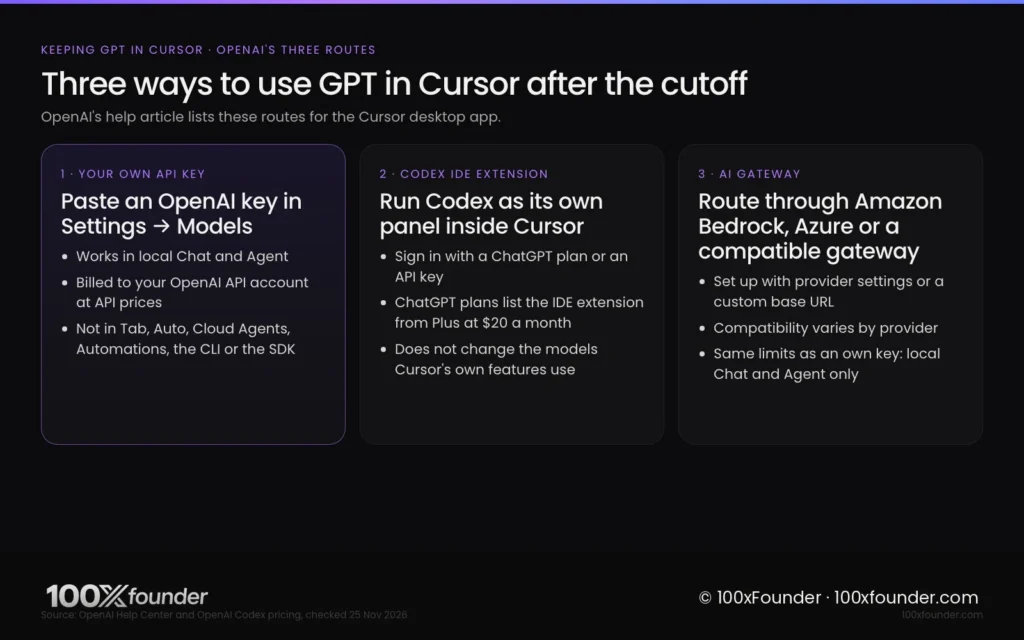
OpenAI’s help article “Using OpenAI models in Cursor” gives three routes for the Cursor desktop app: your own API key, the Codex IDE extension, or an AI gateway. Each works without OpenAI’s contract with Cursor, because the requests go to OpenAI on your own account.
1. Bring your own OpenAI API key
Your own OpenAI API key keeps GPT models working in Cursor’s local Chat and Agent. OpenAI’s help article describes the steps: create an API key (API access requires billing on your OpenAI account), paste it in Cursor Settings under Models, turn on the model and pick it in Chat or Agent. Usage is billed to your OpenAI API account at API prices, separately from any Cursor plan. A ChatGPT subscription does not include API usage, according to the same article.
The key does not cover everything. OpenAI’s help article says your own key and gateway credentials do not work with Cursor Tab, Auto model selection, Cloud or Background Agents, Automations, the Cursor CLI, Cursor’s API and SDK, or Cursor’s own models.
Cursor’s own API-keys page adds three details. On individual plans, requests on your own key are billed by your provider and do not use your included Cursor usage. On Teams and Enterprise plans, eligible own-key requests still carry the Cursor Token Rate of $0.25 per million tokens. And Cursor’s Zero Data Retention policy does not apply to your own keys, because your provider’s policy governs the data; the key is not stored on Cursor’s servers but is sent with every request. Cursor’s page also describes OpenAI support as covering “standard, non-reasoning chat models,” which is narrower than OpenAI’s description, so check which models the picker shows once your key is added.
2. Install the Codex IDE extension
The Codex IDE extension runs OpenAI’s coding agent as a separate panel inside Cursor. OpenAI’s help article says you can sign in with a ChatGPT subscription or an OpenAI API key, and that the extension does not change the models used by Cursor’s own features. OpenAI’s Codex pricing page lists the IDE extension from ChatGPT Plus at $20 a month.
3. Use an AI gateway
An AI gateway such as Amazon Bedrock, Azure or another OpenAI-compatible provider is the third route. OpenAI’s help article says it is set up through provider settings or a custom base URL, that compatibility varies, and that some model-specific controls may not pass through. The same feature limits as an own key apply.
What are the best Cursor alternatives for GPT and Claude users?
The main Cursor alternatives in November 2026 are Claude Code, OpenAI Codex, GitHub Copilot, Cline and Zed, with paid plans starting at $10 a month. We checked each vendor’s own pricing page on 25 November 2026; the table lists what each page states.
| Tool | Free option | Paid plans (USD per month) | What the plan includes | Source |
|---|---|---|---|---|
| Claude Code (Anthropic) | No; Claude Free does not include Claude Code | Pro $20 ($17 billed annually), Max $100, Ultra $200; Team $25 standard seat or $125 premium seat ($20 / $100 billed annually) | Claude Code on every paid plan; Max adds $100 and Ultra $200 in monthly API credits; extension installs in Cursor | claude.com/pricing |
| OpenAI Codex | Yes, for quick tasks in the desktop app | Go $8, Plus $20, Pro from $100 ($100 / $200 / $500 tiers); Business $25 per user ($20 billed annually) | From Plus: Codex on web, CLI, IDE extension and iOS, plus code review and Slack; API key option billed per token | OpenAI Codex pricing page |
| GitHub Copilot | Yes, limited chat and agent use | Pro $10, Pro+ $39, Max $100 | AI Credits ($0.01 each): $15 total on Pro, $70 on Pro+, $200 on Max; agent mode on all plans | github.com/features/copilot/plans |
| Cline | Yes, open-source extension | No subscription; Enterprise priced on request | VS Code extension and CLI; pay for inference at cost or bring your own key | cline.bot/pricing |
| Zed | Yes, Personal plan | Pro $10, Business $30 per seat | Free plan: own keys and external agents such as Codex CLI; Pro: unlimited edit predictions, $5 of tokens, then API list price +10% | zed.dev/pricing |
Table: each vendor’s own pricing page, checked 25 November 2026.
Windsurf is not in the table. On 25 November 2026 the Windsurf pricing address redirected to Devin’s pricing page, which listed only Devin plans, so we had no Windsurf price to show.
Which alternative fits which developer?
The right choice depends on which model you want and whether you want to leave Cursor at all. Here is how we read the options, based on the pricing pages and docs above.
- You want GPT and want to stay in Cursor: add your own OpenAI API key for Chat and Agent, or install the Codex extension with a ChatGPT Plus plan at $20 a month. Both keep Cursor’s editor and Tab completion, which stays on Cursor’s own models.
- You mostly use Claude: nothing changes inside Cursor, because Anthropic models stay through a direct partnership. Claude Code is the option if you want Anthropic’s own agent; its extension installs in Cursor and needs a paid Claude plan from $20 a month.
- You want one low price with many models: GitHub Copilot Pro at $10 a month and Zed Pro at $10 a month are the cheapest paid plans in the table.
- You want to pay only for what you use: Cline and Zed’s free plan let you bring your own keys, so your bill is whatever your model provider charges.
Why it matters
The OpenAI–Cursor split shows that an AI code editor is only as stable as its model contracts. A change of ownership let OpenAI cancel, and developers who chose Cursor for GPT now depend on dates set in talks between two companies. The practical lesson is to keep your own API keys set up for the models you rely on, so a contract dispute costs you a settings change rather than a lost workday. It also shows the value of tools that accept your own key, which several of the alternatives above are built around.
FAQ
Can you still use GPT models in Cursor after 12 November 2026?
Yes. OpenAI extended Cursor’s access past 12 November 2026, and Cursor’s support team said on 16 November that access runs through 25 November. As of 25 November, Cursor’s docs still list GPT-5 to GPT-5.6. After any final cutoff, your own OpenAI API key keeps GPT working in Cursor’s local Chat and Agent, billed at OpenAI’s API prices.
When exactly will OpenAI models leave Cursor?
No final date had been published as of 25 November 2026. OpenAI first proposed 12 November, then extended access with no new date. Cursor later said access runs through 25 November and promised more updates. OpenAI’s help article says the official date will be shared once both companies confirm it.
Does my ChatGPT Plus subscription work in Cursor?
Not for Cursor’s own Chat and Agent: OpenAI’s help article says a ChatGPT subscription does not include API usage, and Cursor’s own-key setting needs an OpenAI API key. A ChatGPT plan does work with the Codex IDE extension, which runs as a separate panel inside Cursor; OpenAI lists the extension from Plus at $20 a month.
Will GPT-6 come to Cursor?
Not under the current terms. OpenAI said on 28 August 2026 that it will not provide future models to Cursor, and a Cursor community ambassador wrote on 18 November that newer models will not be added for now. Cursor’s model list on 25 November ends at GPT-5.6, while OpenAI’s Codex plans list GPT-6.1 Sol and GPT-6 Luna.
Are Claude models affected by the OpenAI cutoff?
No. Cursor’s support team said on 29 August 2026 that models from Anthropic, Google, Meta and Grok continue through direct partnerships. Cursor’s models page on 25 November lists Claude models up to Opus 5.5 and Sonnet 5.5.
Does Cursor Tab use OpenAI models?
Cursor’s API-keys page says Tab completion keeps using Cursor’s built-in models, and OpenAI’s help article says your own key does not apply to Cursor Tab. The OpenAI cutoff concerns models you pick in Chat and Agent.
Sources
- OpenAI, “Our decision on Cursor following its acquisition by SpaceX”, 28 August 2026 (update of 12 November 2026)
- OpenAI Help Center, “Using OpenAI models in Cursor”, checked 25 November 2026
- CNBC, “OpenAI to end model access to Cursor after acquisition by Elon Musk’s SpaceX”, 29 August 2026
- Cursor Community Forum, “I heard OpenAI is about to cut off GPT access for Cursor — is this true?”, staff posts of 29 August and 16 November 2026
- Cursor Docs, “Models”, checked 25 November 2026
- Cursor Docs, “API keys”, checked 25 November 2026
- OpenAI, “Codex pricing”, checked 25 November 2026
- Anthropic, “Claude pricing”, checked 25 November 2026
- Anthropic, “Claude Code for VS Code”, checked 25 November 2026
- GitHub, “GitHub Copilot plans”, checked 25 November 2026
- Cline, “Pricing”, checked 25 November 2026
- Zed, “Pricing”, checked 25 November 2026
- Cognition, “Devin pricing” (Windsurf pricing redirect), checked 25 November 2026
Related stories



Sources (13)
- OpenAI 28 Aug 2026Wind-down notice to SpaceX, proposed 12 Nov 2026 shutoff, no future models, change-of-control clause, stated reasons, Astra; 12 Nov update: access temporarily extended beyond 12 Nov
- OpenAI Help Center 25 Nov 2026Three routes (own API key, Codex IDE extension, gateway); own key limited to local Chat and Agent, not Tab, Auto, Cloud/Background Agents, Automations, CLI, API/SDK; ChatGPT plan excludes API usage; official date to be confirmed; Cursor may end sooner
- CNBC 29 Aug 2026SpaceX completed $60B acquisition of Anysphere on 14 Aug per filings; Truell: OpenAI ~5% of traffic; Tom Brown post
- Cursor Community Forum 16 Nov 2026Staff 29 Aug: ~5% traffic, Anthropic/Google/Meta/Grok continue; staff 16 Nov: access extended through 25 Nov; ambassador 18 Nov: newer models not added
- Cursor 25 Nov 2026GPT-5 to GPT-5.6 listed, hidden by default, no end date; Claude to Opus 5.5/Sonnet 5.5; Gemini 4; Composer 2.5; Grok 4.5-4.7 jointly trained with SpaceXAI
- Cursor 25 Nov 2026Own keys: chat models only, Tab uses built-in models, individual plans billed by provider, Teams $0.25 per 1M token Cursor Token Rate, ZDR does not apply, OpenAI standard non-reasoning chat models
- OpenAI 25 Nov 2026Codex plans: Free, Go $8, Plus $20 (web, CLI, IDE extension, iOS), Pro from $100 ($100/$200/$500), Business $20 annual/$25 monthly; API key option; GPT-6.1 Sol and GPT-6 Luna
- Anthropic 25 Nov 2026Pro $20 ($17 annual), Max $100, Ultra $200, Team $25/$125 ($20/$100 annual); Claude Code on paid plans; Max $100 and Ultra $200 API credits
- Anthropic 25 Nov 2026Claude Code extension installs in Cursor; needs a paid Claude plan or Console account
- GitHub 25 Nov 2026Free, Pro $10 ($15 credits), Pro+ $39 ($70), Max $100 ($200); 1 AI credit = $0.01; agent mode
- Cline 25 Nov 2026Free open-source extension and CLI, inference at cost or BYOK, Enterprise custom
- Zed 25 Nov 2026Personal $0 with BYOK and external agents, Pro $10 with $5 tokens then API list +10%, Business $30/seat
- Cognition 25 Nov 2026windsurf.com/pricing redirects here; only Devin plans listed