AI coding tools funding, valuation and ARR compared (2026)
Cursor sold for $60B, Cognition is worth $48B, Lovable $13.3B, Replit $9B, India's Emergent $1.5B: rounds, company-reported ARR and the India angle.
 Ishaan Vardhan23 Nov 2026 · 18 min read
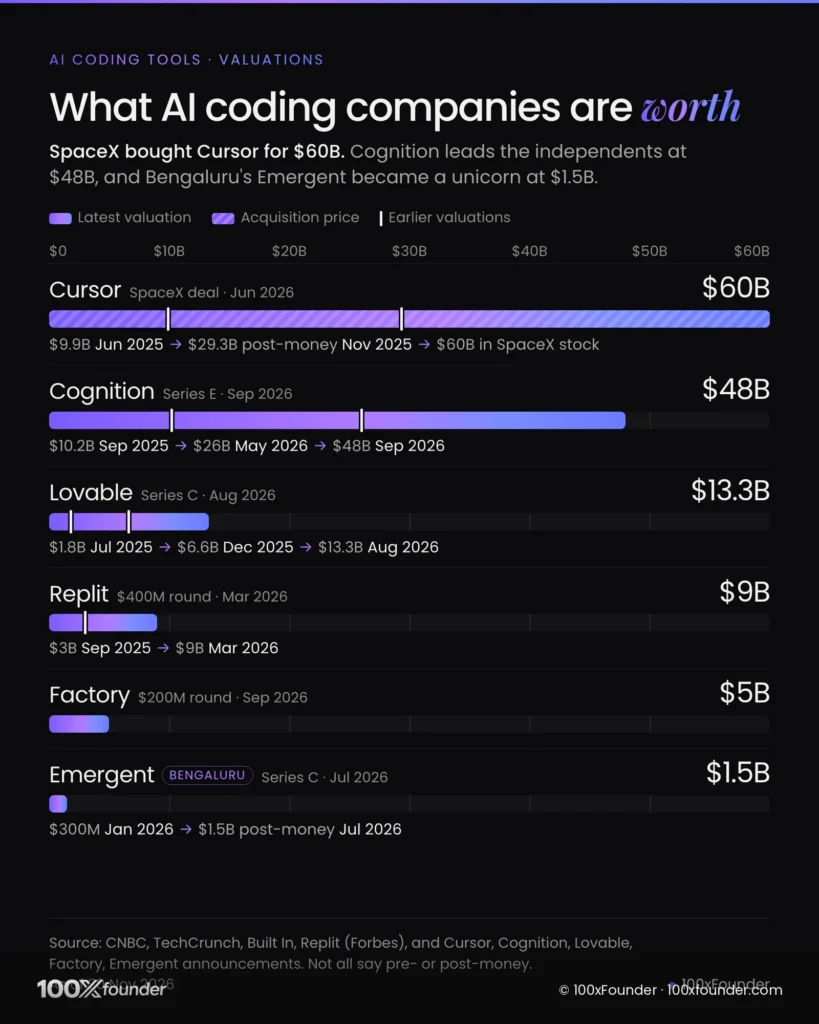
Cursor carries the highest price tag in this comparison: SpaceX agreed to buy its parent Anysphere for $60 billion, and Cursor had roughly $2.6 billion in annualised business revenue in June 2026, according to company data reported by CNBC. Cognition, maker of Devin and Windsurf, is next at a $48 billion valuation after a Series E of more than $2 billion in September 2026, and it crossed a $1 billion annualised run rate on 25 September 2026.
Below them, Lovable is valued at $13.3 billion (August 2026), Replit at $9 billion (March 2026), Factory at $5 billion (September 2026) and Bengaluru-based Emergent at $1.5 billion (July 2026). Every revenue figure here is company-reported and the companies use different measures, so this comparison labels each one exactly as published, explains what drove it and sets out what it means for founders and buyers in India.
Key takeaways
- Cursor’s $60 billion price is a stock-based acquisition by SpaceX, completed on 14 August 2026; its last private round valued it at $29.3 billion post-money in November 2025.
- Cognition went from a $492 million run rate in May 2026 to more than $1 billion in September 2026, on enterprise customers such as NVIDIA, Citi and GE Aerospace.
- The prompt-to-app builders (Lovable, Replit, Emergent) sell mostly to people who do not write code, while Cursor, Cognition and Factory sell to engineering teams.
- Emergent, founded by Mukund and Madhav Jha, reported a $120 million annual run rate in July 2026; India is 8% to 9% of its revenue, according to TechCrunch.
- Cursor launched an India-only Start plan at ₹649 a month, tax inclusive and payable by UPI, on 28 July 2026; the other tools here list dollar prices on their pricing pages.
AI coding tools compared: funding, valuation and ARR
The table puts the latest published round, valuation and revenue figure for each AI coding company side by side, as of 20 November 2026. Each revenue figure carries its date and the exact type the company used, because “ARR”, “run rate” and “annualised revenue” are not the same measure.
| Company | Latest round | Valuation (date) | Latest revenue (date, type) | Source |
|---|---|---|---|---|
| Cursor (Anysphere) | Acquired by SpaceX (deal complete 14 Aug 2026); last round $2.3B Series D, Nov 2025 | $60B acquisition price (Jun 2026); $29.3B post-money (Nov 2025) | About $2.6B (Jun 2026, annualised B2B revenue, company data) | CNBC; Cursor blog |
| Cognition (Devin, Windsurf) | Series E, over $2B, led by Andreessen Horowitz and Accel | $48B (8 Sep 2026) | $1B (25 Sep 2026, annualised revenue run rate, company-reported) | Cognition blog |
| Lovable | Series C, $400M, led by Menlo Ventures, co-led by the Scaleup Europe Fund | $13.3B (12 Aug 2026) | $100M (23 Jul 2025, ARR, company-reported) | Lovable blog |
| Replit | $400M round led by Georgian (reported as Series D) | $9B (Mar 2026) | $150M (Sep 2025, annualised revenue, company-reported) | Replit news; Built In |
| Factory | $200M round; total funding over $400M | $5B (15 Sep 2026) | Not published | Factory news |
| Emergent | Series C, $130M, led by Creaegis; total funding $230M | $1.5B post-money (Jul 2026) | $120M (Jul 2026, annual run-rate revenue, company-reported) | TechCrunch; Emergent news |
| Bolt.new (StackBlitz) | No round in the pages we read | Not published in our sources | Not published in our sources | Netlify; Bolt pricing page |
Table: 100xFounder, from the companies’ announcements, CNBC, TechCrunch and Built In, as of 20 November 2026. Revenue is company-reported and not audited.
Two different businesses: tools for engineers and app builders for everyone else
The seven companies in this comparison sell to two different buyers. Cursor, Cognition and Factory sell to software engineers and the companies that employ them; Lovable, Replit, Emergent and Bolt.new sell mainly to people who want an app without writing the code themselves.
- Engineering tools. Cursor is a code editor with AI built in. Cognition’s Devin is an agent that takes a task and works on it on its own, and Windsurf is its editor. Factory sells what it calls software factories: one governed system across the development lifecycle that can run in the cloud, on-premises or air-gapped, which Factory says extends it to regulated and public-sector customers.
- App builders. Lovable, Replit, Emergent and Bolt.new turn a plain-language description into a working web or mobile app and host it. About 70% of Emergent’s users have no prior coding experience, the company says, and a Forbes profile that Replit republished with its March 2026 funding news says Replit wants to be the coding agent for non-technical staff such as salespeople, marketers and small-business owners, with Agent 4 as the latest step.
The split explains the revenue sizes. Engineering tools ride on enterprise seat and usage contracts that grow as a company rolls the tool out to more engineers. App builders depend on many small subscriptions: Emergent has more than 200,000 paying customers, according to TechCrunch, yet its run rate is about one-twentieth of Cursor’s.
Cursor: a $60 billion exit and about $2.6 billion in revenue
Cursor, the AI code editor made by Anysphere, is now part of SpaceX. TechCrunch reported that an April 2026 deal gave SpaceX the option to buy Cursor for $60 billion, and CNBC reported on 16 June 2026 that SpaceX was locking in the deal as a stock-based merger between Anysphere and a SpaceX subsidiary. Cursor’s own post of 14 August 2026 said the acquisition process was complete.
The same CNBC report said Cursor had roughly $2.6 billion in annualised business-to-business revenue, citing company data shared with Reuters. Cursor documented the climb on its own blog:
- 16 January 2025: a $105 million Series B, with recurring revenue past $100 million.
- 6 June 2025: $900 million at a $9.9 billion valuation, with more than $500 million in ARR.
- 13 November 2025: a $2.3 billion Series D at a $29.3 billion post-money valuation, after crossing $1 billion in annualised revenue. Returning backers were Accel, Thrive and Andreessen Horowitz, with Coatue, NVIDIA and Google joining.
What drove it: at the Series D, Cursor credited “millions of developers” and large engineering organisations as customers, and claimed that the models it builds itself now produce more code than nearly any other model. Those in-house models matter for margins, because a coding tool that only resells other labs’ models pays for every request it serves. Cursor had more than 300 staff at that point. Its pricing page on 20 November 2026 listed a free plan and paid individual plans from $8 a month (Plus) up to $200 a month (Ultra).
Cognition: $48 billion and a $1 billion run rate
Cognition, the company behind the autonomous coding agent Devin and the Windsurf editor, reached a $48 billion valuation on 8 September 2026 with a Series E of more than $2 billion led by Andreessen Horowitz and Accel. Its run-rate revenue was then almost $900 million, up from $492 million at its May round, and on 25 September 2026 it said it had crossed $1 billion. The company says it was started in January 2024.
- March 2024: a $21 million Series A led by Founders Fund, with the launch of Devin.
- September 2024: $1 million of Devin ARR; by June 2025, $73 million.
- 14 July 2025: an agreement to buy Windsurf, which brought $82 million of ARR and more than 350 enterprise customers.
- 8 September 2025: more than $400 million at a $10.2 billion post-money valuation, led by Founders Fund.
- 27 May 2026: more than $1 billion at a $26 billion valuation, led by Lux Capital, General Catalyst and 8VC.
What drove it: Cognition’s Series E post says enterprise customers are expanding usage fast, and names NVIDIA, GE Aerospace, Citi, Mercedes-Benz and Modal. It added products that start work without a person typing a request (Devin Automations, triggered from Slack, GitHub or Linear), plus incident triage and security scanning. It also opened offices in Washington, D.C., Tokyo, Singapore, London, São Paulo and Madrid to work directly inside customers’ systems, and it says it combines several models, including its own, instead of depending on one provider.
Two cautions apply. Cognition gives round sizes as floors (“over $2B”), and it does not say whether the $48 billion and $26 billion figures are pre- or post-money. Devin’s pricing page listed a free plan and a Pro plan at $20 a month on 20 November 2026.
Lovable: four rounds and $10 million to $100 million ARR in six months
Lovable, the Stockholm-based app builder that launched in November 2024, is valued at $13.3 billion after a $400 million Series C announced on 12 August 2026. Menlo Ventures led the round, co-led by the Scaleup Europe Fund managed by EQT; new backers included Tencent, Balderton and Kaszek.
- 25 February 2025: $15 million led by Creandum, at $17 million ARR and more than 30,000 paying customers.
- 17 July 2025: a $200 million Series A at a $1.8 billion valuation, from Accel.
- 18 December 2025: a $330 million Series B at $6.6 billion, led by CapitalG and Menlo Ventures’ Anthology fund.
- 12 August 2026: the $400 million Series C at $13.3 billion.
The revenue curve is steep. A Lovable post dated 28 January 2025 was titled “Zero to $10M ARR in 2 months”, and on 23 July 2025 the company said it had passed $100 million in ARR, eight months after its first $1 million. Neither the Series B nor the Series C post gives a newer ARR figure; instead they cite usage, rising from more than 25 million projects in the first year to more than 60 million by August 2026, and apps built on Lovable now get more than 900 million visits a month.
What drove it: Lovable has moved from solo builders towards companies. Its Series C post says employees at nearly two-thirds of the Fortune 500 use it, and names Adidas, NVIDIA and Deutsche Telekom. Since December 2025 it has added payments, Google Workspace, Microsoft 365, Salesforce and Stripe integrations, scheduled security scans and publishing controls, the features a company’s IT team asks for before approving a tool. It plans to reach about 450 staff this year. Pricing on 20 November 2026 started with a free plan, then Pro at $25 a month.
Replit: $9 billion, three times its value six months earlier
Replit, the browser-based platform where people build and deploy apps with an AI agent, raised $400 million at a $9 billion valuation in a round led by Georgian. A Forbes profile that Replit republished on its newsroom says the valuation is up from $3 billion six months earlier, and Built In reported the round on 13 March 2026 as a Series D.
The $3 billion mark came with a $250 million round led by Prysm Capital on 10 September 2025, when Replit said annualised revenue had grown from $2.8 million to $150 million in under a year. It launched Agent 3 the same day; Replit says its first agent could work for 2 minutes at a time, Agent 2 for up to 20 and Agent 3 for up to 200, testing and fixing its own code. In March 2026 Replit would not comment on revenue to Forbes beyond saying it was on track for $1 billion of ARR by the end of 2026, a target rather than a result.
What drove it: company deployments. According to the Forbes profile, Zillow has about 600 Replit seats and its staff built more than 7,000 apps in a year, and PayPal, Adobe and Talkdesk use it for internal tools. The March 2026 money is mainly for international expansion, especially Asia and the Middle East, and a bigger sales team. Replit’s Core plan cost $20 a month billed monthly on 20 November 2026.
Factory: $5 billion for enterprise coding agents
Factory, which sells enterprise teams a governed system of AI coding agents, announced a $200 million round at a $5 billion valuation on 15 September 2026. Investors named include Blackstone, Khosla Ventures, Sequoia Capital, Insight Partners, NEA and Clearlake, and total funding now exceeds $400 million.
Factory was founded in 2023 by Matan Grinberg and Eno Reyes. It names Nvidia, Blackstone, Royal Bank of Canada, Palo Alto Networks, Adobe and T-Mobile among its users and cites hundreds of thousands of developers. Its pitch is control and cost: customers choose where the system runs and which models it uses, and Factory says its Router, which picks a model per task, cuts token spend by more than 60%. Factory has not published revenue, so its cell in the table is empty. Its pricing page listed a free plan (bring your own model access) and Pro at $20 a month.
Emergent: India’s AI app builder at $1.5 billion
Emergent, the Bengaluru and San Francisco company co-founded by Mukund Jha (CEO) and Madhav Jha (CTO), raised a $130 million Series C at a $1.5 billion post-money valuation in July 2026, according to TechCrunch. Creaegis led the round, with MNI Ventures-Claypond and Sentinel Global joining Khosla Ventures, SoftBank Vision Fund 2, Lightspeed and Y Combinator; total funding is $230 million.
- 20 January 2026: a $70 million Series B co-led by Khosla Ventures and SoftBank Vision Fund 2, when Emergent reported more than $50 million in annualised recurring revenue and more than 5 million users, according to SiliconANGLE. TechCrunch put that round’s valuation at $300 million.
- July 2026: the $130 million Series C at $1.5 billion, five times the January valuation, with $120 million in annual run-rate revenue, a 70% rise over the previous four months.
What drove it: small businesses building their own software. TechCrunch reported that Emergent has more than 200,000 paying customers, including trucking firms building shipment tracking, construction businesses building ERP systems and property managers building customer tools. Emergent’s own Series C post describes an 82-person auto-parts company in Bangalore that built a logistics and warehouse suite in two and a half months. More than 12 million apps have been built on it. About one-third of revenue comes from North America, one-third from Europe and 8% to 9% from India. Its Standard plan cost $20 a month billed monthly, or $17 billed annually, on 20 November 2026.
Bolt.new (StackBlitz)
Bolt.new is an AI tool from StackBlitz that generates full-stack web apps from prompts and runs on StackBlitz’s WebContainers technology. A Netlify press release of 26 March 2025 said more than 1 million AI-generated websites were built with Bolt and deployed on Netlify between November 2024 and March 2025; StackBlitz’s CEO is Eric Simons. No funding round or revenue figure appeared in the pages we read, so the table leaves those cells empty. Bolt’s pricing page listed a free plan and Pro at $25 a month on 20 November 2026.
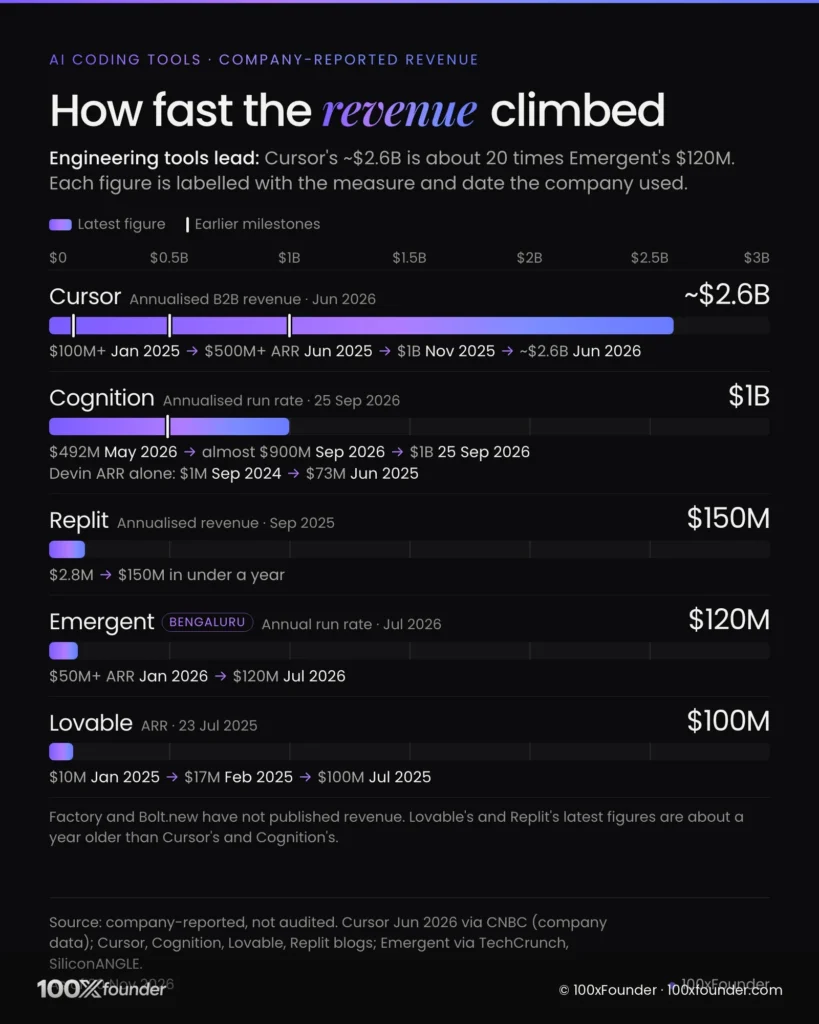
How fast each company grew, and what investors paid per dollar of revenue
Revenue growth in AI coding is measured in months, not years: by the companies’ own figures, Lovable went from $10 million to $100 million ARR in about six months, Replit from $2.8 million to $150 million in under a year, Cognition from $492 million to past $1 billion in four months, and Emergent from more than $50 million to $120 million in six months.
Dividing a valuation by run-rate revenue from the same announcement gives a rough sense of what investors paid. Cursor’s Series D was $29.3 billion against $1 billion, about 29 times. Cognition’s Series E was $48 billion against almost $900 million, more than 50 times. Replit’s September 2025 round was $3 billion against $150 million, 20 times. Emergent’s Series C was $1.5 billion against $120 million, about 12.5 times. These are our arithmetic on company-reported numbers, not valuations anyone published, and Lovable and Factory are left out because neither gave revenue alongside its latest round.
The gap says something. Investors paid the highest multiples for tools that engineering teams at large companies depend on (Cognition, Cursor), and lower multiples for app builders that sell many small subscriptions, even when those builders grew faster.
What it means for Indian founders, developers and buyers
For Indian buyers, the first practical change is price. Cursor launched Cursor Start on 28 July 2026 at ₹649 a month, tax inclusive, billed in rupees and payable by UPI or card, for developers in India, according to its changelog. TechCrunch reported it is Cursor’s first localised price anywhere, compared with the $20 Pro plan, and that it covers Cursor’s own Composer models and Grok but not OpenAI’s or Anthropic’s frontier models, Bugbot or Automations. Every other tool in this comparison lists its plans in dollars on its pricing page, so the rupee cost depends on the exchange rate and your card’s foreign-currency charges.
Second, India is now a market these companies staff for. TechCrunch reported that India is Cursor’s third-largest market, with its user base more than tripled in a year, and that Cursor has hired its first salesperson in India, is adding support staff and a government affairs office, and is expanding in Bengaluru, Chennai, Hyderabad and Mumbai. Emergent has about 200 staff, mostly in Bengaluru. Those are the places to watch for roles; our AI and ML jobs board lists openings from company career pages.
Third, the competition. Emergent shows an Indian-founded company can reach a $1.5 billion valuation in this category, but more than 90% of its revenue comes from outside India, by TechCrunch’s breakdown, and its CEO named Replit as its closest rival. For an Indian founder building here, the paying customers are mostly abroad.
For a small business deciding what to buy, the split above is the useful filter. If your team writes code, the choice is between editors and agents (Cursor, Devin, Factory). If nobody on the team codes and you need an internal tool or a simple customer app, the app builders (Lovable, Replit, Emergent, Bolt.new) are built for that. Our guide to the best AI for coding compares the products themselves, and what Reddit recommends for coding collects developers’ own views.
Caveats: ARR, run rate, valuations and round names
ARR (annual recurring revenue), run rate and annualised revenue all take a recent period’s revenue and scale it to a year; none is revenue actually booked over twelve months. Cursor’s $2.6 billion is annualised business-to-business revenue, Cognition’s $1 billion an annualised revenue run rate, Lovable’s $100 million ARR, Replit’s $150 million annualised revenue and Emergent’s $120 million annual run-rate revenue. None is audited, and each company picks the measure and the moment to announce it.
- Dates differ. Lovable’s and Replit’s latest revenue figures are roughly a year older than Cursor’s and Cognition’s, so the table understates them if growth continued.
- Pre- or post-money. Cursor’s Series D and Emergent’s Series C are stated as post-money. Cognition (for its 2026 rounds), Lovable, Replit and Factory do not say.
- Acquisition price is not a funding valuation. Cursor’s $60 billion is paid in SpaceX stock, so its value depends on how SpaceX shares are valued.
- Round names. Replit’s own announcement does not name its March 2026 round; “Series D” comes from Built In. Cognition and Factory do not give round letters for every round.
- Targets are not results. Replit’s $1 billion ARR by the end of 2026 is a goal it stated in March 2026.
Why it matters
In AI coding, startups have reached billion-dollar revenue figures quickly: Cognition got there less than three years after it started, and Cursor was sold for $60 billion. For Indian founders the signal cuts both ways: one major tool now prices in rupees, and an Indian company has reached unicorn status, but the revenue and the highest valuations sit with tools sold to large engineering teams abroad. Our funding tracker follows new rounds as they are announced.
How we compiled this
On 20 November 2026 we read each company’s own funding and milestone announcements (Cursor, Cognition, Lovable, Replit, Factory and Emergent), their pricing pages and Cursor’s India changelog, the Netlify press release on Bolt, and the CNBC, TechCrunch, Built In and SiliconANGLE reports listed below. Each number comes from one of those pages, with its date and the exact revenue measure the company used. Where a page did not state a figure, we left the cell empty instead of filling it from elsewhere. The valuation-to-revenue multiples are our own division of two published figures from the same announcement.
FAQ
Which AI coding company has the highest valuation?
Cursor, at $60 billion. That is the price SpaceX agreed to pay for its parent Anysphere in a stock-based merger reported by CNBC in June 2026; Cursor said the acquisition was complete on 14 August 2026. Among the independent companies in this comparison, Cognition is highest at $48 billion after its September 2026 Series E.
Is there an Indian AI coding unicorn?
Yes. Emergent, founded by Mukund and Madhav Jha with most of its roughly 200 staff in Bengaluru, raised a $130 million Series C at a $1.5 billion post-money valuation in July 2026, according to TechCrunch. It reported $120 million in annual run-rate revenue, of which India contributes 8% to 9%.
How much does Cursor cost in India?
Cursor Start costs ₹649 a month, tax inclusive, billed in rupees and payable by UPI or card, for developers in India, from 28 July 2026. It includes Cursor’s own models and Grok but not OpenAI’s or Anthropic’s frontier models. Cursor’s other plans are priced in dollars, from $8 (Plus) to $200 (Ultra) a month.
What is Lovable’s valuation and ARR?
Lovable was valued at $13.3 billion after its $400 million Series C on 12 August 2026. The latest ARR it has published on its own blog is $100 million, reached on 23 July 2025, up from $10 million in January 2025. These revenue figures are company-reported.
What is Replit’s valuation and ARR?
Replit was valued at $9 billion after a $400 million round led by Georgian in March 2026. Its latest published revenue figure is $150 million in annualised revenue, from September 2025. In March 2026 it declined to give revenue and said it was on track for $1 billion of ARR by the end of 2026.
Which AI coding tool suits someone who cannot code?
The app builders: Lovable, Replit, Emergent and Bolt.new turn a plain-language description into a hosted app. Emergent says about 70% of its users have no coding experience, and Replit aims Agent 4 at marketers and small-business owners. Cursor, Devin and Factory are built for people who already write code.
Sources
- CNBC, “SpaceX locks in $60 billion Cursor deal to power AI coding push“, 16 June 2026
- TechCrunch, “SpaceX officially closes its Cursor acquisition“, 15 August 2026
- TechCrunch, “Cursor makes its biggest India push yet ahead of SpaceX acquisition with localized pricing“, 27 July 2026
- Cursor changelog, “Cursor Start” (cursor.com/changelog/cursor-start), 28 July 2026
- Cursor blog, “Joining SpaceX” (cursor.com/blog/joining-spacex), 14 August 2026
- Cursor blog, Series D announcement (cursor.com/blog/series-d), 13 November 2025
- Cursor blog, Series C announcement (cursor.com/blog/series-c), 6 June 2025
- Cursor blog, Series B announcement (cursor.com/blog/series-b), 16 January 2025
- Cognition blog, Series E announcement (cognition.com/blog/series-e), 8 September 2026
- Cognition blog, “$1B run rate” (cognition.com/blog/1b-run-rate), 25 September 2026
- Cognition blog, funding announcement (cognition.com/blog/series-d), 27 May 2026
- Cognition blog, “Funding, growth, and the next frontier of AI coding agents” (cognition.com/blog/funding-growth-and-the-next-frontier-of-ai-coding-agents), 8 September 2025
- Cognition blog, Windsurf acquisition (cognition.com/blog/windsurf), 14 July 2025
- Cognition blog, “Introducing Devin” (cognition.com/blog/introducing-devin), 12 March 2024
- Lovable blog, Series C announcement (lovable.dev/blog/series-c), 12 August 2026
- Lovable blog, Series B announcement (lovable.dev/blog/series-b), 18 December 2025
- Lovable blog, “$200M Series A” (lovable.dev/blog/200m-series-a-fundraise), 17 July 2025
- Lovable blog, Lovable Agent announcement (lovable.dev/blog/agent), 23 July 2025
- Lovable blog, “$15m added funding” (lovable.dev/blog/fundraise-series-a-announcement), 25 February 2025
- Lovable blog, “Zero to $10M ARR in 2 months” (lovable.dev/blog/2025-01-29-zero-to-10m-arr-in-2-months), 28 January 2025
- Replit newsroom, “Replit Raises $400M at a $9B Valuation” (Forbes profile republished at replit.com/news/funding-announcement), March 2026
- Built In, “Replit Secures $400M Series D Round at $9B Valuation“, 13 March 2026
- Replit news, Series C announcement (replit.com/news/funding-announcement-series-c), 10 September 2025
- Factory news, “$5 billion valuation” (factory.com/news/5-billion-valuation), 15 September 2026
- TechCrunch, “Indian AI coding startup Emergent becomes a unicorn with $130M Series C“, 15 July 2026
- Emergent news, “Emergent Is Now a Unicorn: $130M Series C at a $1.5B Valuation” (emergent.sh/news), 16 July 2026
- SiliconANGLE, Emergent $70 million Series B report (siliconangle.com), 20 January 2026
- Netlify press release, “Bolt.new and Netlify Power 1 Million AI-Generated Websites” (netlify.com/press), 26 March 2025
- Emergent, home page and information page (emergent.sh, emergent.sh/info), checked 20 November 2026
- Pricing pages of Cursor, Devin, Lovable, Replit, Factory, Bolt and Emergent, checked 20 November 2026
Related stories


Sources (37)
- CNBC 16 Jun 2026$60B stock-based merger; ~$2.6B annualised B2B revenue (company data shared with Reuters)
- TechCrunch 15 Aug 2026April 2026 option deal at $60B; acquisition closed
- Cursor 14 Aug 2026acquisition complete
- Cursor 13 Nov 2025$2.3B Series D at $29.3B post-money; $1B annualised revenue; investors; 300+ staff; in-house models
- Cursor 6 Jun 2025$900M at $9.9B; over $500M ARR
- Cursor 16 Jan 2025$105M Series B; recurring revenue over $100M
- Cognition 8 Sep 2026Series E over $2B at $48B; a16z and Accel; almost $900M run rate, up from $492M; customers NVIDIA, GE Aerospace, Citi, Mercedes-Benz, Modal; Automations; new offices
- Cognition 25 Sep 2026crossed $1B annualised revenue run rate; started January 2024
- Cognition 27 May 2026over $1B at $26B; Lux, General Catalyst, 8VC; $492M run rate
- Cognition 8 Sep 2025over $400M at $10.2B post-money; Founders Fund; Devin ARR $1M Sep 2024, $73M Jun 2025
- Cognition 14 Jul 2025Windsurf acquisition; $82M ARR; 350+ enterprise customers
- Cognition 12 Mar 2024$21M Series A led by Founders Fund
- Lovable 12 Aug 2026$400M Series C at $13.3B; leads; 60M+ projects; 900M+ monthly visits; Stockholm; launched Nov 2024; nearly two-thirds of Fortune 500; Adidas, NVIDIA, Deutsche Telekom; integrations; ~450 staff
- Lovable 18 Dec 2025$330M Series B at $6.6B; CapitalG and Menlo Anthology; 25M+ projects in first year
- Lovable 17 Jul 2025$200M Series A at $1.8B from Accel
- Lovable 23 Jul 2025passed $100M ARR, 8 months after first $1M
- Lovable 25 Feb 2025$15M led by Creandum; $17M ARR; 30,000+ paying customers
- Lovable 28 Jan 2025$10M ARR (post title)
- Replit (Forbes profile) 1 Mar 2026$400M at $9B led by Georgian; up from $3B six months earlier; no revenue comment, on track for $1B ARR by end of 2026; Agent 4; Zillow ~600 seats/7,000+ apps; PayPal, Adobe, Talkdesk; funds mainly for Asia and Middle East expansion
- Built In 13 Mar 2026round date and Series D name
- Replit 10 Sep 2025$250M at $3B led by Prysm; annualised revenue $2.8M to $150M; 40M+ users; Agent 3 runs up to 200 minutes
- Factory 15 Sep 2026$200M at $5B; investors; total over $400M; founded 2023; customers; developers; cloud/on-prem/air-gapped; Router cuts token spend 60%+
- Netlify 26 Mar 2025Bolt from StackBlitz, WebContainers, 1M+ sites Nov 2024-Mar 2025, CEO Eric Simons
- Emergent 20 Nov 2026what it does; 10M+ builders; 15M+ apps (self-reported)
- Emergent 20 Nov 2026Bangalore and San Francisco offices; Agione Technologies Private Limited
- Cursor 20 Nov 2026free plan; Plus $8, Ultra $200 a month
- Cognition (Devin) 20 Nov 2026free plan; Pro $20 a month
- Lovable 20 Nov 2026free plan; Pro $25 a month
- Replit 20 Nov 2026Core $20 a month billed monthly
- Factory 20 Nov 2026free plan (BYO inference); Pro $20 a month
- Bolt 20 Nov 2026free plan; Pro $25 a month
- Emergent 20 Nov 2026Standard $20 monthly, $17 annual
- TechCrunch 27 Jul 2026Cursor Start ₹649 India plan; India third-largest market; users tripled; India hiring and cities; excluded models
- Cursor 28 Jul 2026₹649/month tax inclusive, INR billing, UPI or card, India individuals
- TechCrunch 15 Jul 2026Emergent $130M Series C at $1.5B post-money; investors; $230M total; $120M run rate up 70% in 4 months; 200,000+ paying customers; revenue split; founders; ~200 staff mostly Bengaluru; Series B $70M at $300M
- Emergent 16 Jul 2026Series C details; 12M+ apps; 70% non-coders; Bangalore auto-parts customer
- SiliconANGLE 20 Jan 2026Emergent $70M Series B led by Khosla and SoftBank Vision Fund 2; $50M+ ARR; 5M+ users