Xflow SaaS Bill Payments: Pay AWS, OpenAI and Figma From India
Xflow's new USD virtual card pays foreign SaaS vendors for a 0.5% fee. How it works, what it saves against card markups, GST rules and who should switch.
 Ishaan Vardhan17 Nov 2026 · 11 min read
Indian businesses can now pay foreign software vendors such as AWS, OpenAI, Figma and Slack through Xflow, which launched a SaaS subscription management product on 2 November 2026, according to CXOToday. A business prefunds Xflow once, by SWIFT in dollars or by NEFT/RTGS in rupees, and a USD virtual card then pays each vendor on its own billing date for a 0.5% processing fee at the mid-market rate, according to Xflow’s product page (xflowpay.com) on 15 November 2026.
Below: how it works, what it costs next to an Indian bank card, what it does not fix (GST, for one), and who should switch. Every price was checked on the vendors’ and banks’ own pages on 15 November 2026.
Key takeaways
- Xflow launched SaaS Subscription Management on 2 November 2026 to pay and track subscriptions to global software vendors from India, according to CXOToday.
- The fee is 0.5% of each transaction at the mid-market rate, which Xflow describes as its current offer, against a 3.5% foreign currency fee on most SBI credit cards.
- Only vendors based in the US, UK, Canada or the EU qualify, and only software purchases are allowed.
- Paying through Xflow does not change GST: a GST-registered Indian buyer still pays 18% IGST on imported software under the reverse charge, per the CBIC’s IT sector FAQ.
- The product suits startups with several dollar subscriptions and failing card renewals; a founder with one or two small bills saves little.
What Xflow launched on 2 November 2026
Xflow’s new product, which it calls SaaS Subscription Management (and SaaS Bill Payments on its website), pays recurring bills from foreign software companies on behalf of Indian businesses. CXOToday reported the launch on 2 November 2026 and named AWS, OpenAI, Figma and Slack as examples of the vendors it covers.
Xflow is a cross-border payments company best known for helping Indian exporters collect from overseas clients. Its blog, updated on 6 November 2026, says it holds authorisation from the Reserve Bank of India (RBI) as a Payment Aggregator – Cross Border (PA-CB) for both inward and outward transactions. The outward side is what makes this new product possible: Xflow can take money from an Indian importer and pay a foreign merchant.
In the launch coverage, Xflow co-founder Ashwin Bhatnagar said paying for global software is still broken for Indian businesses, and that a company should be able to pay once and have every subscription handled on one dashboard. A finance manager at Blume Ventures, quoted in the same CXOToday piece, said some of the fund’s portfolio companies already use it.
Why paying for SaaS from India keeps failing
Recurring payments to foreign SaaS vendors fail in India mainly because domestic card rules and bank risk checks were not built for automatic dollar renewals. Xflow cites industry estimates that more than 30% of card-based recurring payments in India tend to fail, according to CXOToday; that is Xflow’s figure, not an RBI statistic.
The rules themselves are public. The RBI’s E-mandate Framework, 2026, dated 21 April 2026, says recurring transactions can run without an extra authentication step (an OTP, usually) only up to ₹15,000 per transaction. Anything above that needs the cardholder to authenticate again. The framework also requires the card issuer to send a notice at least 24 hours before each debit, and it applies to cross-border recurring payments as well as domestic ones.
In practice, a cloud bill above ₹15,000 (about $160 at the 11 November rate) cannot renew silently: someone has to approve it, and if the vendor’s checkout does not support that step, the charge fails. Subscriptions also end up spread across founders’ personal cards and company cards, each with its own renewal date, which slows month-end reconciliation.
A prefunded USD virtual card avoids the Indian mandate step; the vendor sees an ordinary dollar card payment.
How Xflow SaaS Bill Payments works
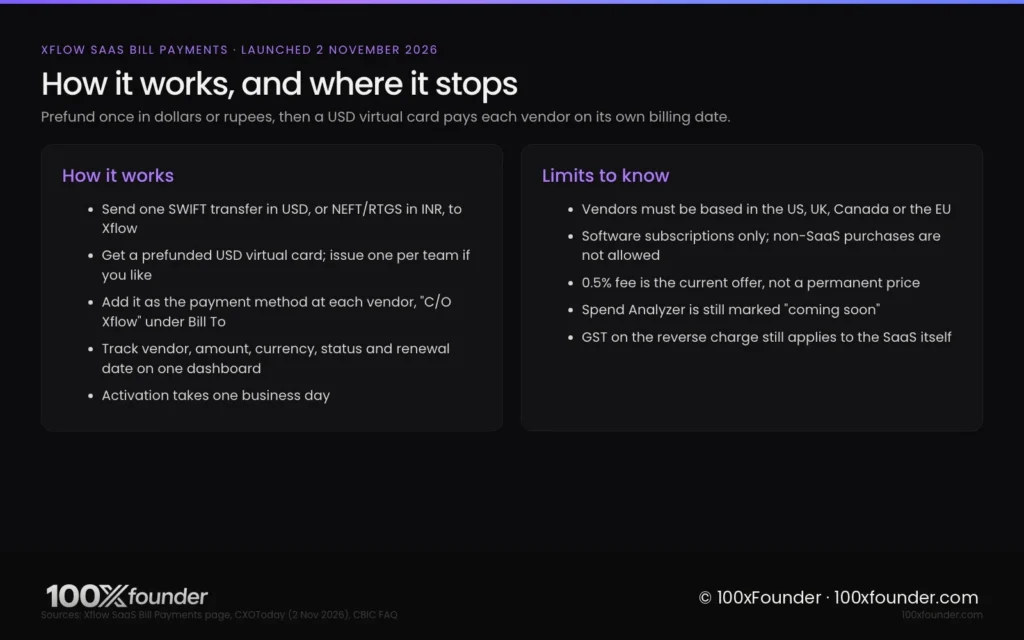
Xflow’s SaaS bill payments work in four steps: prefund, issue a card, swap the card in at each vendor, then track. According to Xflow’s product page on 15 November 2026:
- Prefund once. Work out your total software spend and send one transfer to Xflow, either a SWIFT wire in US dollars or a NEFT/RTGS transfer in rupees. Transfer details and an invoice appear on the dashboard.
- Get a USD virtual card. Xflow issues a prefunded dollar card. You can create separate cards per department, give each a nickname and set a low-balance reminder.
- Update each vendor. Add the card as the payment method on each SaaS account and write “C/O Xflow” under Bill To. You keep your existing vendor account; nothing is migrated.
- Track and reconcile. The dashboard shows each card’s vendor, amount, currency, status and renewal date. You share the vendor invoices with Xflow.
Cards are charged automatically on each vendor’s own billing schedule, one-time purchases and multi-month purchases are allowed, and there is no fixed top-up schedule. Activation takes one business day, and existing Xflow customers need no extra steps, the page says. A “Spend Analyzer” is listed as coming soon, so the analytics are still basic.
What it costs: 0.5% against a bank card’s markup
Xflow charges a 0.5% processing fee on SaaS bill payments and converts at the mid-market rate, according to its SaaS bill payments page on 15 November 2026, which describes the 0.5% as what it is “currently offering”. The page lists no card issuance fee and no monthly fee, and it does not say whether GST applies to the fee itself, so ask before you sign up.
The comparison most founders care about is the corporate or personal credit card they use today. SBI Card’s most important terms and conditions list a 3.5% foreign currency transaction fee on most of its cards, 3% on SBI Card Miles, 2.5% on Miles Prime and 1.99% on a handful of premium cards such as Aurum and Elite. The fee is charged on the rupee amount the card network passes on and is not reversed on refunds.
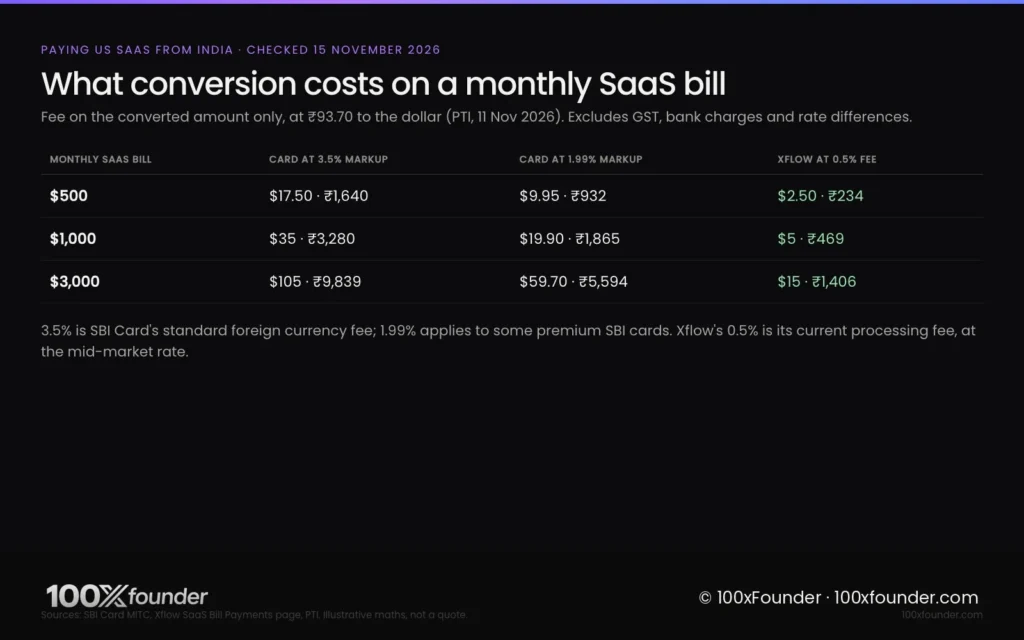
Using the rupee’s close of 93.70 to the dollar on 11 November 2026, reported by PTI, the conversion cost on a monthly software bill works out as follows.
| Monthly SaaS bill | Card at 3.5% | Card at 1.99% | Xflow at 0.5% |
|---|---|---|---|
| $500 | $17.50 (₹1,640) | $9.95 (₹932) | $2.50 (₹234) |
| $1,000 | $35 (₹3,280) | $19.90 (₹1,865) | $5 (₹469) |
| $3,000 | $105 (₹9,839) | $59.70 (₹5,594) | $15 (₹1,406) |
Our calculation from SBI Card’s MITC and Xflow’s SaaS bill payments page, 15 November 2026, at ₹93.70 per dollar. Fee only; excludes GST on fees, your bank’s charges for the transfer to Xflow, and differences between the card network’s rate and the mid-market rate.
On a $1,000 monthly stack, the gap between a 3.5% card and Xflow is about $30 a month, or roughly ₹33,700 a year at that exchange rate. On a $100 stack it is about $3 a month, which is not worth a new vendor relationship on its own.
GST and tax paperwork: what changes and what doesn’t
Paying through Xflow does not change the GST you owe on foreign software. The CBIC’s sectoral FAQ for IT and ITeS says a GST-registered recipient of software from a foreign supplier pays IGST under the reverse charge, that the rate on IT services is 18%, and that reverse-charge GST must be paid in cash, not set off against input tax credit. If the buyer is not registered, the foreign supplier is treated as an online information and database access or retrieval (OIDAR) provider and must collect the tax itself.
So a registered startup paying $1,000 a month to a US tool still self-assesses 18% IGST on that $1,000, whether the money leaves by card, by wire or through Xflow. Your accountant books the vendor invoice the same way; what changes is the name on the payment trail. Our guide to AI accounting and bookkeeping tools covers the software that handles reverse-charge entries.
The income-tax paperwork is where Xflow claims a real saving. Under the Income-tax Act, 2025, which took effect on 1 April 2026, Form 145 replaced Form 15CA for foreign remittance declarations and Form 146 replaced the chartered accountant’s Form 15CB, according to Business Today. Xflow’s product page says one outward remittance to Xflow replaces a Form 145 for each vendor payment, and that it can provide a No PE declaration, a tax residency certificate and Form 10F for your CA on request. Xflow labels this its intended operating model and says it is not tax or legal advice. Confirm the treatment for your company with a qualified chartered accountant before relying on it.
Limits and open questions
Xflow’s SaaS bill payments have four limits that matter before you move every subscription over. All come from Xflow’s product page on 15 November 2026 unless noted.
- Vendor location. Vendors must be based in the US, UK, Canada or the EU. A tool billed from Singapore, Australia or the UAE does not qualify.
- Software only. Non-SaaS purchases are not allowed, so ad spend, domain registrations billed as goods, travel or hardware stay on your existing cards.
- Prefunding ties up cash. You top up in advance, so a seed-stage company with tight runway parks a month or more of software spend with Xflow before it is due.
- The fee is an offer. “Currently offering this at 0.5%” leaves room for a change later; Xflow’s general pricing page lists different, higher plans for its export collections business.
How it compares with the other ways to pay
For most Indian startups the realistic choices are a domestic credit or debit card, a forex-friendly premium card, a bank wire per vendor, or a prefunded service such as Xflow. The comparison below uses only what each source published.
| Option | Conversion cost | Recurring renewals | Paperwork |
|---|---|---|---|
| Most SBI credit cards | 3.5% foreign currency fee | E-mandate rules: re-authentication above ₹15,000 per charge | Card statement per user |
| Premium cards (e.g. SBI Aurum, Elite) | 1.99% | Same e-mandate rules | Card statement per user |
| Bank wire to each vendor | Your bank’s rate and charges | Manual each time, where the vendor accepts wires | Form 145 process per remittance |
| Xflow SaaS Bill Payments | 0.5% at mid-market rate (current offer) | Prefunded USD card, no Indian mandate | One remittance to Xflow, per Xflow |
Sources: SBI Card MITC, RBI E-mandate Framework 2026, Xflow product page; checked 15 November 2026.
Companies with a US entity can use US corporate cards instead (see our look at Ramp and Brex and the India-US founder playbook). Xflow targets India-only companies.
Who should switch now, and who should wait
Xflow’s SaaS bill payments make most sense for an Indian company spending a few hundred dollars or more a month across several US or European tools, especially when renewals keep failing. The decision comes down to spend, the number of vendors and how much cash you can prefund.
Switch now if
- Your monthly software spend is $500 or more, so the fee gap pays for the setup time within a month or two.
- You have AWS, OpenAI, Figma, Slack or similar bills above ₹15,000 that keep bouncing on OTP re-authentication.
- Subscriptions sit on founders’ personal cards and your CA wants one clean trail for the books and the reverse-charge return.
Wait if
- You pay for one or two tools under $100 a month in total; a 1.99% card or your current card is simpler.
- Key vendors are billed from outside the US, UK, Canada or the EU.
- Runway is tight and parking a month of spend in advance would hurt.
- Your CA has not yet confirmed how the single-remittance model fits your Form 145 and Form 146 obligations.
Whatever you choose, price the software itself first. Our priced AI tool stack for startups lists what the common tools cost per seat, which is the number the payment method sits on top of.
Bottom line
Xflow’s 2 November launch tackles a real and boring problem: Indian card rules and bank risk checks make automatic dollar renewals unreliable, and the usual workaround, a premium card or a founder’s personal card, is either costly or messy. A prefunded USD card at 0.5% costs less than the SBI Card markups listed above and sidesteps the ₹15,000 re-authentication step. It does not remove GST, and the income-tax paperwork claim needs your CA’s sign-off. For a startup with a growing software bill across several US vendors, it is worth a trial; for a two-tool founder, it is not yet.
FAQ
How can an Indian startup pay for AWS or OpenAI without card failures?
Use a payment method that does not depend on an Indian card e-mandate. RBI rules require extra authentication for recurring charges above ₹15,000, which many foreign vendors do not support. Options include a prefunded USD virtual card such as Xflow’s SaaS bill payments, launched on 2 November 2026, or paying by bank wire where the vendor accepts invoices.
What does Xflow charge for SaaS bill payments?
Xflow’s SaaS bill payments page, checked on 15 November 2026, lists a 0.5% processing fee per transaction, converted at the mid-market rate, and calls it the fee it is currently offering. The page lists no card issuance or monthly fee and does not say whether GST applies to the fee, so confirm both before you sign up.
Do I still pay GST if Xflow pays my foreign software vendor?
Yes. According to the CBIC’s IT sector FAQ, a GST-registered business that buys software from a foreign supplier pays 18% IGST on the reverse charge, in cash. The payment route does not change that liability. Unregistered buyers are covered by the foreign supplier’s OIDAR registration instead.
Which vendors can I pay through Xflow?
Software vendors based in the US, the UK, Canada or the European Union, according to Xflow’s product page on 15 November 2026. Launch coverage named AWS, OpenAI, Figma and Slack as examples. Non-software purchases are not allowed, so ad spend and hardware stay on other payment methods.
Is Xflow regulated by the RBI?
Xflow says it holds RBI authorisation as a Payment Aggregator – Cross Border for both inward and outward transactions, according to a post on its blog updated on 6 November 2026. Check the RBI’s list of authorised payment aggregators if you need formal confirmation.
Sources
- CXOToday, “Xflow launches SaaS subscription management tool for businesses to manage global vendors like AWS, OpenAI, Slack and more“, 2 November 2026
- Xflow, “SaaS Bill Payments” product page (xflowpay.com/products/saas-bill-payments), accessed 15 November 2026
- Xflow, “Pricing” (xflowpay.com/pricing), accessed 15 November 2026
- Xflow, “Xflow holds PA-CB license” (xflowpay.com blog), 6 November 2026
- Reserve Bank of India, “Digital Payments – E-mandate Framework, 2026“, 21 April 2026
- CBIC / GST Council, “Sectoral FAQs: IT and ITeS“, accessed 15 November 2026
- Business Today, “New Income Tax Act 2025 explained: 12 key tax forms changing from April 1, 2026“, 10 May 2026
- SBI Card, “Most Important Terms and Conditions“, accessed 15 November 2026
- PTI via Telangana Today, “Rupee rises to 93.70 against US dollar“, 11 November 2026
Related stories



Sources (9)
- CXOToday 2 Nov 2026Launch date and product; vendors AWS, OpenAI, Figma, Slack; SWIFT USD or NEFT/RTGS INR; USD virtual card; >30% card recurring failures (industry estimates cited by Xflow); 'millions in volume'; quotes from Ashwin Bhatnagar (co-founder) and Blume Ventures finance manager
- Xflow 15 Nov 20260.5% processing fee currently offered; mid-market rate; vendors in US/UK/Canada/EU; SaaS only; one business day activation; per-department cards, nickname, low-balance reminder; C/O Xflow under Bill To; dashboard fields; Spend Analyzer coming soon; one remittance replaces Form 145 per vendor (intended model, not advice); No PE, TRC, Form 10F; support goes to vendor; one-time and multi-month purchases
- Xflow 15 Nov 2026Separate higher fee plans for collections (Starter/Growth/Scale)
- Xflow 6 Nov 2026RBI PA-CB authorisation for inward and outward transactions
- Reserve Bank of India 21 Apr 2026E-mandate Framework 2026: recurring up to ₹15,000 without AFA; 24-hour pre-debit notice; applies to domestic and cross-border
- CBIC / GST Council 1 Feb 2024Registered recipient pays IGST on reverse charge for imported software; unregistered = OIDAR supplier liable; 18% on IT services; RCM paid in cash only
- Business Today 10 May 2026Form 145 replaces 15CA, Form 146 replaces 15CB from 1 April 2026
- SBI Card 15 Nov 2026Foreign currency transaction fee 3.5%; 3% Miles; 2.5% Miles Prime; 1.99% Aurum, Elite and others; not reversed on refunds
- PTI via Telangana Today 11 Nov 2026Rupee closed at 93.70 per US dollar (provisional)