Gemini 4 Carbon price doubles on 1 December: what it will cost
Gemini 4 Carbon moves from $2/$10 to $4/$20 per million tokens on 1 December 2026. Old vs new rates, Batch and cache prices, monthly cost and rivals.
 Ishaan Vardhan28 Nov 2026 · 8 min read

Gemini 4 Carbon will cost $4 per million input tokens and $20 per million output tokens on Google’s paid Gemini API tier from 1 December 2026, double the introductory $2 and $10 that applies through 30 November, according to Google’s Gemini Developer API pricing page. Cached input doubles from $0.10 to $0.20, and the Batch, Flex and Priority rates double too, so a workload that costs $600 a month today will cost $1,200 at the same volume.
This explainer sets out the old and new rates, the exact date on each Google page, what the change does to a typical monthly bill, and how the new price sits next to Claude, OpenAI and xAI list prices. Prices come from Google’s Gemini API pricing page, model chooser, release notes and Vertex AI pricing page, and from each other vendor’s own pricing page, all read on 25 November 2026.
Key takeaways
- New price: $4 input and $20 output per 1M tokens on the standard paid tier from 1 December 2026, up from $2 and $10 through 30 November 2026.
- Every tier doubles: Batch and Flex go from $1/$5 to $2/$10, Priority from $3.60/$18 to $7.20/$36, and cached input from $0.10 to $0.20.
- Argon doubles on the same day; Gemini 4 Neon ($3/$15) and Gemini 4 Hydrogen ($1.50/$7.50) have no promotional price and do not change.
- Typical effect: in our worked example, 2,000 agent tasks a month go from $600 to $1,200; the Batch API after 1 December costs what standard costs today.
- Versus rivals: from 1 December Carbon’s list price matches Claude Opus 5.5 ($4/$20) and sits at half of Claude Fable 5.2 and GPT-6.2 Astra ($8/$40).
What Gemini 4 Carbon costs before and after 1 December
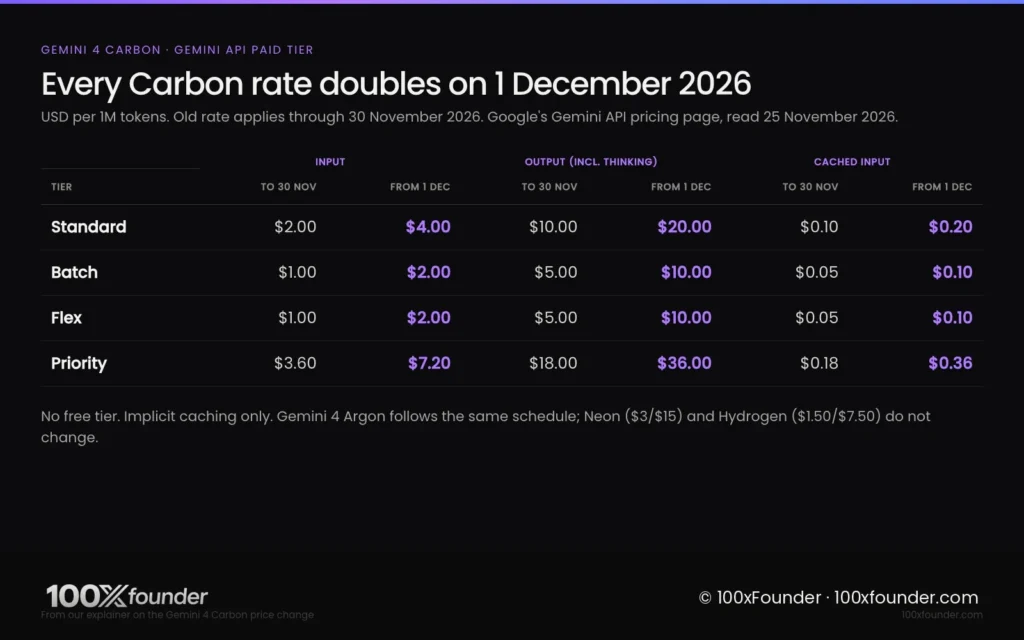
Gemini 4 Carbon’s standard paid-tier price is $2 per million input tokens and $10 per million output tokens through 30 November 2026, and $4 and $20 starting 1 December 2026, according to Google’s pricing page on 25 November 2026. Output includes thinking tokens, and Google’s page says every token the model processes is billed, including internal tool instructions and function declarations when grounding is used.
The doubling applies to every way of calling the model. The table below lists each tier exactly as Google’s pricing page shows it.
| Tier | Input, to 30 Nov | Input, from 1 Dec | Output, to 30 Nov | Output, from 1 Dec | Cached input, to 30 Nov | Cached input, from 1 Dec |
|---|---|---|---|---|---|---|
| Standard | $2.00 | $4.00 | $10.00 | $20.00 | $0.10 | $0.20 |
| Batch | $1.00 | $2.00 | $5.00 | $10.00 | $0.05 | $0.10 |
| Flex | $1.00 | $2.00 | $5.00 | $10.00 | $0.05 | $0.10 |
| Priority | $3.60 | $7.20 | $18.00 | $36.00 | $0.18 | $0.36 |
Some things do not change. Carbon has no free tier before or after the switch, and its context caching is implicit only: Google’s migration guide says explicit caching is not supported, implicit caching is on by default for prompts of at least 4,096 tokens, and cache hits are discounted by 95%. Grounding with Google Search keeps 5,000 free requests a month shared across Gemini 3 and newer models, then $14 per 1,000 requests, with no change date shown.
When the Gemini 4 Carbon price change applies
The new Gemini 4 Carbon price applies from 1 December 2026, and the $2/$10 rate covers usage through 30 November 2026. The date is confirmed on four Google pages read on 25 November 2026:
- Pricing page: “$2.00 through November 30, 2026” and “$4.00 starting December 1, 2026” for input, with matching lines for output, caching and each tier.
- Choosing a model guide: Carbon is “at a promotional price” through 30 November 2026 and costs $4 and $20 from 1 December; the same guide says Neon has no promotional price.
- Release notes: the 10 November 2026 entry made Carbon generally available “at introductory pricing” of $2 and $10 “through November 30, 2026”.
- Vertex AI pricing: the same split for Google Cloud customers, $2/$10 through 30 November and $4/$20 starting 1 December on global endpoints.
Google’s launch post on 28 October 2026 had already set the rule: Carbon would launch at Argon’s introductory price, and a footnote said $4 and $20 apply after the introductory period. None of the pages names a time zone for the switch, so a job that straddles midnight on 30 November may be billed at either rate.
Vertex AI customers
On Vertex AI, non-global endpoints cost 10% more: $2.20/$11 now and $4.40/$22 from 1 December, according to Google Cloud’s pricing page. That page also says the promotional pricing is “provided through 50% credits back on net spend”, so Vertex customers may see the list rate on the invoice with a credit, rather than a lower line price. The promotion does not cover Gemini 4 Carbon Cyber Permissive, which is already listed at $4/$20.
Argon changes too; Neon and Hydrogen don’t
Gemini 4 Argon, released on 13 October 2026, has the same schedule as Carbon on both the Gemini API and Vertex AI: $2/$10 through 30 November and $4/$20 from 1 December. Gemini 4 Neon, generally available since 18 November 2026, is $3/$15 with no promotion, and Gemini 4 Hydrogen stays at $1.50/$7.50, with a free tier. Our Gemini 4 Hydrogen pricing guide covers that model in detail.
What the price change means for a monthly bill
A Gemini 4 Carbon workload that sends 200 million input tokens and gets 20 million output tokens a month costs $600 at today’s standard rate and $1,200 from 1 December. The figures below are our own arithmetic on Google’s list prices, not Google’s estimates; your token mix will differ.
Our example is a team running 2,000 agent tasks a month, each reading 100,000 tokens of code or documents and returning 10,000 tokens of output, counting thinking:
- Standard, no cache hits: 200M x $2 + 20M x $10 = $600 today; 200M x $4 + 20M x $20 = $1,200 from 1 December.
- Standard, 60% of input from cache: 80M x $2 + 120M x $0.10 + 20M x $10 = $372 today; 80M x $4 + 120M x $0.20 + 20M x $20 = $744 from 1 December.
- Batch from 1 December, 60% cached: 80M x $2 + 120M x $0.10 + 20M x $10 = $372, the same as standard with caching today.
One task of 100,000 tokens in and 10,000 out goes from $0.30 to $0.60. Thinking tokens are the variable to watch: Google’s Carbon guide says the model spends more thinking tokens per turn than Argon on complex tasks, and the default thinking level is medium. A team that raises the level to high will see a larger output share, and output is the part that rises by $10 per million.
How Gemini 4 Carbon compares with other frontier model prices
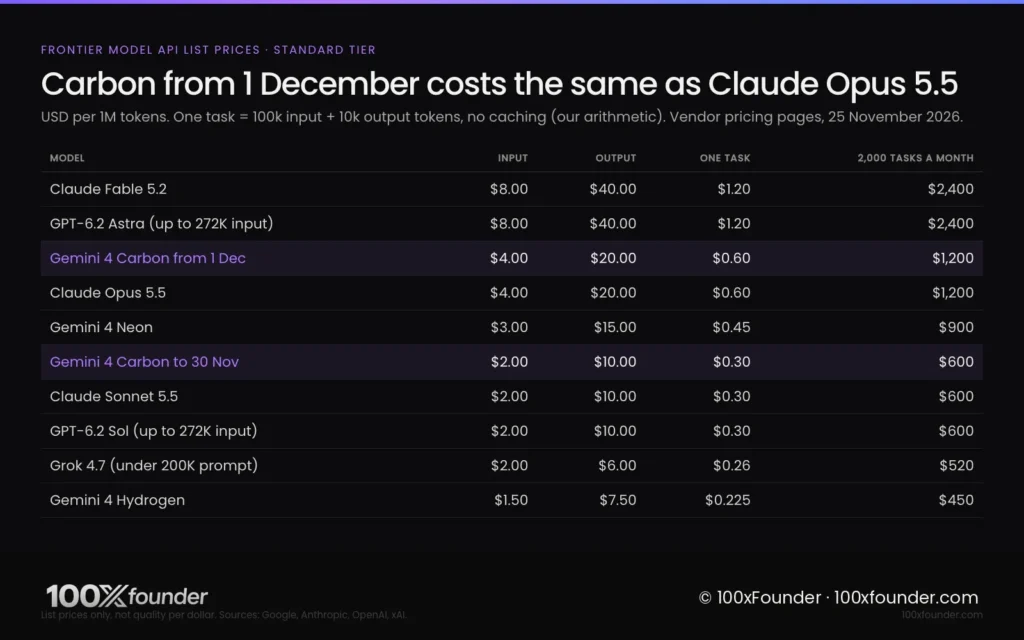
From 1 December 2026, Gemini 4 Carbon’s $4/$20 list price is the same as Claude Opus 5.5 and half of Claude Fable 5.2 and GPT-6.2 Astra, according to each vendor’s pricing page on 25 November 2026. Until then, Carbon costs the same as Claude Sonnet 5.5 and GPT-6.2 Sol.
| Model | Input | Output | Cached input | One task | 2,000 tasks |
|---|---|---|---|---|---|
| Claude Fable 5.2 | $8.00 | $40.00 | $0.20 | $1.20 | $2,400 |
| GPT-6.2 Astra (up to 272K input) | $8.00 | $40.00 | $0.40 | $1.20 | $2,400 |
| Gemini 4 Carbon from 1 Dec | $4.00 | $20.00 | $0.20 | $0.60 | $1,200 |
| Claude Opus 5.5 | $4.00 | $20.00 | $0.20 | $0.60 | $1,200 |
| Gemini 4 Neon | $3.00 | $15.00 | $0.15 | $0.45 | $900 |
| Gemini 4 Carbon to 30 Nov | $2.00 | $10.00 | $0.10 | $0.30 | $600 |
| Claude Sonnet 5.5 | $2.00 | $10.00 | $0.10 | $0.30 | $600 |
| GPT-6.2 Sol (up to 272K input) | $2.00 | $10.00 | $0.10 | $0.30 | $600 |
| Grok 4.7 (under 200K prompt) | $2.00 | $6.00 | $0.50 | $0.26 | $520 |
| Gemini 4 Hydrogen | $1.50 | $7.50 | $0.075 | $0.225 | $450 |
The table compares list prices only, not quality per dollar. Each vendor’s rules for long prompts differ: OpenAI charges more above 272,000 input tokens, xAI charges $4/$12 for Grok 4.7 at 200,000 prompt tokens or more, while Anthropic’s page says Opus 5.5, Fable 5.2 and Sonnet 5.5 bill the full 1M context at standard rates, and Google’s Carbon page shows one rate across its 1,048,576-token window. Batch APIs at Anthropic and OpenAI also take 50% off, matching Google’s Batch discount. For more on the rivals, see our guides to Claude Fable 5.2 and GPT-6.1 Terra and Sol.
How to keep a Gemini 4 Carbon bill down after 1 December
The cheapest way to run Gemini 4 Carbon after 1 December is the Batch or Flex tier, which at $2/$10 costs the same as today’s standard rate. Four other levers come from Google’s own documentation:
- Route by task. Google’s model chooser recommends Carbon for multi-hour background runs, deep research, formal proofs and security audits, Neon for interactive coding where someone waits on the answer, and Hydrogen for routine edits and parallel subagents. It suggests pairing Carbon or Neon for planning with Hydrogen for implementation.
- Keep thinking at medium. Google’s Carbon guide recommends the medium default unless a workload needs high, and lowering the level rather than cutting the output limit to save tokens.
- Reuse long prompts. Implicit caching bills repeated input of 4,096 tokens or more at 5% of the input price, $0.20 per million after 1 December.
- Check tools that resell the API. Cursor’s models page says third-party models are billed at the model’s API list price, and on 25 November it still listed Carbon at $2/$10 with no end date. Expect tools like Cursor to follow Google’s list price; our guide to AI coding tools compares the main ones.
Why it matters
Since its general release on 10 November, Gemini 4 Carbon has been priced like a mid-tier model while Google calls it its strongest reasoning model. From 1 December it is priced like Claude Opus 5.5, so teams that picked Carbon on price should rerun their comparison on quality per task. Teams that keep it can hold most of today’s cost by moving unattended jobs to Batch or Flex and leaving interactive work to Neon or Hydrogen.
FAQ
How much will Gemini 4 Carbon cost after the introductory price ends?
From 1 December 2026, Gemini 4 Carbon costs $4 per million input tokens and $20 per million output tokens on the Gemini API’s standard paid tier, according to Google’s pricing page on 25 November 2026. Cached input costs $0.20 per million, Batch and Flex cost $2 and $10, and Priority costs $7.20 and $36.
Is the Gemini 4 Carbon price really doubling on 1 December?
Yes. Google’s pricing page, model chooser and Vertex AI pricing page all list $2/$10 through 30 November 2026 and $4/$20 starting 1 December 2026, and the 10 November release notes call the $2/$10 rate introductory. Every rate for the model, including caching, doubles. Google does not say which time zone the switch follows.
Does Gemini 4 Carbon have a free tier?
No. Google’s pricing page says Gemini 4 Carbon is not available on the free tier of the Gemini API. Its model chooser says Carbon can also be used in Google AI Studio on the AI Ultra plan. Gemini 4 Hydrogen is the Gemini 4 model with a free API tier.
Is Gemini 4 Carbon cheaper than Claude Opus 5.5?
Until 30 November 2026, yes: Carbon is $2/$10 per million tokens against Opus 5.5’s $4/$20. From 1 December the two have the same list price of $4 input and $20 output, according to Google’s and Anthropic’s pricing pages on 25 November 2026. Cached input is $0.20 per million on both.
Which Gemini 4 models are not changing price?
Gemini 4 Neon ($3/$15 per million tokens) and Gemini 4 Hydrogen ($1.50/$7.50) show no scheduled change on Google’s pricing page on 25 November 2026, and Google’s model chooser says Neon has no promotional price. Gemini 4 Argon doubles on 1 December along with Carbon.
Sources
- Google AI for Developers, “Gemini Developer API pricing“, 2026-11-25
- Google AI for Developers, “Choosing a model“, 2026-11-25
- Google AI for Developers, “Gemini API release notes“, 2026-11-25
- Google AI for Developers, “What’s new in Gemini 4 Carbon“, 2026-11-25
- Google AI for Developers, “Gemini 4 Carbon model card“, 2026-11-25
- Google, “Introducing Gemini 4 Carbon“, 2026-10-28
- Google Cloud, “Vertex AI generative AI pricing“, 2026-11-25
- Anthropic, “Claude API pricing“, 2026-11-25
- OpenAI, “API pricing“, 2026-11-25
- xAI, “Models and pricing“, 2026-11-25
- Cursor, “Models“, 2026-11-25
Related stories

Sources (11)
- Google AI for Developers 25 Nov 2026Carbon Standard/Batch/Flex/Priority input, output and cache prices through 30 Nov and from 1 Dec 2026; no free tier; implicit caching only; all tokens billed incl. thinking and grounding instructions; grounding 5,000 free then $14/1,000; Argon same schedule; Neon $3/$15/$0.15; Hydrogen $1.50/$7.50/$0.075 and free tier
- Google AI for Developers 25 Nov 2026Carbon promotional price through 30 Nov, $4/$20 from 1 Dec; Neon has no promotional price; Carbon in AI Studio on AI Ultra; when to choose Carbon, Neon, Hydrogen; pairing models
- Google AI for Developers 25 Nov 2026Carbon GA 10 Nov 2026 at introductory $2/$10 through 30 Nov; Neon GA 18 Nov at $3/$15; Hydrogen GA 12 Nov; Argon GA 13 Oct 2026
- Google AI for Developers 25 Nov 2026Strongest reasoning model; default thinking level medium; more thinking tokens than Argon; implicit caching for prompts of 4,096+ tokens with 95% discount; explicit caching unsupported; keep medium unless high needed
- Google AI for Developers 25 Nov 2026Model ID, 1,048,576-token context window, Batch/Flex/Priority supported
- Google 28 Oct 2026Launch at Argon's introductory $2/$10 with cached input 95% off; footnote: $4/$20 after the introductory period
- Google Cloud 25 Nov 2026Vertex Carbon and Argon $2/$10 (non-global $2.20/$11) through 30 Nov, $4/$20 (non-global $4.40/$22) from 1 Dec; promo via 50% credits back; Cyber Permissive excluded
- Anthropic 25 Nov 2026Fable 5.2 $8/$40, Opus 5.5 $4/$20, Sonnet 5.5 $2/$10, cache hit prices; Batch 50% off; full 1M context at standard rates
- OpenAI 25 Nov 2026GPT-6.2 Astra $8/$40/$0.40 and GPT-6.2 Sol $2/$10/$0.10 short context; short context up to 272K input tokens; Batch at half
- xAI 25 Nov 2026Grok 4.7 $2/$6, cached $0.50 under 200k prompt tokens; $4/$12 at 200k or more
- Cursor 25 Nov 2026Third-party models billed at API list price; Carbon listed at $2 input, $0.10 cache read, $10 output