Voice AI startup funding: ElevenLabs, Deepgram, Gnani.ai compared
ElevenLabs hit a $22B valuation, Deepgram $1.3B and Gnani.ai raised $10M. The latest voice AI rounds and valuations, compared with sources, as of November 2026.
 Ishaan Vardhan23 Nov 2026 · 20 min read
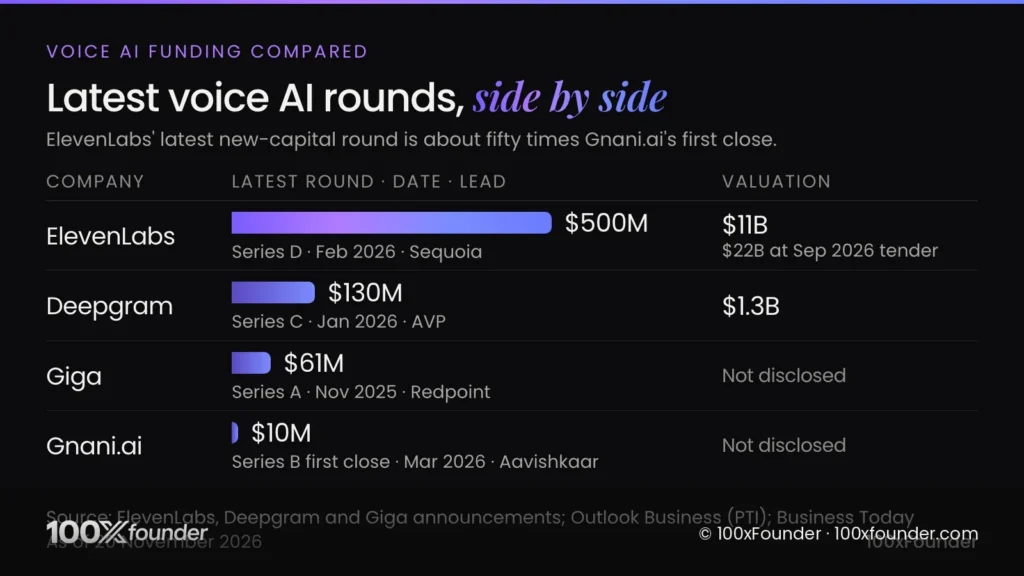
ElevenLabs is the most valuable voice AI startup by a wide margin: its $300 million employee tender in September 2026 valued it at $22 billion, after a $500 million Series D at $11 billion in February 2026. Deepgram raised a $130 million Series C at a $1.3 billion valuation in January 2026, Giga raised a $61 million Series A in November 2025, and Bengaluru’s Gnani.ai closed the first $10 million of its Series B in March 2026.
The gap between those numbers is the story, and revenue explains most of it. ElevenLabs says it passed $500 million in annual recurring revenue (ARR) by April 2026, and TechCrunch reported a run rate above $600 million in September. Below: the rounds each company has announced, what it sells and who pays for it, why the numbers moved, how the figures compare, how to read them without being misled, and which vendor fits which Indian buyer.
Key takeaways
- ElevenLabs’ valuation went from $3.3 billion (Series C, January 2025) to $22 billion (September 2026), according to its own announcements. The $22 billion mark came from a $300 million employee tender, a secondary sale, so total funding stays at the $781 million reported after the Series D.
- ElevenLabs said it ended 2025 with more than $330 million in annual recurring revenue (ARR) and passed $500 million ARR within the first four months of 2026.
- ElevenLabs’ $11 billion Series D price was roughly 31 to 33 times its end-2025 ARR, using the two ARR figures the company has published. No other company here publishes revenue, so no other multiple can be worked out.
- For Indian buyers, prices differ in kind, not just size: Deepgram charges $0.075 a minute for its standard voice agent, Sarvam AI ₹3.50 a minute before GST, and Gnani.ai publishes no price list.
- Gnani.ai is the India angle: a $10 million first close of its Series B led by Aavishkaar Capital, with 250+ enterprise customers listed on its site.
Voice AI startup funding compared
Voice AI startup funding in 2025 and 2026 ranges from a $10 million Series B first close at Gnani.ai to a $500 million Series D at ElevenLabs. The table lists each company’s latest announced round and the valuation, where the company or a reliable outlet has published one.
| Company | What it builds | Latest round | Date | Valuation | Source |
|---|---|---|---|---|---|
| ElevenLabs | Text-to-speech, speech-to-text and voice agents | $500M Series D (new capital); then a $300M employee tender (secondary) | Feb 2026; Sep 2026 | $11B at Series D; $22B at tender | ElevenLabs blog |
| Deepgram | Speech-to-text, text-to-speech and voice agent APIs | $130M Series C led by AVP | 13 Jan 2026 | $1.3B | Deepgram press release; TechCrunch |
| Giga | AI agents for customer support across voice and chat | $61M Series A led by Redpoint | 5 Nov 2025 | Not disclosed | Giga blog |
| Gnani.ai | Own speech and language models; enterprise voice agents | $10M Series B first close led by Aavishkaar Capital | 31 Mar 2026 | Not disclosed | Outlook Business (PTI); Business Today |
Table as of 20 November 2026. “Not disclosed” means neither the company nor the outlets we read published a valuation.
Who pays voice AI companies, and how much
Voice AI companies earn money in three ways: monthly subscriptions for creators and teams (ElevenLabs), per-minute API billing for developers (Deepgram), and enterprise contracts for finished voice agents (Gnani.ai and Giga).
ElevenLabs sells self-serve plans from a free tier with 10,000 credits a month to Starter at $6, Creator at $22, Pro at $99, Scale at $299 and Business at $990 a month, with Enterprise priced on request, according to its pricing page on 20 November 2026. Larger companies are now the bigger payer: its September 2026 post said enterprise customers make up 55% of revenue and named Stripe, Deutsche Telekom, SevenRooms, Admiral, Customers Bank and Cadence, plus the governments of Ukraine and Greece.
Deepgram bills developers by usage. Its pricing page lists Nova-3 streaming speech-to-text at $0.0048 a minute (shown as a promotional rate, down from $0.0077), Aura-2 text-to-speech at $0.030 per 1,000 characters and its standard Voice Agent at $0.075 a minute. New accounts get $200 of free credit, and a Growth plan starts at $4,000 a year in prepaid credit with up to 20% off pay-as-you-go rates.
Gnani.ai and Giga sell finished agents to large companies and publish no price list. Gnani.ai’s site names Tata Motors, Bank of Baroda, Equitas Small Finance Bank, EarlySalary, Crompton and matrimony.com among its customers and offers to run in its own cloud, a customer’s private cloud, on-premise or fully air-gapped. Giga’s site, read on 20 November 2026, sells through demos only, targets fintech, banking, retail, telecom, healthcare, logistics and hospitality support teams, and lists SOC 2 Type II, ISO 27001, ISO 42001 and PCI DSS 4.0.1 compliance. It quotes DoorDash at a 90%+ resolution rate, which is Giga’s own customer-story figure.
| Company | How it charges | Published entry price | Indian languages listed |
|---|---|---|---|
| ElevenLabs | Monthly plans with credits; enterprise contracts | Free tier; Starter $6 a month | Eleven v4 lists Hindi, Bengali, Tamil, Telugu, Marathi, Gujarati and more |
| Deepgram | Pay per minute or per character; prepaid Growth plan | $200 free credit; Voice Agent $0.075 a minute | Nova-3 speech-to-text lists Hindi, Tamil, Telugu, Bengali, Marathi, Kannada and others |
| Gnani.ai | Enterprise contracts; model API | Not published | Site lists Hindi, Bengali, Marathi, Tamil, Telugu, Kannada and more |
| Giga | Enterprise contracts | Not published | Not listed by language; 99 languages claimed |
| Sarvam AI (India comparison) | Rupee per-minute plans | Voice agents ₹3.50 a minute, excluding GST | 11 Indian languages plus English |
Prices from each company’s pricing page and language lists from its documentation, read on 20 November 2026. Prices change often; check the vendor’s page before you budget.
ElevenLabs valuation history
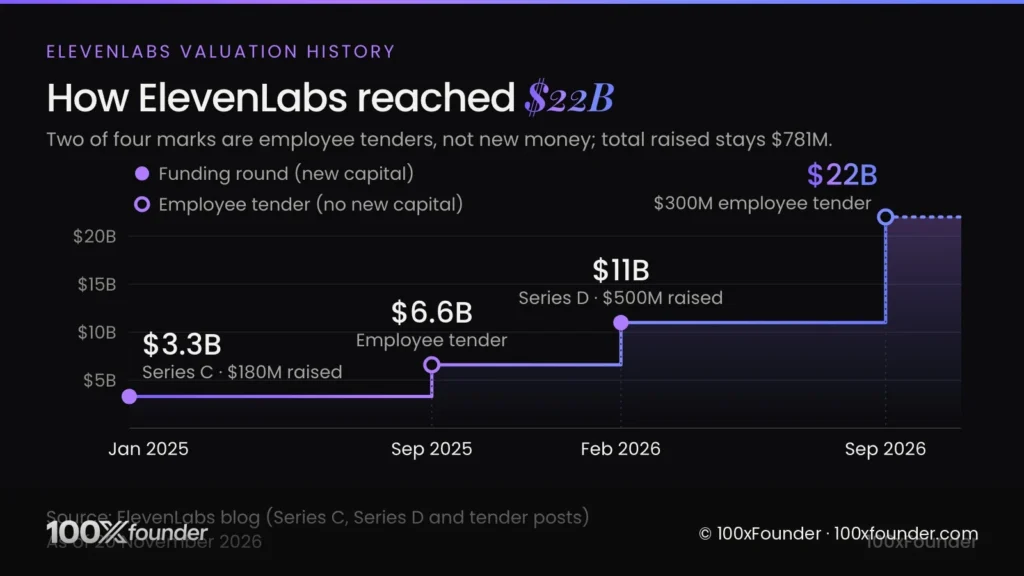
ElevenLabs’ valuation history runs $3.3 billion in January 2025, $6.6 billion in September 2025, $11 billion in February 2026 and $22 billion in September 2026, according to the company’s blog. Two of those four marks come from funding rounds and two from employee tender offers.
Series B, January 2024
ElevenLabs announced an $80 million Series B on 22 January 2024, co-led by Andreessen Horowitz, Nat Friedman and Daniel Gross. The company’s post said the round gave it unicorn status but did not publish a valuation figure, so we leave one out.
Series C, January 2025: $180 million at $3.3 billion
On 30 January 2025 ElevenLabs raised $180 million in a Series C co-led by a16z and ICONIQ Growth, at a $3.3 billion valuation, according to its announcement. The company said that brought its total funding to $281 million across four rounds and that its team had grown from 30 to 120 people over the previous year.
Employee tender, September 2025: $6.6 billion
ElevenLabs’ Series D post lists an employee tender offer on 8 September 2025 at a $6.6 billion valuation. The post does not give the size of that tender.
Series D, February 2026: $500 million at $11 billion
On 4 February 2026 ElevenLabs announced a $500 million Series D led by Sequoia Capital at an $11 billion valuation, which it described as more than three times its valuation a year earlier. a16z and ICONIQ added to their stakes, and Lightspeed Venture Partners, Evantic Capital and BOND joined as new investors. The company said it had raised $781 million across five rounds.
The Series D post puts the jump down to “rapid enterprise adoption” of its three product lines: ElevenAgents (voice and chat agents for businesses), ElevenCreative (generating, editing and dubbing audio) and ElevenAPI (voice infrastructure for developers). It named Deutsche Telekom, Square, Revolut and the Ukrainian government as ElevenAgents users, and Meta, Epic Games, Salesforce, MasterClass and Harvey as ElevenAPI users. The money is earmarked for research, product and international expansion through local go-to-market teams in 14 cities, one of which is Bengaluru.
In a 5 May 2026 post, ElevenLabs described a third close of the Series D with new backers including BlackRock, Wellington, D.E. Shaw, Schroders, NVIDIA’s NVentures, Santander and Deutsche Telekom’s T.Capital. That post gave no amount for the extra close and mentioned a separate $100 million tender offer, its second in less than a year.
Employee tender, September 2026: $300 million at $22 billion
On 30 September 2026 ElevenLabs announced a $300 million employee tender offer led by Wellington and T. Rowe Price that values the company at $22 billion, double its Series D valuation. This is a secondary transaction: in a tender, outside investors buy existing shares from employees, so the $300 million goes to the sellers and is not new capital raised by ElevenLabs. Finimize described the deal as mostly a secondary sale that gives staff liquidity. For that reason it does not add to the $781 million total.
ElevenLabs revenue: what the company has disclosed
ElevenLabs reported more than $330 million in ARR at the end of 2025 in its Series D post, and later said it passed $500 million ARR within the first four months of 2026. ARR, or annual recurring revenue, is the yearly value of subscriptions and contracts running at a point in time; it is not audited annual revenue.
The company’s own posts do not quite agree on the end-2025 figure. The February Series D post says “over $330 million”, while the May 2026 post says ElevenLabs ended 2025 with $350 million in ARR. We show both and do not pick one.
The September 2026 tender post added detail without a new ARR total: enterprise customers now account for 55% of revenue, its voice agents handle more than 15 million conversations a week (three times February’s level), and the company has more than 800 people. It also said ARR for ElevenAgents, its voice agent product, had more than tripled since February.
TechCrunch, reporting the Eleven v4 model launch on 28 September 2026, said ElevenLabs’ annualised revenue run rate had climbed from roughly $330 million at the start of the year to over $600 million. The company’s own posts have not published that figure, so treat it as reported rather than disclosed.
Our ElevenLabs Scribe v3 listing covers its speech-to-text model.
ElevenLabs growth rate and valuation multiples
ElevenLabs is the only company in this comparison that publishes revenue, so it is the only one whose valuation can be set against sales. The figures below are our arithmetic on published numbers only.
- ARR growth: from $330 million to $350 million at the end of 2025 to more than $500 million by the end of April 2026 is growth of at least 43% to 52% in four months, depending on which end-2025 figure you use.
- Series D multiple: $11 billion against $330 million to $350 million of end-2025 ARR is roughly 31 to 33 times ARR.
- Tender multiple: $22 billion against the reported run rate of over $600 million is below about 37 times, and only if that reported figure holds.
- Valuation step-ups: 3.3 times from the Series C ($3.3 billion, January 2025) to the Series D ($11 billion, February 2026), then 2 times in the eight months to the September 2026 tender.
- Capital efficiency: ElevenLabs reported $781 million raised in total and more than $500 million in ARR by April 2026, so ARR was already about two-thirds of everything it had raised.
Deepgram has not published revenue, only that it was cashflow positive the year before its Series C, according to TechCrunch. Giga and Gnani.ai have published neither revenue nor valuation. Any revenue multiple you see for those three is someone’s estimate, not a disclosed figure.
Deepgram funding: five stages to a $1.3 billion valuation
Deepgram has raised money at five stages, from Y Combinator and seed funding in 2016 to a $130 million Series C at a $1.3 billion valuation in January 2026, according to the timeline on its about page. The company was founded on 18 August 2015 and sells speech-to-text, text-to-speech and voice agent APIs to developers.
- 2016: Y Combinator and other seed funding; no amount shown.
- 2019: $12 million Series A.
- 2020: $25 million Series B.
- 2022: Series B extension. Deepgram says it “completes $72M Series B round”, so $72 million is the Series B in total, including the 2020 money. Counting $25 million plus $72 million would double-count.
- 13 January 2026: $130 million Series C at a $1.3 billion valuation, led by AVP.
Deepgram’s Series C release names existing investors Alkeon, In-Q-Tel, Madrona, Tiger, Wing, Y Combinator and BlackRock-managed funds, plus Twilio, ServiceNow Ventures, SAP and Citi Ventures. TechCrunch reported that Deepgram had raised over $215 million to date, and that CEO Scott Stephenson said the company was cashflow positive the previous year. Alongside the round, Deepgram bought OfOne, a voice AI platform for quick-service restaurants and drive-throughs; the release says OfOne has delivered more than 95% containment (calls handled without a human), which is OfOne’s own figure.
Deepgram’s product line explains who pays it: Nova-3 for speech-to-text, Aura-2 for text-to-speech, Flux for conversational speech recognition, a Voice Agent API and Saga, which it calls a voice operating system, with self-hosted deployment for customers who keep audio in-house. The release says the money will expand its intellectual property, including patents, and fund international expansion, including Europe, and cites more than 200,000 developers and over 50,000 years of audio processed.
The customer count depends on which page you read. The January release says more than 1,300 organisations build with Deepgram’s APIs, and the about page now lists 5,000+ organisations in its 2026 milestone. Our Deepgram listing has the product and pricing details.
Giga: a $61 million Series A for voice support agents
Giga, which builds AI agents for customer support over voice, chat and other channels, raised a $61 million Series A led by Redpoint, announced on 5 November 2025. The company did not publish a valuation.
Giga named DoorDash as a customer in the announcement and said its voice experience works across 99 languages. Co-founder Varun Vummadi wrote that he and his co-founder Esha started the company in their college dorm. Y Combinator’s profile lists Esha Dinne as founder and CTO, a 2023 computer science graduate of IIT Kharagpur, and places the San Francisco company in its Summer 2023 batch with a team of 30.
Giga’s post makes two performance claims of its own: agents that improve “from 60% to 98% resolution automatically” and customers who go live in under two weeks. These are the company’s figures, not independent measurements. The post names Agent Canvas, Scout, a command-line tool and a Browser Agent as products, names no investor besides Redpoint, and does not say how the money will be spent.
Why it matters in this comparison: Giga sells finished support agents rather than raw voice models, which is the same market ElevenLabs is chasing with ElevenAgents and Deepgram with its Voice Agent API. A $61 million Series A for a company from Y Combinator’s Summer 2023 batch shows investors are paying for the agent layer, not only for the models underneath.
Voice AI startups in India: Gnani.ai’s Series B
Gnani.ai, a Bengaluru voice AI company founded in 2016, raised $10 million as the first close of its Series B, led by Aavishkaar Capital with existing investor Info Edge Ventures, according to a PTI report in Outlook Business on 31 March 2026. The company called it the first close of a larger round.
Business Today reported the same $10 million (about ₹94 crore; a crore is 10 million rupees) and said the round remained open to more investors. It added that Info Edge had earlier invested about $4 million (₹30 crore) in the company. Neither report nor the company gave a valuation. According to Business Today, the money is for a bigger international footprint and more research and development; the company already works with customers in Japan, West Asia and the US, and has built a 14-billion-parameter speech-to-speech model, with a voice-to-voice language model in development.
On 6 May 2026 Gnani.ai announced eight senior hires after the first tranche, including a VP of marketing, an India general manager for banking and financial services, and a head of AI transformation for the public sector. That release described the company as serving more than 200 enterprise customers and handling over 30 million voice interactions a day in 12+ languages. Its about page now lists 250+ enterprises, 40 million+ daily voice interactions and 40+ languages and dialects. The page does not date those figures, so the gap from May may reflect growth or a different way of counting.
Gnani.ai sells mainly to banks, insurers, carmakers, consumer-durables brands, and education, healthcare and travel companies, according to its website, and names Tata Motors and Bank of Baroda among customers. It can run fully air-gapped or in a customer’s own data centre, which matters to regulated Indian lenders and public-sector buyers who cannot send call audio to a foreign cloud.
Gnani.ai builds its own speech and language models; its site lists Prisma for speech-to-text, Evon as a language model and Timbre for text-to-speech. The founders are Ganesh Gopalan (CEO), Ananth Nagaraj (CTO) and Bharath Shankar (chief product and engineering officer). For other Indian model builders, see our comparison of Indian AI models such as Sarvam, BharatGen and Krutrim.
What the funding gap means for Indian voice AI founders
ElevenLabs’ latest new-capital round alone is about fifty times Gnani.ai’s first close. Three points stand out for Indian founders.
Revenue is carrying the valuations. ElevenLabs published ARR figures with its Series D and again in May 2026, and Deepgram told TechCrunch it was cashflow positive. Investors in this category are paying for disclosed revenue, not only model quality.
India’s opening is enterprise and multilingual. Gnani.ai’s pitch rests on banks, insurers and the public sector, and on many Indian languages, the same ground where a global player has to localise. Indian founders raising for voice AI should expect smaller cheques than San Francisco peers, and should lead with customer counts and daily usage, which is what Gnani.ai published.
Competition is arriving locally. ElevenLabs is building a go-to-market team in Bengaluru with Series D money, Deepgram lists India as a Voice Agent region, and Sarvam AI already prices in rupees. A new Indian voice startup selling generic text-to-speech now competes with all three; on-premise deployment, regulated-sector know-how and code-mixed Indian speech are where the published Indian players have chosen to compete.
You can follow new rounds as they are announced on our funding tracker.
What it means for Indian buyers and job seekers
For an Indian business choosing a voice AI vendor, three questions matter more than the funding table: does it speak your customers’ languages, where does the audio go, and what does a minute cost in rupees.
Languages. ElevenLabs, Deepgram, Gnani.ai and Sarvam AI all list Indian languages; Giga claims 99 languages but does not publish the list. ElevenLabs’ documentation lists Hindi, Bengali, Tamil, Telugu, Marathi, Gujarati, Kannada, Malayalam, Punjabi, Odia and Assamese among the 90+ languages of its Eleven v4 voice model. Deepgram’s Nova-3 speech-to-text lists Hindi, Tamil, Telugu, Bengali, Marathi, Kannada and Gujarati in its multilingual model and more in single-language mode. Gnani.ai and Sarvam AI build specifically for Indian languages and code-mixed speech. A listed language is not the same as good accuracy on your calls, so test with your own recordings.
Data location. Deepgram’s pricing page lists India among the regions where its Voice Agent runs (up to 45 concurrent agents there on the Growth plan). Gnani.ai offers on-premise and air-gapped deployment. Buyers in banking and insurance should check these options against their own data-protection obligations before signing.
Cost. Deepgram and ElevenLabs bill in US dollars, while Sarvam AI prices its voice agents in rupees, from ₹3.50 a minute down to ₹3.00 at 65,000+ minutes a month, plus GST, according to its pricing page. Convert dollar prices at the day’s rate and add GST before comparing. Our guide to the best AI text-to-speech tools compares voice quality and per-character prices in more detail.
Which vendor fits which buyer. The shortlist below matches each company’s published offer to a typical Indian use case. It is a starting point by features and pricing, not a ranking of quality.
| If you need | Start with | Why, from the vendor’s own pages |
|---|---|---|
| Voiceovers, dubbing or narration in Hindi and other Indian languages | ElevenLabs | Self-serve plans from $6 a month; Hindi and ten other Indian languages listed for Eleven v4 |
| Speech-to-text or a voice agent inside your own app | Deepgram | Per-minute API, $200 free credit, India listed as a Voice Agent region |
| A bank, insurer or government call centre that must keep audio in-house | Gnani.ai | On-premise and air-gapped deployment, its own speech models, Indian banks named as customers |
| A voice agent billed in rupees | Sarvam AI | ₹3.50 a minute pay-as-you-go, ₹3.00 at volume, plus GST |
| A finished support agent across voice, chat and email for a large consumer brand | Giga | Demo-led enterprise sales, SOC 2 Type II, ISO 27001 and PCI DSS listed, DoorDash named |
Jobs. TechCrunch noted in September 2026 that ElevenLabs has hired in India, and Gnani.ai’s May hires included an India general manager for banking and financial services. Open roles from official careers pages are on our ElevenLabs jobs page and Sarvam AI jobs page.
How to read voice AI funding numbers
Voice AI headlines mix several kinds of number that are not directly comparable. Six checks keep comparisons honest.
- ARR is self-reported. Every ARR figure here comes from the company or a press report, not audited accounts, and companies define ARR in their own way.
- Run rate is not ARR. TechCrunch’s “over $600 million” is a reported run rate; the company’s last disclosed figure is “over $500 million” ARR.
- Tenders are not raises. A tender sets a price for existing shares; none of the money reaches the company. Compare primary rounds with primary rounds.
- A first close is not the round. Gnani.ai’s $10 million is the first tranche of a Series B that Business Today said was still open, so the final size may be larger.
- Pre-money or post-money is rarely stated. None of the ElevenLabs, Deepgram, Giga or Gnani.ai announcements we read says which it is, so treat each valuation as the headline figure the company chose to publish.
- Round names are not standard. Deepgram’s Series B grew to $72 million through an extension two years after it was first announced, and a Series A at one company can be larger than a Series C at another.
How we compiled this
We read each company’s own funding announcements, about pages, home pages, pricing pages and documentation (listed in full under Sources) and coverage in TechCrunch, Outlook Business, Business Today and Finimize, on 19 and 20 November 2026. Growth rates and multiples are our own arithmetic on those published figures. Every figure in this article appears on at least one of those pages. Where two pages disagree, we show both. We did not include third-party valuation estimates.
FAQ
What is ElevenLabs’ valuation in 2026?
ElevenLabs was valued at $22 billion in its $300 million employee tender, announced on 30 September 2026 and led by Wellington and T. Rowe Price. Earlier in 2026 its $500 million Series D, announced on 4 February, valued it at $11 billion. Both figures come from the company’s own blog, which also says ARR passed $500 million in the first four months of 2026. TechCrunch reported a run rate above $600 million in September, a figure the company has not confirmed.
Is an employee tender offer the same as a funding round?
No. In a tender offer, investors buy existing shares from employees, so the money goes to the staff who sell, not to the company. ElevenLabs’ $300 million tender in September 2026 set a $22 billion price but raised no new capital; its last new-money round was the $500 million Series D in February 2026.
How much has Deepgram raised in total?
Deepgram’s about page lists a $12 million Series A, a Series B of $72 million in total and a $130 million Series C, plus undisclosed seed money from Y Combinator and others. TechCrunch reported in January 2026 that the company had raised over $215 million to date.
Which voice AI startups in India have raised funding recently?
Bengaluru’s Gnani.ai raised $10 million as the first close of its Series B in March 2026, led by Aavishkaar Capital with Info Edge Ventures. It builds its own speech and language models and lists 250+ enterprise customers. Giga is based in San Francisco, not India, but its CTO is an IIT Kharagpur graduate; it raised a $61 million Series A in November 2025.
How much does Deepgram cost per minute?
Deepgram’s pricing page, read on 20 November 2026, lists Nova-3 streaming speech-to-text at $0.0048 a minute on a promotional pay-as-you-go rate and its standard Voice Agent at $0.075 a minute. New accounts get $200 in free credit, and the Growth plan starts at $4,000 a year in prepaid credit with up to 20% off.
Does ElevenLabs support Hindi and other Indian languages?
Yes. ElevenLabs’ model documentation lists Hindi, Bengali, Tamil, Telugu, Marathi, Gujarati, Kannada, Malayalam, Punjabi, Odia and Assamese among the 90+ languages of its Eleven v4 voice model. Test with your own scripts before committing, since quality varies by language and accent.
Which voice AI is cheapest for an Indian call centre?
Only Sarvam AI publishes a rupee price: ₹3.50 a minute pay-as-you-go for voice agents, falling to ₹3.00 at 65,000+ minutes a month, plus GST, according to its pricing page on 20 November 2026. Deepgram’s standard Voice Agent is $0.075 a minute in US dollars. Gnani.ai and Giga quote on request, so compare all-in quotes, including GST and currency conversion, on your own call volumes.
Sources
- ElevenLabs, “ElevenLabs raises $80m Series B” (elevenlabs.io/blog/series-b), 22 January 2024
- ElevenLabs, “ElevenLabs raises $180m Series C” (elevenlabs.io/blog/series-c), 30 January 2025
- ElevenLabs, “ElevenLabs raises $500m Series D” (elevenlabs.io/blog/series-d), 4 February 2026
- ElevenLabs, “$500M ARR and new investors” (elevenlabs.io/blog/500m-arr-and-new-investors), 5 May 2026
- ElevenLabs, “$22bn employee tender” (elevenlabs.io/blog/tender-22bn), 30 September 2026
- Finimize, “ElevenLabs’ $22 billion tender offer gave staff a payday“, accessed 20 November 2026
- Deepgram, “About Deepgram” (deepgram.com/about) (company timeline), accessed 20 November 2026
- Deepgram, “Deepgram raises $130M Series C at $1.3B valuation” (deepgram.com/learn/press-release-deepgram-raises-series-c), 13 January 2026
- TechCrunch, “Deepgram raises $130M at $1.3B valuation and buys a YC AI startup“, 13 January 2026
- Giga, “Giga Series A” (giga.ai/news/series-a), 5 November 2025
- Y Combinator, “Giga company profile“, accessed 20 November 2026
- Outlook Business (PTI), “Gnani.ai raises $10 Mn in first tranche of funding round led by Aavishkaar Capital“, 31 March 2026
- Business Today, “Gnani.ai raises $10 million in funding from Aavishkaar Capital to scale global voice AI push“, 31 March 2026
- Gnani.ai, “Leadership hires after Series B first tranche” (gnani.ai/press-releases/gnani-ai-leadership-hires-after-series-b-first-tranche), 6 May 2026
- Gnani.ai, “About us” (gnani.ai/about-us), accessed 20 November 2026
- ElevenLabs, “Pricing” (elevenlabs.io/pricing), accessed 20 November 2026
- ElevenLabs, “Models” (elevenlabs.io/docs/overview/models) (documentation), accessed 20 November 2026
- TechCrunch, “ElevenLabs’ new v4 speech model supports more expression control and 90 languages“, 28 September 2026
- Deepgram, “Pricing” (deepgram.com/pricing), accessed 20 November 2026
- Deepgram, “Models and languages overview” (developers.deepgram.com/docs/models-languages-overview), accessed 20 November 2026
- Gnani.ai, “Home page” (gnani.ai), accessed 20 November 2026
- Sarvam AI, “Voice agents pricing” (sarvam.ai/products/voice-agents/pricing), accessed 20 November 2026
- Giga, “Home page” (giga.ai), accessed 20 November 2026
Related stories
Sources (23)
- ElevenLabs 22 Jan 2024$80M Series B, co-leads, unicorn status
- ElevenLabs 30 Jan 2025$180M Series C at $3.3B, co-leads, $281M total, team 30 to 120
- ElevenLabs 4 Feb 2026$500M Series D at $11B led by Sequoia; Sep 2025 tender at $6.6B; $781M total over five rounds; ARR over $330M end 2025; growth from enterprise adoption; ElevenAgents/ElevenCreative/ElevenAPI and named customers; go-to-market teams in 14 cities incl. Bengaluru; no pre/post-money
- ElevenLabs 5 May 2026$500M ARR in first four months of 2026; $350M end-2025; third close of Series D investors; $100M tender
- ElevenLabs 30 Sep 2026$300M employee tender at $22B led by Wellington and T. Rowe Price; 55% enterprise revenue; 15M+ weekly conversations; 800+ people
- Finimize 20 Nov 2026tender described as mostly a secondary sale
- Deepgram 20 Nov 2026founding date; funding timeline; $72M Series B total; 5,000+ organisations
- Deepgram 13 Jan 2026$130M Series C at $1.3B led by AVP; investors; OfOne; 1,300+ organisations; products Nova-3, Aura-2, Flux, Voice Agent API, Saga; 200,000+ developers; 50,000+ years of audio; OfOne 95% containment; use of funds incl. Europe
- TechCrunch 13 Jan 2026over $215M raised to date; cashflow positive
- Giga 5 Nov 2025$61M Series A led by Redpoint; DoorDash; 99 languages; dorm founding; Agent Canvas, Scout, CLI, Browser Agent; only Redpoint named
- Y Combinator 20 Nov 2026Esha Dinne background; S23 batch; San Francisco; team 30
- Outlook Business (PTI) 31 Mar 2026$10M first close led by Aavishkaar Capital with Info Edge Ventures
- Business Today 31 Mar 2026Rs 94 crore; round open; Info Edge earlier $4M (Rs 30 crore); use of funds international and R&D; customers in Japan, West Asia, US; 14B speech-to-speech model
- Gnani.ai 6 May 2026eight hires; 200+ customers, 30M+ daily interactions, 12+ languages; Bengaluru HQ
- Gnani.ai 20 Nov 2026founded 2016 Bengaluru; founders; 250+ enterprises; 40M+ daily; 40+ languages
- ElevenLabs 20 Nov 2026plans Free 10k credits, Starter $6, Creator $22, Pro $99, Scale $299, Business $990, Enterprise custom
- ElevenLabs 20 Nov 2026Eleven v4 lists Hindi, Bengali, Tamil, Telugu, Marathi, Gujarati, Kannada, Malayalam, Punjabi, Odia, Assamese among 90+ languages
- TechCrunch 28 Sep 2026run rate from roughly $330M to over $600M; hired in India; v4 90+ languages
- Deepgram 20 Nov 2026Nova-3 $0.0048/min promo, Aura-2 $0.030/1k chars, Voice Agent $0.075/min, $200 credit, Growth $4,000+/yr up to 20% off, India concurrency 45
- Deepgram 20 Nov 2026Eleven v4 lists Hindi, Bengali, Tamil, Telugu, Marathi, Gujarati, Kannada, Malayalam, Punjabi, Odia, Assamese among 90+ languages
- Gnani.ai 20 Nov 2026industries (no government listed), named customers, deployment options, Indian languages, no published pricing
- Sarvam AI 20 Nov 2026voice agents ₹3.50/min PAYG to ₹3.00/min Business, excl GST; 11 Indian languages plus English
- Giga 20 Nov 2026demo-led sales, no public price list (/pricing 404), industries, SOC 2 Type II, ISO 27001, ISO 42001, PCI DSS 4.0.1, DoorDash 90%+ Did We Resolve rate