How to Get a Job at Coinbase in 2026: Remote Policy, Rounds and Pay
Coinbase lists 229 roles, 11 in India with base pay up to ₹1.49 crore. Here is its remote-first policy, official interview stages and how to prepare.
 Ishaan Vardhan14 Oct 2026 · 10 min read

To get a job at Coinbase in 2026, apply to no more than three roles at a time and prepare for engineering interviews that focus on clean, production-quality code over puzzle tricks. Expect to work remotely, with in-person “surges” every quarter. On 4 October 2026 Coinbase listed 229 open roles, 11 of them in India. Every India posting shows a single annual base salary figure, from ₹27.6 lakh to ₹1.49 crore. This guide covers Coinbase’s remote-first policy as it states it, the interview stages it has published, what candidates report, and how to prepare.
100Xfounder is an independent site. This guide is not official, and we are not affiliated with or endorsed by Coinbase. Confirm details with your recruiter and Coinbase’s careers site. Nothing here is investment advice.
Key takeaways
- Coinbase listed 229 roles on 4 October 2026. 136 were “Remote – USA”, 10 were “Remote – India”, and one was hybrid in Bengaluru.
- Coinbase calls itself “remote-first, not remote-only.” Every posting says staff meet quarterly for in-person working sessions called “surges.”
- Each India posting lists one annual base salary figure: ₹44.1 lakh for a Software Engineer, ₹66.1 lakh for a Senior ML Engineer and ₹94.2 lakh for Staff-level engineering roles.
- Coinbase’s own engineering interview guide says most unsuccessful candidates fail the pair programming rounds, and that it judges code quality, not just correctness.
- Candidates can submit at most three applications in any six-month period.
Where Coinbase is hiring now
Coinbase publishes its roles on a public Greenhouse board that feeds its careers site. On 4 October 2026 there were 229 openings. The largest groups were Internships & Emerging Talent (27), Backend Engineering (26), Customer Experience (25), Finance & Accounting (23), Legal & Compliance (15) and general Engineering (14). There were smaller teams in marketing, product, security, machine learning, infrastructure, frontend and mobile. By location, “Remote – USA” dominated with 136 roles, followed by “Hybrid – New York” (21), “Remote – Canada” (10), “Remote – India” (10) and “Remote – UK” (9).
The 11 India roles were:
- Software Engineer, Security Platform; Staff Software Engineer, Security Platform; Staff Software Engineer, Customer Administration
- Machine Learning Engineer; Senior Machine Learning Engineer; Engineering Manager, Customer Experience AI
- Senior Product Manager, Help Center (CX Automation); Senior IT Automation Engineer; Specialist, CSIRT (security incident response)
- Country Director, India
- Capacity Planning Lead, the only one marked “Hybrid – Bangalore”
The engineering bars are stated plainly. The Software Engineer, Security Platform post asks for at least 3 years of software engineering and lists building services in Go or Java. The Staff version asks for 8+ years. The Machine Learning Engineer role asks for 2+ years of professional ML and software experience, and the senior role 5+ years. Our Coinbase jobs page tracks the live list from the official feed.
Coinbase’s remote-first policy, as it states it
Coinbase’s position starts with a note CEO Brian Armstrong sent to staff on 20 May 2020 and published on the Coinbase blog. He wrote that after quarantine restrictions ended, Coinbase would become “remote-first”: the vast majority of roles could be done from an office or remotely. He described the aim as no explicit or implicit disadvantage to working from any location. Coinbase would keep offices in major hub cities, with a long-term vision of “one floor of office space in ten cities, rather than ten floors of office space in one city.”
The current wording adds a caveat. The current careers page lists “Remote-first, not remote-only” as a cultural tenet. It says most roles are remote-first, with any in-office requirements noted in the job post, and that remote employees will be asked to join periodic in-person events. Every one of the 229 postings on 4 October 2026 carried the same line: Coinbase is “a remote-first, but not remote-only company,” and staff should expect to get together quarterly for intense in-person working sessions called “surges.”
In practice the location label on each posting tells you the arrangement. Ten India roles are “Remote – India”. The Capacity Planning Lead is “Hybrid – Bangalore”, and all 27 internships were hybrid in New York or San Francisco. When Coinbase first announced India hiring on 24 March 2021, it said new hires in India would be able to work from various locations within the country. It also said it expected to open a physical office, initially in Hyderabad, once COVID conditions allowed. The current India postings do not name a Hyderabad office. If an office base matters to you, ask the recruiter.
India pay: what the postings say
Coinbase is unusually open about India pay. Each India posting has a “Pay Transparency Notice” that gives one annual base salary figure (shown as a range with the same number at both ends) and says total compensation may also include equity, bonus eligibility and benefits. On 4 October 2026 the figures were:
| Role (India) | Annual base salary |
|---|---|
| Capacity Planning Lead; Specialist, CSIRT | ₹27,55,300 (about ₹27.6 lakh) |
| Senior IT Automation Engineer | ₹34,19,600 (about ₹34.2 lakh) |
| Software Engineer, Security Platform; Machine Learning Engineer | ₹44,08,400 (about ₹44.1 lakh) |
| Senior Machine Learning Engineer; Senior Product Manager | ₹66,12,600 (about ₹66.1 lakh) |
| Staff Software Engineer (two roles); Engineering Manager, CX AI | ₹94,24,500 (about ₹94.2 lakh) |
| Country Director, India | ₹1,48,78,400 (about ₹1.49 crore) |
For readers outside India: a lakh is ₹100,000 and a crore is ₹10 million, so ₹44.1 lakh is ₹4.41 million a year. These are base salaries before equity and bonus, as Coinbase describes them. To see what a base figure means as monthly take-home pay, use our in-hand salary calculator. For tax treatment of equity or any crypto-linked pay, check with a qualified tax professional.

What Coinbase looks for
Coinbase’s careers page sets the tone directly: working there “isn’t for the faint of heart.” It lists three tenets alongside remote-first. The first is being apolitical: no social or political activism unrelated to the mission at work. The second is a “championship team”: high expectations, outsized reward for outperformance, and a generous severance package for unremarkable performance. The company describes its mission as increasing economic freedom and helping a billion people access an open financial system.
Its September 2021 engineering interview guide listed the tenets it assessed then: clear communication, efficient execution, act like an owner, top talent, championship team, customer focus, repeatable innovation, positive energy and continuous learning. It said assessment happens “almost exclusively” through that lens. The wording on the careers page has since changed, but the emphasis on ownership, clear communication and high performance is consistent.
Most current postings (211 of 229 on 4 October 2026) also list a skill phrased as using generative AI responsibly, keeping human oversight while improving efficiency, cost and quality. Expect to be asked how you actually use AI tools at work.
The hiring process for engineers
Coinbase’s own guide describes the engineering stages as “typically but not always”:
- An initial chat with someone from HR about the role.
- One 60-minute pair programming problem.
- One or two 60-minute engineering manager interviews.
- One or two 60- or 90-minute pair programming interviews.
- One or two 60-minute system design interviews.
You need to do well at every stage. The guide says most unsuccessful candidates fail at pair programming. That is not usually because they didn’t finish, but because their code or process was not good enough. Coinbase says it is not looking for a minimal “Leetcode-style” optimal answer. It looks for production-grade code: idiomatic, readable, well named, tested, with sensible error handling and confident use of your editor and debugger. Problems are deliberately longer than the time allowed, so not finishing is not automatically a fail. In system design, you are expected to clarify requirements, think about scale, failure and observability, and say openly when you don’t know something.
The same guide says interviews are virtual on Google Meet with cameras on. It asks you to say so if you have seen a question before, and it does not require crypto knowledge unless the role specifically needs it.
What candidates report
Third-party platform interviewing.io gives a different outline. These are candidate and engineer reports, not an official Coinbase description, and the page is undated. It describes a CodeSignal online assessment of about 70 minutes with four data-structures-and-algorithms questions, then a 30-minute recruiter call. It reports an onsite usually split over two days with three one-hour interviews: a technical coding round described as building a feature against a small dataset, a system design round, and a hiring manager interview. It says you can often use your own IDE with screen sharing. Where this differs from Coinbase’s 2021 guide, assume the process has evolved and ask your recruiter which version applies.

How to stand out
- Use your three applications carefully. Coinbase limits candidates to three applications in six months. Choose roles where your experience clearly matches the stated years and stack rather than applying widely.
- Practise production-quality pairing. Rehearse realistic problems under time pressure in your own setup. Write tests, name things clearly, handle errors and talk through your reasoning, because that is what Coinbase says it grades.
- Know your tools. The guide specifically mentions using a debugger with breakpoints rather than changing code at random. Make sure your IDE, test runner and language are second nature.
- Show remote-work habits. A remote-first company needs written clarity. Bring examples of design docs, async decisions and cross-time-zone work.
- Be ready to talk about the mission. Deep crypto knowledge is not required for most roles, but you should understand Coinbase’s products and be able to explain honestly why its mission interests you.
- Check for in-person expectations. Quarterly surges mean some travel. Make sure that fits your situation before you accept.
Coinbase also offers an “Extraordinary ability” route on its careers page for people who don’t see a matching role but have achieved something exceptional.
Bottom line
Coinbase hires for remote roles in India and publishes a base salary on every India posting. The trade-offs are a demanding performance culture, quarterly in-person surges and a three-application limit. Engineers should prepare for practical, quality-focused pair programming more than algorithm puzzles.
FAQ
Is Coinbase fully remote?
Not fully. Coinbase calls itself “remote-first, not remote-only.” Most roles are remote, in-office requirements are noted on the post, and staff meet quarterly for in-person “surges.”
Does Coinbase hire in India?
Yes. On 4 October 2026 it had 10 “Remote – India” roles and one hybrid Bengaluru role, across security, machine learning, product, IT, customer experience and country leadership.
How much does Coinbase pay software engineers in India?
The current India postings list annual base salaries of ₹44.1 lakh for Software Engineer and Machine Learning Engineer, ₹66.1 lakh for Senior ML Engineer, and ₹94.2 lakh for Staff Software Engineer, with equity and bonus possibly on top.
How many times can I apply to Coinbase?
Coinbase’s postings say candidates may submit a maximum of three applications within a six-month period.
Do I need crypto knowledge to work at Coinbase?
Not for most roles, according to Coinbase’s engineering interview guide. Your recruiter will tell you if a role needs deep crypto or blockchain knowledge.
Sources
- Coinbase (Greenhouse job board), “Coinbase open positions“, accessed 4 October 2026
- Coinbase Careers, “Software Engineer, Security Platform (Remote – India)“, 28 August 2026
- Coinbase Careers, “Staff Software Engineer, Security Platform (Remote – India)“, 31 August 2026
- Coinbase Careers, “Machine Learning Engineer (Remote – India)“, 23 September 2026
- Coinbase Careers, “Senior Machine Learning Engineer (Remote – India)“, 14 September 2026
- Coinbase Careers, “Capacity Planning Lead (Hybrid – Bangalore)“, 28 September 2026
- Coinbase, “Coinbase Careers“, accessed 4 October 2026
- Coinbase Blog (Brian Armstrong), “Post COVID-19, Coinbase will be a remote-first company“, 20 May 2020
- Coinbase Blog (Ankur Nandwani), “Coinbase is now hiring in India“, 24 March 2021
- Coinbase Blog, “How Coinbase interviews for engineering roles“, 7 September 2021
- interviewing.io (third-party; candidate and engineer reports), “Coinbase’s Interview Process & Questions“, undated, accessed 4 October 2026
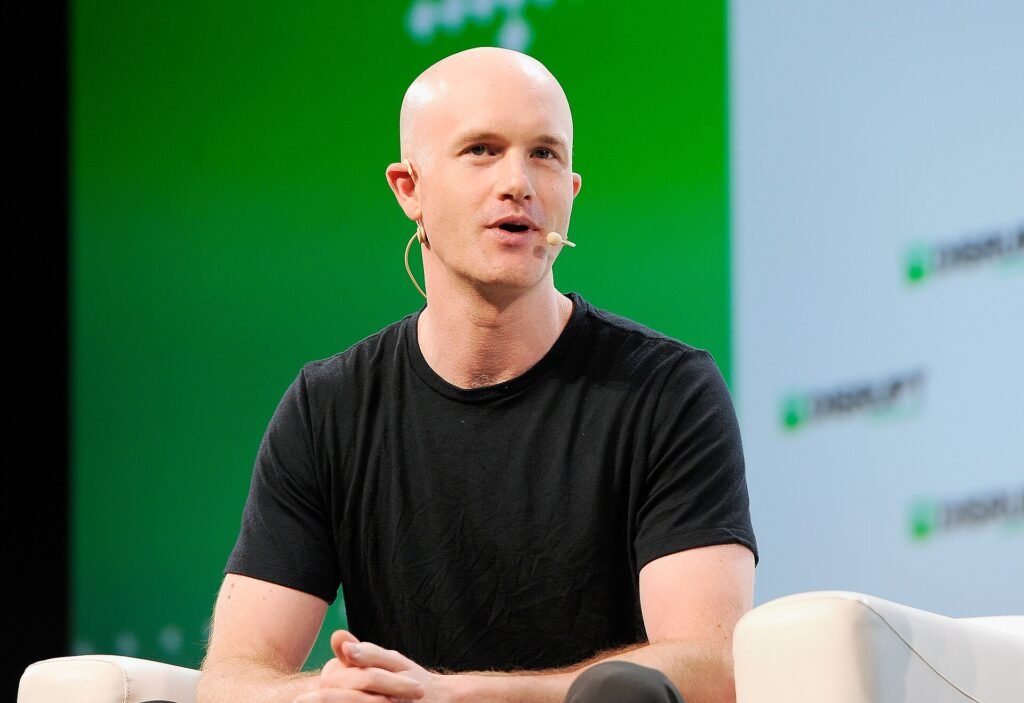
Featured image: Coinbase co-founder and CEO Brian Armstrong at TechCrunch Disrupt in 2018. He announced the remote-first policy in May 2020. · Photo: TechCrunch / Wikimedia Commons, CC BY 2.0
How this article was made: researched and drafted with AI assistance by the 100xFounder editorial desk, using only the sources listed in it; every figure links to its source. Read our editorial policy, or report an error through our corrections policy.
Related stories



Sources
- Coinbase (Greenhouse job board) 4 Oct 2026229 roles; team and location counts; 11 India roles with INR base salaries; surges line and 3-application limit on all posts; generative AI skill on 211 posts; internships hybrid NY/SF
- Coinbase Careers 28 Aug 20263+ years; Go/Java; ₹4,408,400 base; remote-first not remote-only; surges; application limit
- Coinbase Careers 31 Aug 20268+ years; ₹9,424,500 base
- Coinbase Careers 23 Sep 20262+ years; ₹4,408,400 base
- Coinbase Careers 14 Sep 20265+ years; ₹6,612,600 base
- Coinbase Careers 28 Sep 2026Only hybrid Bangalore role; ₹2,755,300 base
- Coinbase 4 Oct 2026Not for the faint of heart; Apolitical; Remote-first, not remote-only wording; Championship team; Extraordinary ability route; mission
- Coinbase Blog (Brian Armstrong) 20 May 2020Remote-first definition; no disadvantage by location; hub offices; one floor in ten cities
- Coinbase Blog (Ankur Nandwani) 24 Mar 2021India business presence; work across locations in country of hire; physical office initially in Hyderabad
- Coinbase Blog 7 Sep 2021Tenets assessed; typical stages; pair programming failure point; production-grade code criteria; system design; Google Meet with cameras; crypto knowledge not mandatory
- interviewing.io (third-party; candidate and engineer reports) 4 Oct 2026Reported CodeSignal 70-min assessment, recruiter call, two-day onsite with three one-hour interviews, own IDE