Whatfix funding, valuation and new CEO Vara Kumar: the Bengaluru SaaS company explained
Whatfix funding explained: a $90M Series D at about $600M, a $125M Series E at an undisclosed value, pricing, rivals and new CEO Vara Kumar.
 Ishaan Vardhan23 Nov 2026 · 16 min read

Whatfix, the Bengaluru and San Jose software company that puts step-by-step help inside other companies’ apps, has raised two large disclosed rounds: a $90 million Series D led by SoftBank Vision Fund 2 in June 2021, reported at a valuation of around $600 million, and a $125 million Series E led by Warburg Pincus in September 2024, whose valuation was never disclosed. Since 8 September 2026 it has a new chief executive, co-founder Vara Kumar, who took over after co-founder and founding CEO Khadim Batti died on 1 September 2026.
The short read for buyers and founders: on the company’s own numbers, annual recurring revenue (ARR) grew 4.5x between the two rounds while the valuation, by the then-CEO’s account, rose only 50%, so investors paid far less per rupee of revenue in 2024 than in 2021. Below: what Whatfix sells, how pricing works, what each funding figure rests on, where its own numbers disagree, and what the leadership change means for Indian customers. Every figure comes from a page we opened on 20 November 2026.
Key takeaways
- Whatfix sells a digital adoption platform (DAP): in-app guidance, product analytics and Mirror, a simulated copy of an application for hands-on training and AI roleplay.
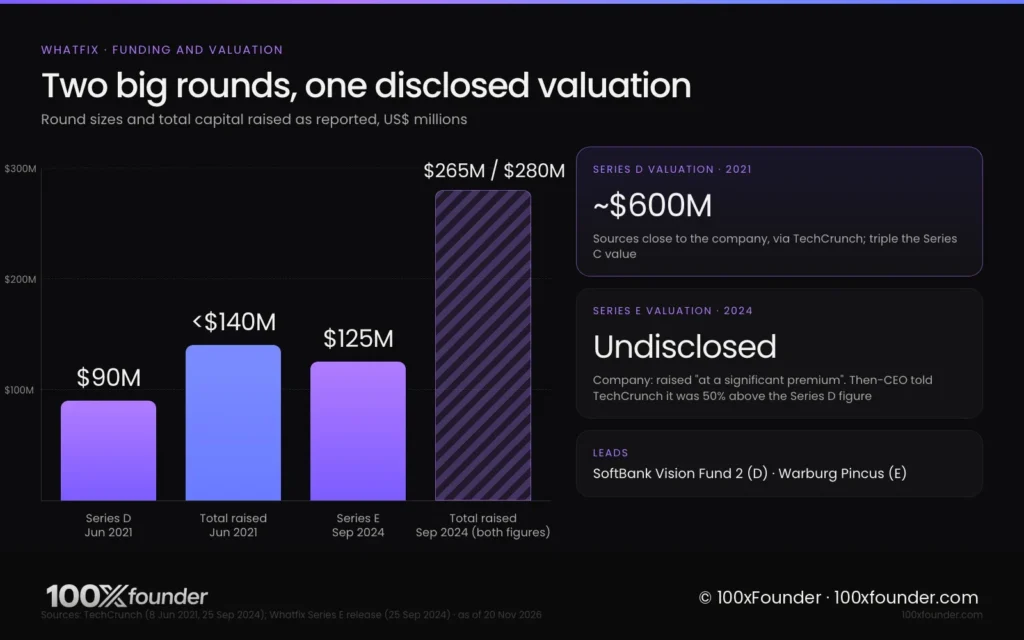
- Disclosed funding: $90 million Series D (June 2021, SoftBank Vision Fund 2) and $125 million Series E (September 2024, Warburg Pincus). TechCrunch put total capital raised at both $265 million and $280 million in the same 2024 article.
- The only reported valuation is “around $600 million” for the 2021 round, from sources close to the company. The 2024 round was raised “at a significant premium”, per Whatfix, at a figure the company has not published.
- Vara Kumar, co-founder and the company’s product and research architect, became CEO with immediate effect on 8 September 2026.
- Pricing is not published: a flat fee plus user licences, counted by employees with access or by monthly active users.
- The closest benchmark is WalkMe, which SAP bought for about $1.5 billion in equity value in September 2024, the same month Whatfix closed its Series E.
What Whatfix sells and who pays for it
Large companies buy expensive software (Salesforce, Workday, SAP, ServiceNow) and then find that employees use only part of it. Whatfix sits on top of those applications and shows people what to do, inside the screen they are already working in. TechCrunch described it in 2021 as working with Salesforce, Microsoft Dynamics, Oracle’s CRM, ServiceNow, SuccessFactors, SharePoint and Workday, and in principle with any web application, through a browser extension or an overlay that the customer’s IT team installs.
Whatfix’s pricing page, checked on 20 November 2026, lists three product lines:
- Digital Adoption Platform: guided Flows, Smart Tips (tooltips), Beacons, Pop-Ups, Task Lists, a Self Help wiki, surveys, auto-translation and automated testing that flags walkthroughs broken by a UI change. Plans cover web and desktop apps and, separately, mobile apps.
- Product Analytics: usage and adoption tracking for enterprise applications, with session replay and PII masking sold as an add-on. The Standard analytics plan is included free with any DAP web and desktop plan.
- Mirror: automatic screen capture builds an interactive replica of an application, so trainees can practise without touching live data; it adds AI roleplay in voice and chat with instant feedback, and AI-assisted PII redaction.
The buyers are enterprises and public bodies. The Series E release named Arrow Electronics, Schneider Electric and Avnet as customers and Microsoft, Salesforce, Infosys and Accenture as partners. The September 2026 release lists Shell, Schneider Electric, Mercedes-Benz, Heineken and UPS Supply Chain Solutions among its Fortune 500 customers. In 2021, about 75% of its business came from the US and 18% from Europe, according to TechCrunch.
How it works, in plain language
Think of Whatfix as a layer of sticky notes and a satnav laid over another company’s software. A content author, usually someone in training or IT, records a walkthrough once with a no-code editor: “click here, fill this field, choose this option”. From then on, every employee who opens that screen sees the steps in context. The same layer records where users stall or abandon a task, which feeds the analytics product, and the walkthroughs can be exported as videos, slide decks, PDFs or knowledge-base articles.
Mirror handles training before go-live. Rather than giving trainees a sandbox copy of the real system, it captures the screens and turns them into a clickable simulation.
The pitch has shifted with AI. In September 2024, TechCrunch reported the platform supported about 750 applications and that Whatfix was experimenting with AI agents that take actions inside some apps, closer to robotic process automation than to tooltips. By September 2026 the company was describing itself as an “agentic” DAP built on ScreenSense, a layer it says reads a user’s context and intent to guide them in real time, automate support and flag where processes stall. The 2024 release counted four new products launched since 2021, five US patents granted and 18 more pending. Those are company statements; independent benchmarks of the agent features were not available on the pages we read.
Pricing: no list price, a flat fee plus licences
Whatfix does not publish prices in rupees, dollars or any other currency. Its pricing page (checked 20 November 2026) offers Standard, Premium and Enterprise plans, each behind “Get a Demo” or “Talk to Sales”, and explains the model in its FAQ:
- Every product and plan has a flat fee plus user licence fees.
- For employee-facing apps, a licence equals the total number of users with access to the application where Whatfix runs.
- For customer-facing apps, a licence equals monthly active users (MAUs).
- A free trial is offered, and the company says it gives discounts based on need.
- Standard support runs 24 hours a day, Monday to Friday. Enterprise plans add multi-app or unlimited deployments, and professional services (a Digital Adoption Assistant or a Program Manager) are sold separately.
For a buyer this means the bill scales with headcount on the target application, not with how many people author content. A 2,000-person sales team on one CRM will be priced on 2,000 licences. If you are working out what that does to your own unit economics, our guide to ARR, burn, CAC and NRR covers the vocabulary vendors will use in the negotiation.
Funding, valuation and revenue: what each figure rests on
| Item | Figure | As of | Source |
|---|---|---|---|
| Series D | $90 million, led by SoftBank Vision Fund 2; Eight Roads, Sequoia Capital India, Dragoneer, F-Prime and Cisco Investments also invested | 8 Jun 2021 | TechCrunch |
| Series D valuation | Around $600 million, triple the Series C value (sources close to the company) | 8 Jun 2021 | TechCrunch |
| Total raised after Series D | Just under $140 million | 8 Jun 2021 | TechCrunch |
| Series E | $125 million, led by Warburg Pincus, with SoftBank Vision Fund 2 | 25 Sep 2024 | Whatfix release |
| Series E valuation | Not disclosed; “a significant premium” (company); 50% above the Series D valuation (Batti to TechCrunch) | 25 Sep 2024 | Whatfix release; TechCrunch |
| Total capital raised | $280 million and “$265 million”, both in the same article | 25 Sep 2024 | TechCrunch |
| ARR growth | 4.5x since the 2021 round; products launched since 2021 made up 15% of revenue | 25 Sep 2024 | Whatfix release |
| Revenue in dollars or rupees | Not published | 20 Nov 2026 | None found |
Two cautions. First, the $600 million figure was never disclosed by Whatfix; TechCrunch attributed it to sources close to the company. Second, TechCrunch’s 2024 writer worked out a Series E valuation of about $900 million by applying Batti’s “50% higher” to that $600 million. That is the publication’s arithmetic, not a company figure, so we do not treat it as Whatfix’s valuation. The September 2026 release lists Warburg Pincus, SoftBank Vision Fund 2, Dragoneer, Peak XV Partners, Eight Roads and Cisco Investments as backers. Several also appear in our list of top VC firms in India.
Why the numbers moved: 4.5x revenue, 1.5x valuation
The most useful figure for anyone pricing a SaaS company is not the valuation itself but how it moved against revenue. Whatfix said ARR grew 4.5x since the 2021 round. Batti put the 2024 valuation 50% above 2021’s. Dividing one by the other, the value investors placed on each dollar of ARR in 2024 was roughly one-third of what they paid in 2021 (1.5 ÷ 4.5). That is our arithmetic on the company’s own ratios, not a disclosed multiple, and it holds only if both statements use the same base.
Three things on the record help explain it:
- 2021 was priced for speed. TechCrunch reported in June 2021 that revenue had grown 100% quarter on quarter for six months and that the Series D tripled the Series C valuation. A round struck at that pace leaves little room for the next one to rise as fast as revenue.
- The category stayed small in absolute terms. TechCrunch reported in 2024 that DAP vendors together generated roughly $646 million in revenue in 2022, the same year venture investment in DAPs rose sixfold to $470 million. When one year’s funding equals about three-quarters of the whole category’s revenue, later rounds tend to be priced more cautiously.
- Insiders stayed in. SoftBank Vision Fund 2, which led the 2021 round, put money into the 2024 round too, and Warburg Pincus’s Narendra Ostawal said in the release that Whatfix could capitalise on “the tailwinds” in the DAP market. A new lead plus a returning investor at a higher price is a better signal than a flat or down round, even with a compressed multiple.
The release said the money would go to acquisitions and product work, and to growing in the US, Europe and Asia-Pacific with a push into the public sector.
For scale, SAP paid $14.00 a share for WalkMe, about $1.5 billion in equity value and a 45% premium to WalkMe’s closing price on 4 June 2024. That is the one hard price on a large DAP business. Whatfix’s own value after 2024 is not public, so the gap between the two should not be read as a discount or a premium.
Founders and the 2026 leadership change
Khadim Batti was co-founder and founding CEO. TechCrunch reported in 2024 that he and Vara Kumar met while working at Huawei and first built an SEO tool called SearchEnabler; customers struggled to act on its suggestions, and that gap led them to build software that teaches people how to use other software. Whatfix’s about page tells the same origin story and lists Batti as founding CEO from 2014 to 2026.
On 8 September 2026, Whatfix announced that Batti had died suddenly on 1 September 2026 and that Vara Kumar was appointed CEO with immediate effect. In its release, the company describes Kumar as the architect of its product and research strategy since the founding; TechCrunch’s 2021 article lists him as CTO. Kumar paid tribute to Batti in the release as a leader, partner and close friend, and said the executive team would stay committed to the vision the two had shared for twelve years. The company says it continues to operate across all regions under Kumar, the executive team and the board.
The about page lists the wider leadership, including Vispi Daver (sales and partnerships, and an early investor) and Amit KKS (chief financial officer, based in India).
What changes for customers? On the record, very little. The release stresses continuity, and the new CEO is the co-founder who ran product, not an outside hire. The open questions are strategic: TechCrunch reported in 2024 that the company planned more acquisitions (it had bought Airim, Nittio Learn and Leap.is) and was experimenting with AI agents that act inside apps, and Batti declined to say whether an IPO was planned. Customers renewing in 2027 can reasonably ask their account team about the roadmap for those agent features, and whether named customer-success contacts are changing.
Growth and traction, from sourced figures only
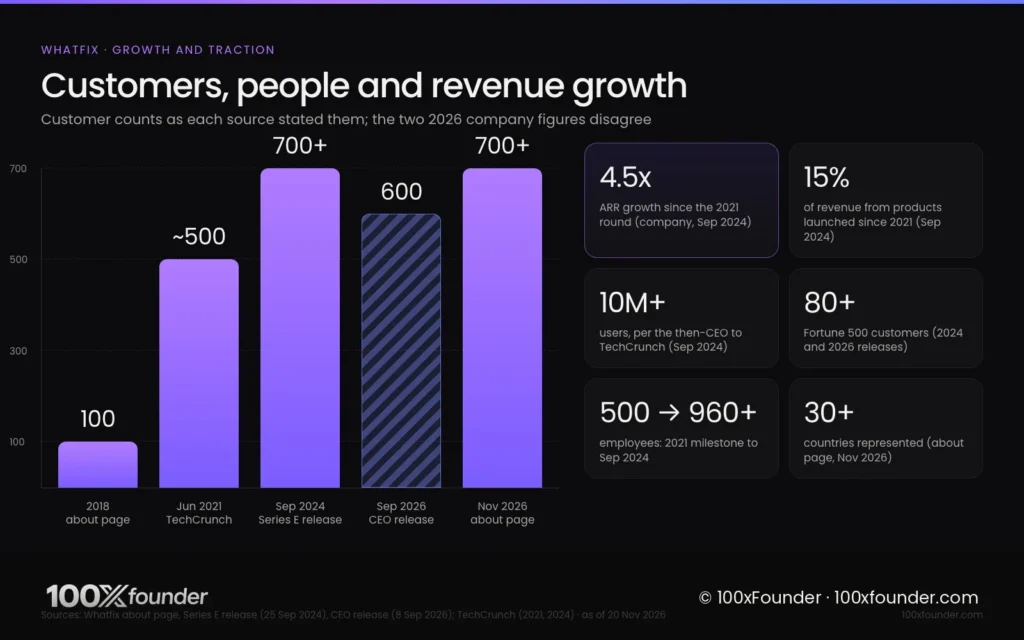
- Customers: first India customer (Flipkart) and first international customer (Université d’Angers) in 2014; 100 customers in 2018; about 500 by June 2021 (TechCrunch); 700 in September 2024; “700+” on the about page in November 2026, but “600 enterprises” in the September 2026 release.
- Fortune 500: crossed 50 Fortune 500 customers in 2021 (about page); “80+” in both the 2024 and 2026 releases.
- Users: over 10 million, Batti told TechCrunch in 2024. That is a total across customers, not a per-company figure.
- Team: 500 employees in 2021 (about page); over 960 by September 2024 after doubling, with new offices in Singapore, Germany, Australia and India (TechCrunch).
- Revenue pace: revenue grew 100% quarter on quarter for the six months before June 2021 (TechCrunch); ARR grew 4.5x between the 2021 round and September 2024 (company).
- Footprint: “30+ countries represented” and 24×7 support claimed on the about page; seven offices across the US, India, UK, Germany, Singapore and Australia per the 2024 release.
How Whatfix compares with alternatives
| Product | Ownership | Public pricing (checked 20 Nov 2026) | Best read as |
|---|---|---|---|
| Whatfix | Private; Warburg Pincus and SoftBank Vision Fund 2 among investors | None; flat fee plus licences by users with access or MAUs | Enterprise DAP with analytics and simulation training |
| WalkMe | Part of SAP since 12 Sep 2024 (equity value about $1.5 billion) | Not reviewed for this piece | DAP folding into SAP’s Joule copilot |
| Pendo | Private | Base, Core and Ultimate tiers, all “request pricing”, custom MAU volume; a free tier | Product analytics plus in-app guides, product-team led |
| Userpilot | Private | Starter $299 a month (up to 2,000 MAUs); Growth from $849 a month; Enterprise on request | Lower-cost onboarding and analytics for SaaS products |
The strongest comparison is WalkMe, the other large DAP. SAP completed its purchase on 12 September 2024 at about $1.5 billion in equity value, a 45% premium to WalkMe’s share price on 4 June 2024, and said WalkMe’s technology would feed context-aware help into its Joule copilot, according to SAP News. For a company that runs mostly on SAP, that tie-in matters; for a mixed stack of Salesforce, Workday and home-grown tools, an independent vendor such as Whatfix may be the simpler choice.
Pendo and Userpilot come from the product-team side: they are usually installed in a SaaS company’s own product to onboard its customers, not in third-party tools used by employees. Userpilot is the only one of the four that prints a price. Apty and Userlane were named as direct competitors in TechCrunch’s 2021 article; Apty’s pricing page says all features are included from day one but gives no figures.
What it means for Indian businesses
- Local entity: Whatfix’s privacy notice (last updated 13 October 2025) is issued by Whatfix Private Limited, formerly Quicko Technosoft Labs Private Limited, incorporated in India with its registered office in HSR Layout, Bengaluru. An Indian contracting party can simplify procurement for Indian buyers; the pricing page does not say whether invoices are raised in rupees or how GST is shown, so ask sales.
- Price in ₹: none published. Expect a quote, and compare it against the employee count on the target app, because that drives licence cost.
- Data: the pricing page lists “Data Residency”, meaning a choice of the Whatfix data centre for the deployment, and both cloud and self-hosted deployment, with some Standard and Premium features unavailable when self-hosted. It does not name an India region. The privacy notice says the company processes personal data in the USA and India. Buyers preparing for the DPDP Rules should ask for the region list and sub-processors in writing.
- Support: Standard support is 24 hours a day, five days a week; the about page claims 24×7 support. Confirm which applies to your plan.
- Who it suits: Indian IT services firms, banks, insurers and large employers rolling out CRM, HRMS or ERP systems to thousands of staff. Whatfix’s own industry pages list banking, insurance, financial services, pharma and the public sector, and its application categories include CRM, ERP, HCM, applicant tracking and procurement. A 20-person startup onboarding its own users will usually find a self-serve tool with a published price easier to evaluate.
- Questions to put to sales: the licence count basis for your app (users with access or MAUs), whether ScreenSense and agent features cost extra, the data region, invoicing currency and GST treatment, and support hours on your tier. Our free founder tools help size that spend.
- For Indian SaaS founders: Whatfix is a Bengaluru-built enterprise product that sells mostly to US buyers (about 75% of business in 2021). Its path, from a failed SEO tool to a category product, then a 2024 round where revenue grew far faster than valuation, is a realistic template of how global SaaS is priced after a boom.
Caveats
- Founding year: Whatfix says 2014 (about page and the 2026 release); TechCrunch’s 2024 article says the pair launched it in 2013. We use 2014, the company’s own date.
- Customer count: 600 (September 2026 release) against 700+ (about page and 2024 release). The company has not explained the difference; it may reflect a different definition, but we have no source for that.
- Total funding: $265 million or $280 million, both in one TechCrunch article. We show both.
- Valuation: only the 2021 figure has been reported, and only through sources. Any number for 2024 or 2026 is unconfirmed.
- Revenue: only growth multiples are public, not absolute revenue.
- ARR period: Whatfix’s release says ARR grew 4.5x “since the 2021 round”; TechCrunch’s 2024 article calls it 4.5x year on year. We use the company’s wording, which also drives our 1.5 ÷ 4.5 comparison.
- Self-reported claims: product, patent, award and customer-result figures come from Whatfix’s own pages.
How we compiled this
On 20 November 2026 we read Whatfix’s September 2026 CEO announcement, its September 2024 Series E release, its about page, its pricing page and its privacy notice; TechCrunch’s June 2021 and September 2024 funding reports; SAP’s September 2024 release on completing the WalkMe deal; and the public pricing pages of Pendo, Userpilot and Apty. Figures are quoted with the date their source gives. Where two sources disagree, both are shown. Details about Khadim Batti’s death are limited to what Whatfix itself announced.
FAQ
How much funding has Whatfix raised?
TechCrunch reported in September 2024 that Whatfix had raised $280 million in total, while quoting the then-CEO in the same article on “$265 million” of capital. The two disclosed recent rounds are a $90 million Series D in June 2021 led by SoftBank Vision Fund 2 and a $125 million Series E in September 2024 led by Warburg Pincus.
What is Whatfix’s valuation?
The last reported figure is around $600 million for the June 2021 Series D, from sources close to the company cited by TechCrunch. Whatfix said its 2024 Series E came “at a significant premium” and Khadim Batti told TechCrunch it was 50% above the Series D, but the company has not published a figure.
Who is the CEO of Whatfix now?
Co-founder Vara Kumar became CEO on 8 September 2026, with immediate effect, according to Whatfix. He succeeded co-founder and founding CEO Khadim Batti, who died on 1 September 2026. Kumar had led the company’s product and research strategy since it was founded.
Is Whatfix an Indian company?
It started in Bangalore and is co-headquartered in Bengaluru and San Jose, per TechCrunch. Its privacy notice is issued by Whatfix Private Limited, incorporated in India, and its about page also lists a registered office in Singapore. Most of its 2021 revenue came from the US.
Why did Whatfix’s valuation rise less than its revenue?
Whatfix said ARR grew 4.5x after its 2021 round, while Khadim Batti said the 2024 valuation was 50% higher than 2021’s. On those ratios, investors paid about a third as much per dollar of ARR in 2024. The 2021 round came after six months of 100% quarter-on-quarter growth and at triple the previous valuation, which set a high bar.
Who are Whatfix’s investors?
Whatfix’s September 2026 release lists Warburg Pincus, SoftBank Vision Fund 2, Dragoneer, Peak XV Partners, Eight Roads and Cisco Investments. Warburg Pincus led the 2024 Series E and SoftBank Vision Fund 2 led the 2021 Series D.
Is Whatfix planning an IPO?
No plan has been announced. In September 2024 Khadim Batti declined to tell TechCrunch whether an IPO was planned, while noting Warburg Pincus’s record of taking companies public. The 2026 release on Vara Kumar’s appointment does not mention one.
How much does Whatfix cost?
Whatfix does not publish prices. Its pricing page says each plan has a flat fee plus user licence fees: employees with access for internal apps, or monthly active users for customer-facing apps. A free trial and need-based discounts are offered; a quote comes after a demo.
What are the main Whatfix alternatives?
WalkMe, now owned by SAP after a deal completed in September 2024, is the closest large rival. Pendo and Userpilot cover in-app guides and product analytics for SaaS teams, and Userpilot publishes prices from $299 a month. Apty and Userlane were named as direct competitors by TechCrunch in 2021.
Sources
- Whatfix, “Whatfix Names Co-Founder Vara Kumar as Chief Executive Officer”, 8 September 2026 (whatfix.com newsroom)
- Whatfix, “Whatfix Raises $125 Million Series E”, 25 September 2024 (whatfix.com newsroom)
- Whatfix, “About Us”, accessed 20 November 2026 (whatfix.com)
- Whatfix, “Whatfix Pricing”, accessed 20 November 2026 (whatfix.com)
- Whatfix, “Privacy Notice”, last updated 13 October 2025 (whatfix.com)
- TechCrunch, “Whatfix nabs $90M to help workers onboard and get the most out of their IT stacks“, 8 June 2021
- TechCrunch, “Whatfix raises $125M to provide in-app guides to users“, 25 September 2024
- SAP News, “SAP Completes Acquisition of WalkMe”, 12 September 2024 (news.sap.com)
- Pendo, “Pricing”, accessed 20 November 2026 (pendo.io)
- Userpilot, “Pricing”, accessed 20 November 2026 (userpilot.com)
- Apty, “Digital Adoption Platform Pricing”, accessed 20 November 2026 (apty.ai)
Related stories



Sources (11)
- Whatfix 8 Sep 2026Vara Kumar CEO with immediate effect; Batti's death on 1 Sep 2026; co-founded 2014; 600 enterprises, 80+ Fortune 500; named customers; investor list; ScreenSense; agentic DAP positioning; industries and app categories
- Whatfix 25 Sep 2024$125M Series E led by Warburg Pincus with SoftBank Vision Fund 2; significant premium; 4.5x ARR; 15% revenue from new products; 700+ customers; 7 offices; patents; four new products; use of funds (acquisitions, US/EMEA/APAC, public sector); four new products; five US patents and 18 pending; Ostawal quote
- Whatfix 20 Nov 20262014 founding and timeline (Flipkart, 100 customers 2018, San Jose office 2018, 500 employees 2021, 50 Fortune 500 2021, Leap 2022, Product Analytics 2023); 700+ customers, 30+ countries, 24x7 support; leadership; Singapore registered office
- Whatfix 20 Nov 2026Standard/Premium/Enterprise plans; flat fee plus user licences; free trial; discounts; 24/5 support; data residency; cloud and self-hosted; Mirror and Product Analytics features; session replay is an add-on
- Whatfix 13 Oct 2025Whatfix Private Limited (formerly Quicko Technosoft Labs), incorporated in India, Bengaluru office; personal data processed in USA and India
- TechCrunch 8 Jun 2021$90M Series D led by SoftBank Vision Fund 2; ~$600M valuation via sources, triple Series C; under $140M total; ~500 customers; 75% US / 18% Europe; 100% QoQ growth; Kumar as CTO; co-HQ San Jose and Bangalore; competitors Apty, Userlane
- TechCrunch 25 Sep 2024Series E 50% above Series D per Batti; 2013 founding; Huawei and SearchEnabler origin; 10M+ users, 700 customers; 960+ employees; $280M and $265M totals; acquisitions; AI agents; IPO not discussed; ~750 apps supported; DAP vendor revenue ~$646M in 2022; VC in DAPs $470M in 2022; ARR 4.5x year on year wording
- SAP News 12 Sep 2024SAP completed WalkMe acquisition; ~$1.5B equity value; 45% premium; Joule; $14.00 per share
- Pendo 20 Nov 2026Base/Core/Ultimate tiers, request pricing, custom MAU volume, free tier
- Userpilot 20 Nov 2026Starter $299/mo up to 2,000 MAUs; Growth from $849/mo; Enterprise on request
- Apty 20 Nov 2026all features included; no published prices