Gupshup valuation, funding and revenue: from $1.4B unicorn to an unpriced 2025 round
Gupshup's last priced valuation was $1.4B in 2021; Fidelity's marks fell to $278M by January 2026. Every round, mark and revenue figure, with dates.
 Ishaan Vardhan24 Nov 2026 · 16 min read
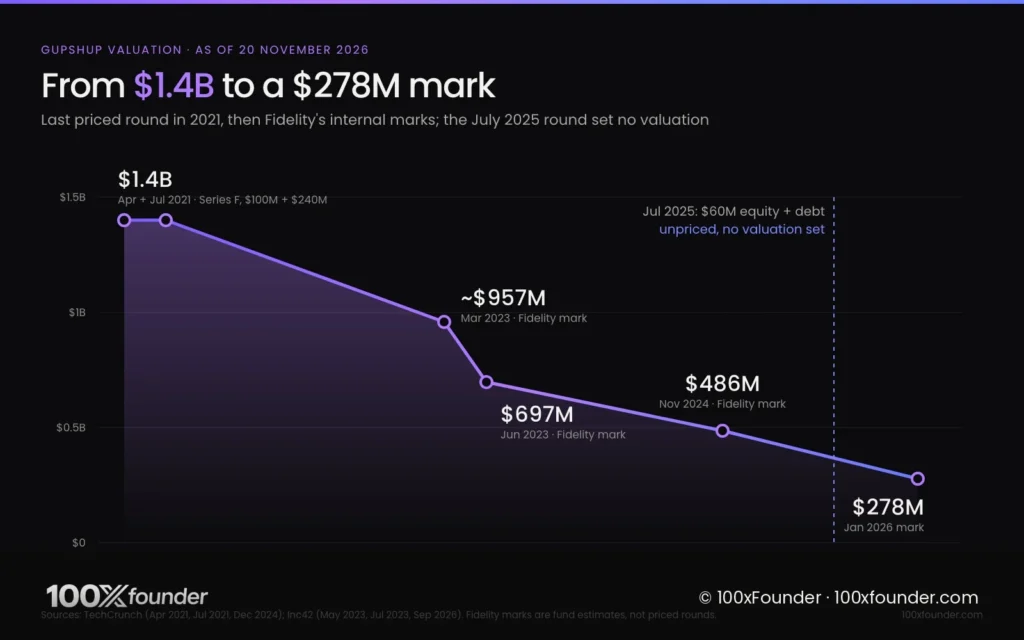
Gupshup’s last priced valuation is still the $1.4 billion set in its 2021 Series F, but its own investor Fidelity now carries the company at a fraction of that: about $486 million in November 2024 and $278 million in a January 2026 mark, according to TechCrunch and Inc42. The $60 million equity-and-debt round Gupshup announced in July 2025 set no new price, so there is no fresh valuation to replace either number.
That gap matters if you run customer messaging on Gupshup or sell against it. The business behind the valuation has not shrunk: founder Beerud Sheth told Inc42 in September 2026 that Gupshup did roughly $350 million of business in FY26 and is profitable. What changed is what investors will pay for a messaging company that sits on top of WhatsApp. This explainer lays out every round, every mark and every revenue figure we could source, with dates, and flags where the sources disagree.
Key takeaways
- Gupshup raised $340 million in 2021 in two Series F tranches ($100 million in April from Tiger Global, $240 million in July), both at a $1.4 billion valuation, according to TechCrunch.
- Fidelity’s marks on its stake implied about $957 million (March 2023), $697 million (June 2023), $486 million (November 2024) and $278 million (January 2026), per Inc42 and TechCrunch.
- The July 2025 round of more than $60 million in equity and debt, from Globespan Capital Partners and EvolutionX Debt Capital, was not priced, TechCrunch reported.
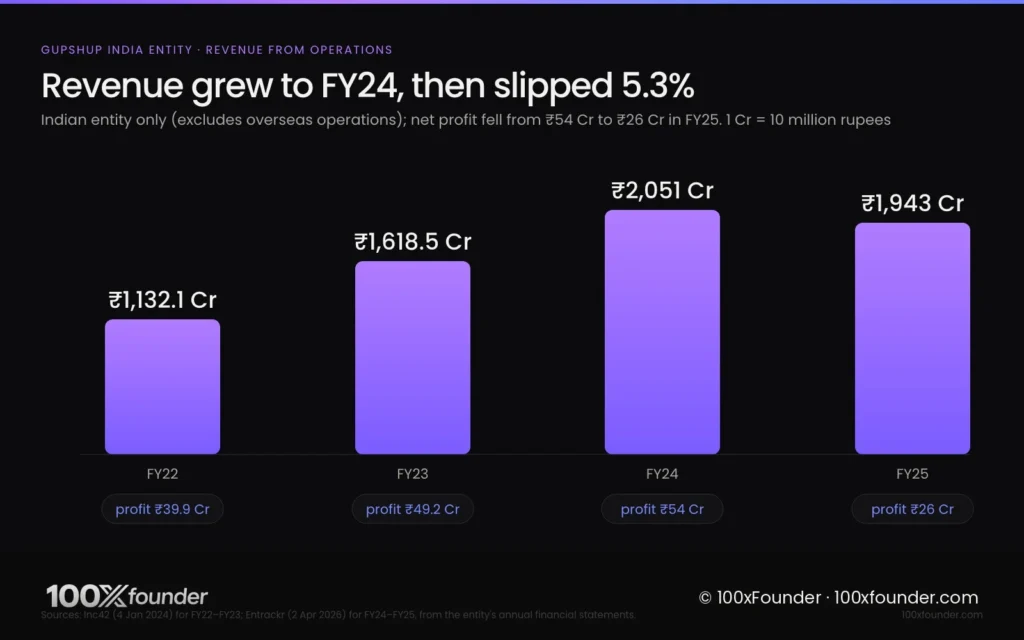
- Gupshup’s India entity booked ₹1,943 crore of operating revenue in FY25, down 5.3% from ₹2,051 crore, and net profit halved to ₹26 crore, according to Entrackr.
- Gupshup’s India entity spent ₹0.99 to earn each rupee in FY25, with a 3.91% EBITDA margin, against 17.2% at listed rival Tanla Platforms, according to Entrackr and Tanla’s FY25 results.
- Gupshup’s self-serve WhatsApp fee is a flat US$0.001 per message on top of Meta’s charge, per its pricing page checked on 20 November 2026.
What Gupshup does and who pays for it
Gupshup is a conversational messaging and AI platform that businesses use to run marketing, commerce and customer support over WhatsApp, RCS, SMS, voice and Instagram, according to the company’s website. It is a Meta Business Solution Provider, which means businesses can get access to the WhatsApp Business API through it, as Inc42 explained in September 2026.
The paying customers are mostly mid-size and large businesses. Gupshup says it has more than 50,000 customers and handles over 120 billion messages a year, according to its July 2025 funding press release. Its homepage displays the logos of Netflix, HSBC, Unilever, Tata, Flipkart and JioHotstar. Inc42 reported that some of Gupshup’s largest customers spend as much as ₹10 crore a month.
The company did not start here. For its first six years Gupshup was a consumer group-messaging service in India with tens of millions of users, and it pivoted to enterprise messaging after it could neither subsidise SMS costs nor sell ads in messages, Sheth told TechCrunch in 2021.
How Gupshup works, in plain language
Gupshup sits between a business and the messaging channels its customers already use. A bank, retailer or app connects its systems to Gupshup once, and Gupshup sends and receives messages on WhatsApp, RCS, SMS and voice on its behalf, with bots or AI agents answering and handing hard cases to human staff.
The product line in late 2026, as listed on Gupshup’s website and in its July 2025 release, covers:
- Conversation Cloud: campaigns, journeys and workflow automation, plus an AI co-pilot for support agents.
- AI agents: chat and voice agents for lead qualification, payment follow-ups, cart recovery and support calls, built on Gupshup’s own ACE LLM.
- Click-to-chat ads and an AI campaign copilot for marketing teams.
- RCS business messaging and Verified Business Chat in Truecaller.
- Super Agent: an orchestration layer introduced in April, Inc42 reported in September 2026, that lets teams set up messaging, campaigns, payments and analytics through plain-language instructions.
Much of this came through acquisitions. Gupshup bought RCS specialist Dotgo in September 2021, cloud-telephony company Knowlarity in February 2022 and conversational AI firm AskSid in April 2022, according to Inc42. Knowlarity alone served more than 6,000 clients in 65 countries when the deal was announced, CXM Today reported, and Inc42 put the price at $100 million in its 2026 feature.
Gupshup pricing in 2026
Gupshup’s self-serve WhatsApp plan charges a flat US$0.001 per message, and Meta’s own WhatsApp fee is passed through at actual cost, according to Gupshup’s WhatsApp API pricing page checked on 20 November 2026. The page lists prices in US dollars only, with no rupee rates and no mention of GST.
| Item (self-serve) | Gupshup fee |
|---|---|
| Outbound template message | US$0.0010 per message |
| Session message, inbound or outbound | US$0.0010 per message |
| Outbound media above 64KB | Free |
| WhatsApp voice calls | US$0.0001 per second |
| Meta’s WhatsApp fee | Billed at actuals |
Source: Gupshup WhatsApp API self-serve pricing page, checked 20 November 2026. Enterprise pricing is quoted separately.
Two Meta changes affect what Indian customers actually pay. Meta began billing Indian businesses and solution providers in rupees on 1 January 2026, and accounts whose sold-to country is India must move to INR by 31 December 2026, according to Meta’s WhatsApp pricing documentation. From 1 October 2026 Meta also charges for service messages beyond 1,000 free per business number a month.
Gupshup’s newer voice AI is priced separately. Inc42 reported a self-serve rate starting at $0.035 (₹3.50) per minute.
Gupshup funding, valuation and revenue: every figure with its date
Gupshup’s funding history is short but large: one Series F in two tranches in 2021 and one mixed round in 2025, according to TechCrunch and the company. Everything after 2021 that looks like a valuation comes from Fidelity’s monthly marks on its own shares, not from a new round.
| Date | Event | Amount | Valuation | Source |
|---|---|---|---|---|
| 8 Apr 2021 | Series F, from Tiger Global | $100M | $1.4B (priced) | TechCrunch |
| 28 Jul 2021 | Series F extension (Fidelity, Tiger Global, Think Investments, Malabar and others; some secondary sales) | $240M | $1.4B (priced) | TechCrunch |
| 31 Mar 2023 | Fidelity cuts fair value of its stake by 31.6% | None | ~$957M (implied) | Inc42 |
| 30 Jun 2023 | Fidelity Blue Chip Growth Fund stake marked at $8.08M | None | $697M (implied) | Inc42, TechCrunch |
| 30 Nov 2024 | Stake marked at $5.62M, more than 65% below cost | None | $486M (implied) | TechCrunch |
| 22 Jul 2025 | Equity and debt (Globespan Capital Partners, EvolutionX Debt Capital) | $60M+ | Not priced | TechCrunch, company release |
| Jan 2026 | Fidelity mark, over 80% below $1.4B | None | $278M (implied) | Inc42 |
As of 20 November 2026. “Implied” values are what each outlet derived from Fidelity’s disclosed stake value; they are fund estimates, not prices paid.
On revenue, Gupshup has published few numbers. The ones on record:
| Period | Metric | Figure | Source |
|---|---|---|---|
| April 2021 | Annual run rate (global) | $150M, profitable | TechCrunch |
| FY22 | India entity operating revenue / net profit | ₹1,132.1 Cr / ₹39.9 Cr | Inc42 |
| FY23 | India entity operating revenue / net profit | ₹1,618.5 Cr / ₹49.2 Cr | Inc42 |
| FY23 | Global business, per Sheth | About $300M | Inc42 |
| FY24 | India entity operating revenue / net profit | ₹2,051 Cr / ₹54 Cr | Entrackr |
| FY25 | India entity operating revenue / net profit | ₹1,943 Cr / ₹26 Cr | Entrackr |
| FY26 | Global business, per Sheth | About $350M, profitable | Inc42 |
Crore (Cr) = 10 million. India-entity figures exclude overseas operations.
Why the 2025 round was unpriced
TechCrunch reported that the July 2025 round “was not priced”. Sheth told it that equity made up “a little more than half” of the $60 million, and Gupshup would not reveal the exact debt portion. Asked about unicorn status, he said founders focus on value and “the valuation will follow.” In practice an unpriced round lets a company raise money without putting a number on record below its last $1.4 billion price. TechCrunch’s own headline put it plainly: the round left Gupshup’s unicorn status “hanging”.
Why the valuation kept falling
Three things in the record explain why a profitable company with growing volumes lost most of its paper value.
- The 2021 price was a peak-market price. Both Series F tranches were set at $1.4 billion in 2021 with Tiger Global leading, and part of the July tranche was secondary sales, TechCrunch reported. Inc42 linked the January 2026 mark to a wider reset in software valuations, as investors question how durable traditional SaaS businesses are once AI agents arrive.
- Thin margins in the India entity. Entrackr reported that the India entity spent ₹0.99 to earn every rupee in FY25, with an EBITDA margin of 3.91%. Its largest cost, ₹1,245 crore booked as miscellaneous expenses that Entrackr described as likely solution-provider fees, was about 65% of total expenses. The same report put cash and bank balances at ₹7 crore against ₹1,590 crore of current assets at March 2025.
- Dependence on Meta’s rules. Meta switched WhatsApp from conversation-based to per-message pricing on 1 July 2025, made utility messages inside an open service window free that day, and from 1 October 2026 began charging for those utility messages and for service messages beyond 1,000 a month per business phone number, according to Meta’s pricing documentation. Each change alters what a business pays per conversation, and with it the volume flowing through providers like Gupshup. Meta’s own Business Agent, launched in 2026, moves WhatsApp into the AI layer Gupshup sells, Inc42 noted.
Put the January 2026 mark ($278 million) next to Sheth’s FY26 figure (about $350 million of business) and the fund is valuing Gupshup at roughly 0.8 times a year’s revenue, our arithmetic. Treat that ratio loosely: the mark is a fund estimate and the revenue is an unaudited founder statement.
What the money is for
Gupshup said it would use the 2025 funds to expand in India, the Middle East, Latin America and Africa and to scale adoption of its AI agents. Sheth has described an IPO as the next milestone: within 18 to 24 months in July 2025, per TechCrunch, and within 12 to 24 months in September 2026, per Inc42, possibly on Indian exchanges after moving its parent company from the US to India.
Founders and company
Beerud Sheth is Gupshup’s co-founder and CEO. He holds a B.Tech in computer science from IIT Bombay (1991) and an MS from MIT (1994), worked for about five years at Citibank and Merrill Lynch, and co-founded Elance in 1998, which later became Upwork, according to his IIT Bombay alumni award profile. He co-founded Webaroo in 2004 and led its pivot into mobile messaging under the Gupshup name, the same profile says.
Gupshup is headquartered in San Francisco and began in India, according to TechCrunch. Ravi Dugar, formerly of Awfis, joined as CFO in March 2026, Inc42 reported.
Growth and traction
Gupshup’s scale has grown in volume terms while India-entity revenue flattened. In April 2021 its clients sent more than 6 billion messages a month, TechCrunch reported; by July 2025 the company cited more than 120 billion messages a year. Sheth told TechCrunch in July 2025 that revenue had tripled since the 2021 round.
The India entity tells a more mixed story. Operating revenue rose from ₹1,132.1 crore in FY22 to ₹2,051 crore in FY24, then slipped 5.3% to ₹1,943 crore in FY25, while net profit fell from ₹54 crore to ₹26 crore, according to Inc42 and Entrackr. Entrackr reported an FY25 EBITDA margin of 3.91% and said the largest cost line, ₹1,245 crore, was likely fees paid to solution providers. Sheth told Inc42 the India entity does not represent the global business.
Costs have also been cut. Gupshup laid off at least 100 employees, about four months after an earlier round of close to 200 job cuts, according to Inc42 in September 2025. Inc42 reported in its 2026 feature that AI-related offerings now bring in about a quarter of revenue.
How Gupshup’s numbers compare with listed Indian rivals
Two listed Indian messaging companies give the clearest public benchmark, because they file full-year results. The India entity of Gupshup is far smaller on revenue and much thinner on profit.
| Company (FY25) | Revenue | Net profit | Net margin | Source |
|---|---|---|---|---|
| Route Mobile (consolidated) | ₹4,575.62 Cr (up from ₹4,023.29 Cr) | ₹333.93 Cr | 7.3% (our arithmetic) | Business Today |
| Tanla Platforms | ₹4,028 Cr (up 2.5%) | ₹507 Cr | 12.6% (our arithmetic); EBITDA margin 17.2% | Tanla FY25 results release |
| Gupshup (India entity only) | ₹1,943 Cr (down 5.3%) | ₹26 Cr | 1.3% (our arithmetic); EBITDA margin 3.91% | Entrackr |
FY25 = April 2024 to March 2025. Route Mobile’s figures are consolidated, per its results release, and Tanla’s are its reported full-year results; Gupshup’s are for its India entity only, so its global business is larger than shown.
The comparison does not make Gupshup a weaker product, but it explains investor caution: Route Mobile grew revenue about 14% in FY25 and Tanla held a double-digit net margin, while Gupshup’s India entity shrank and earned about a penny per rupee. Profit also fell at Route Mobile, from ₹388.84 crore in FY24, which points to pressure across Indian business messaging, not at Gupshup alone.
How Gupshup compares with alternatives
Gupshup competes on two fronts: global CPaaS providers selling APIs to developers, and Indian WhatsApp tools selling ready-made dashboards to small businesses. Here is how three alternatives price WhatsApp, from each vendor’s page checked on 20 November 2026.
| Provider | Model | Published price |
|---|---|---|
| Gupshup (self-serve) | Per-message platform fee plus Meta fee at cost | US$0.001 per message |
| Twilio | Per-message platform fee plus Meta template fee | US$0.005 per message, inbound or outbound |
| Interakt (Jio Haptik) | Monthly plan plus per-message rates in ₹ | Growth ₹2,799/month (+taxes); marketing message ₹0.958 to Indian numbers |
| AiSensy | Prepaid credits plus add-on products in ₹ | Marketing message ₹1.09; AI agent builder from ₹1,350/month |
Sources: vendor pricing pages for Gupshup, Twilio, Interakt and AiSensy, checked 20 November 2026. Interakt and AiSensy quote per-message rates in rupees; Gupshup and Twilio quote their own fee on top of Meta’s charge.
On raw platform fees Gupshup’s self-serve rate is a fifth of Twilio’s published fee. Small Indian businesses comparing it with Interakt or AiSensy should compare total cost per message, including Meta’s charge and any subscription, because the vendors present their prices differently. The bigger long-term competitor may be Meta itself, which launched Meta Business Agent with its own LLM and agent features in 2026, Inc42 reported.
What it means for Indian businesses
For an Indian business, the valuation markdown is a signal about investor appetite, not about service quality: Sheth told Inc42 the company is profitable, and Inc42’s and Entrackr’s reports on the India entity show a net profit in every year from FY22 to FY25. A few practical points follow from the sources above.
- Availability and billing: Gupshup’s page lists a self-serve WhatsApp plan priced in US dollars, with enterprise pricing on request; Meta’s own WhatsApp charges for Indian accounts move to rupees by 31 December 2026.
- GST and invoicing: Gupshup’s pricing page does not state GST treatment; ask sales for a GST invoice before committing.
- Data residency: Gupshup’s security page lists compliance badges (ISOQAR, AICPA, RBI, GDPR, CCPA, LGPD) but does not state where data is stored. Businesses preparing for the DPDP Rules should get this in writing; our DPDP compliance guide explains the 13 May 2027 deadline.
- Vendor risk: layoffs, a flat India top line and an IPO plan that still needs redomiciling are reasons to negotiate data-export terms, not reasons on their own to switch.
If you are choosing between messaging-led support tools and AI help desks, our roundup of the best AI customer support tools covers the help-desk side, and our free founder tools can help with the hiring and salary maths behind a support team.
Caveats and conflicts in the record
- Founding year: TechCrunch called Gupshup about 15 years old in April 2021 (about 2006) and said “17 years ago” in December 2024 (about 2007), while TechCrunch in July 2025 and Inc42 say 2004, the year Webaroo was founded.
- Countries: Gupshup’s homepage stats say 60+ countries served, its footer and July 2025 release say 130+, and TechCrunch’s July 2025 report said over 100.
- Total raised: TechCrunch said Gupshup had raised $150 million before 2021; adding the $340 million Series F and the $60 million 2025 round gives about $550 million including debt, our sum. Inc42 wrote in September 2025 that total funding “exceeds $480 million”. Gupshup publishes no lifetime total.
- Latest mark: Inc42 gives $278 million for January 2026. Entrackr reported in April 2026 that Fidelity’s Blue Chip Growth Fund valued its stake at $3.35 million against $16.2 million invested, implying about $280 million to $300 million.
- Revenue: “tripled since 2021” (TechCrunch, July 2025) and “about $350 million in FY26” (Inc42, September 2026) are both founder statements, measured differently from the 2021 run rate; none is an audited global figure.
This is reporting, not investment advice. Confirm figures with primary filings before using them in a financial decision.
How we compiled this
On 20 November 2026 we read TechCrunch’s five reports on Gupshup’s funding and Fidelity marks (2021 to 2025), Inc42’s reports on the 2023 markdowns, FY23 financials, the September 2025 layoffs and its September 2026 feature, Entrackr’s two April 2026 reports, Gupshup’s July 2025 press release, homepage, security page and WhatsApp pricing page, Meta’s WhatsApp pricing documentation, the Twilio, Interakt and AiSensy pricing pages, Route Mobile’s FY25 results as reported by Business Today, Tanla’s FY25 results release, and Sheth’s IIT Bombay alumni profile. Rupee figures are as reported and not converted; margins and the revenue multiple marked “our arithmetic” are simple divisions of the sourced figures. Where two sources differ, both are given above.
FAQ
What is Gupshup’s valuation in 2026?
Gupshup has no priced valuation newer than the $1.4 billion set in its 2021 Series F. Its investor Fidelity marked its stake at a level implying $278 million in January 2026, according to Inc42, and Entrackr reported a stake value implying about $280 million to $300 million in April 2026. The July 2025 round was unpriced.
Is Gupshup still a unicorn?
Not by its investors’ marks. Fidelity’s March 2023 cut implied about $957 million, below the $1 billion unicorn line, Inc42 reported, and later marks went lower. Gupshup has not raised at a price since 2021, so no round has confirmed or replaced the $1.4 billion figure.
How much funding has Gupshup raised?
Gupshup raised $340 million in its 2021 Series F and more than $60 million in equity and debt in July 2025, per TechCrunch and the company. TechCrunch also said it had raised $150 million before 2021. Inc42 put total funding above $480 million in September 2025; Gupshup does not publish a lifetime total.
What is Gupshup’s revenue?
Founder Beerud Sheth told Inc42 Gupshup did about $350 million of business in FY26 and is profitable. Its India entity reported ₹1,943 crore of operating revenue and ₹26 crore net profit in FY25, down from ₹2,051 crore and ₹54 crore in FY24, according to Entrackr.
How much does Gupshup charge for WhatsApp messages in India?
Gupshup’s self-serve plan charges US$0.001 per message on top of Meta’s WhatsApp fee, which it bills at cost, according to its pricing page checked on 20 November 2026. Meta’s own rate depends on the message category and destination country, and Indian accounts move to rupee billing by 31 December 2026.
Why did Gupshup’s valuation fall?
The $1.4 billion price was set in the 2021 funding boom, and later marks by Fidelity tracked a broader reset in software valuations, which Inc42 tied to doubts about traditional SaaS in the AI era. Gupshup’s India entity also showed thin economics: a 3.91% EBITDA margin and ₹0.99 spent per rupee earned in FY25, per Entrackr. Its business also depends on Meta, which changed WhatsApp pricing in July 2025 and again in October 2026.
How does Gupshup compare with Tanla and Route Mobile?
In FY25 Route Mobile reported ₹4,575.62 crore of consolidated revenue and ₹333.93 crore of profit, and Tanla Platforms ₹4,028 crore and ₹507 crore. Gupshup’s India entity reported ₹1,943 crore and ₹26 crore. Gupshup’s figure covers its India entity only.
Who owns Gupshup and who founded it?
Gupshup is a private company led by co-founder and CEO Beerud Sheth, who earlier co-founded Elance (now Upwork). Its 2021 investors include Tiger Global, Fidelity, Think Investments and Malabar Investments, and Globespan Capital Partners and EvolutionX Debt Capital backed its 2025 equity-and-debt round, per TechCrunch.
Sources
- TechCrunch, “Messaging platform Gupshup raises $100 million at $1.4 billion valuation“, 8 April 2021
- TechCrunch, “Business messaging platform Gupshup raises $240 million from Tiger Global, Fidelity and others“, 28 July 2021
- TechCrunch, “Fidelity deepens valuation cut for SaaS startup Gupshup“, 30 July 2023
- TechCrunch, “Gupshup investor cuts value of its stake by 65%, implying new valuation of $486M“, 30 December 2024
- TechCrunch, “Gupshup raises $60M in equity and debt, leaves unicorn status hanging“, 22 July 2025
- Gupshup, “Gupshup Secures Over $60 Million in Funding from Globespan and EvolutionX” (press release, gupshup.ai), 23 July 2025
- Inc42, “Fidelity Puts Gupshup Out Of The Unicorn League, Slashes Valuation To $957 Mn“, 31 May 2023
- Inc42, “Fidelity Cuts Gupshup’s Valuation By Another 8.4%“, 30 June 2023
- Inc42, “Markdown Season: Fidelity Gives Gupshup An Additional 20% Valuation Jolt“, 31 July 2023
- Inc42, “Gupshup’s FY23 Revenue Crosses INR 1,500 Cr Mark, Posts INR 49 Cr Profit“, 4 January 2024
- Inc42, “Enterprisetech Unicorn Gupshup Continues Acquisition Spree; Buys AI Startup AskSid“, 20 April 2022
- Inc42, “Exclusive: Gupshup Lays Off 100+ Employees In Cost-Cutting Exercise“, 4 September 2025
- Inc42, “Gupshup’s AI Rebuild: Can It Stay Ahead Of The Platforms It Runs On?“, 23 September 2026
- Entrackr, “Gupshup India’s profit falls 52% amid flat scale in FY25“, 2 April 2026
- Entrackr, “Fidelity slashes Gupshup’s valuation further to $300 Mn“, 2 April 2026
- Business Today, “Route Mobile Q4 earnings: Net profit falls 37%, board declares final dividend“, 8 May 2025
- Tanla Platforms, “Tanla Announces Fourth Quarter and FY25 Result” (results release, tanla.com), 24 April 2025
- CXM Today, “Gupshup acquires Knowlarity Communications“, 8 February 2022
- IIT Bombay Alumni, “Mr. Beerud Sheth“, accessed 20 November 2026
- Gupshup, homepage, security page and WhatsApp API self-serve pricing page (gupshup.ai), checked 20 November 2026
- Meta, WhatsApp Business Platform pricing documentation (developers.facebook.com), checked 20 November 2026
- Twilio, Interakt and AiSensy WhatsApp pricing pages, checked 20 November 2026
Related stories

Sources (27)
- TechCrunch 8 Apr 2021$100M Series F led by Tiger Global at $1.4B; $150M run rate; profitable; $150M raised before; 6B messages/month; pivot history; Sheth co-founded Elance
- TechCrunch 28 Jul 2021$240M Series F extension at $1.4B; investors; secondary sales
- TechCrunch 30 Jul 2023Fidelity Blue Chip Growth Fund stake $8.08M end-June 2023; $16.2M invested
- TechCrunch 30 Dec 2024Stake $5.62M end-Nov 2024, >65% cut, implied $486M; '17 years ago'
- TechCrunch 22 Jul 2025$60M equity+debt, unpriced, equity a little more than half; revenue tripled since 2021; 100+ countries; IPO 18-24 months; founded 2004
- Gupshup 23 Jul 2025$60M+ from Globespan and EvolutionX (equity and debt, split not stated); 50,000+ customers, 130+ countries, 120B+ messages; use of funds; products
- Inc42 31 May 2023Fidelity 31.6% cut as of 31 Mar 2023, ~$957M
- Inc42 30 Jun 2023Fidelity stake $10.15M May 2023; FY22 India financials context
- Inc42 31 Jul 2023Stake $8.08M end-June 2023; total valuation $697M (citing ET)
- Inc42 4 Jan 2024India entity FY22/FY23 operating revenue and net profit
- Inc42 20 Apr 2022Acquisitions: Dotgo Sep 2021, Knowlarity Feb 2022, AskSid Apr 2022
- Inc42 4 Sep 2025Layoffs of 100+, earlier ~200; total funding >$480M
- Inc42 23 Sep 2026FY26 ~$350M and FY23 ~$300M business per Sheth; $278M Jan mark; Knowlarity $100M; Super Agent; voice AI $0.035/min; Meta Business Agent; CFO Ravi Dugar; IPO 12-24 months; AI ~25% of revenue; ₹10 Cr/month customers; Jan 2026 markdown tied to broad software valuation reset in AI era
- Entrackr 2 Apr 2026India entity FY25 ₹1,943 Cr revenue, ₹26 Cr profit; FY24 ₹2,051 Cr, ₹54 Cr; EBITDA 3.91%; ₹1,245 Cr solution-provider fees; ₹0.99 spent per ₹1 earned; misc/solution-provider fees ~65% of expenses; cash ₹7 Cr vs current assets ₹1,590 Cr; ROCE 12.72%
- Entrackr 2 Apr 2026Fidelity stake $3.35M vs $16.2M; implied ~$280-300M
- CXM Today 8 Feb 2022Knowlarity: 6,000+ clients in 65 countries
- IIT Bombay Alumni 20 Nov 2026Sheth education and career; Webaroo 2004
- Gupshup 20 Nov 2026Self-serve fee $0.001/message; Meta fee at actuals; voice $0.0001/sec
- Gupshup 20 Nov 2026Products, channels, 60+/130+ countries, customer logos
- Gupshup 20 Nov 2026Compliance badges; no data-location statement
- Meta 20 Nov 2026INR billing from 1 Jan 2026, migrate by 31 Dec 2026; service-message charges from 1 Oct 2026; per-message pricing from 1 Jul 2025; utility in service window free from 1 Jul 2025
- Twilio 20 Nov 2026$0.005 per WhatsApp message
- Interakt 20 Nov 2026Growth ₹2,799/month; ₹0.958 marketing message
- AiSensy 20 Nov 2026₹1.09 marketing message; AI agent builder ₹1,350/month
- Business Today 8 May 2025Route Mobile FY25 revenue ₹4,575.62 Cr (FY24 ₹4,023.29 Cr), PAT ₹333.93 Cr (FY24 ₹388.84 Cr)
- Tanla Platforms 24 Apr 2025Tanla FY25 revenue ₹4,028 Cr up 2.5%, EBITDA ₹691 Cr, 17.2% margin, PAT ₹507 Cr
- Route Mobile 7 May 2025FY25 figures are consolidated