1Password says attacker copied customer names and emails via GitHub
1Password said on 25 Nov an attacker used an employee's GitHub account to copy customer names and emails. Vaults were untouched. What it means for teams.
 Ishaan Vardhan26 Nov 2026 · 5 min read
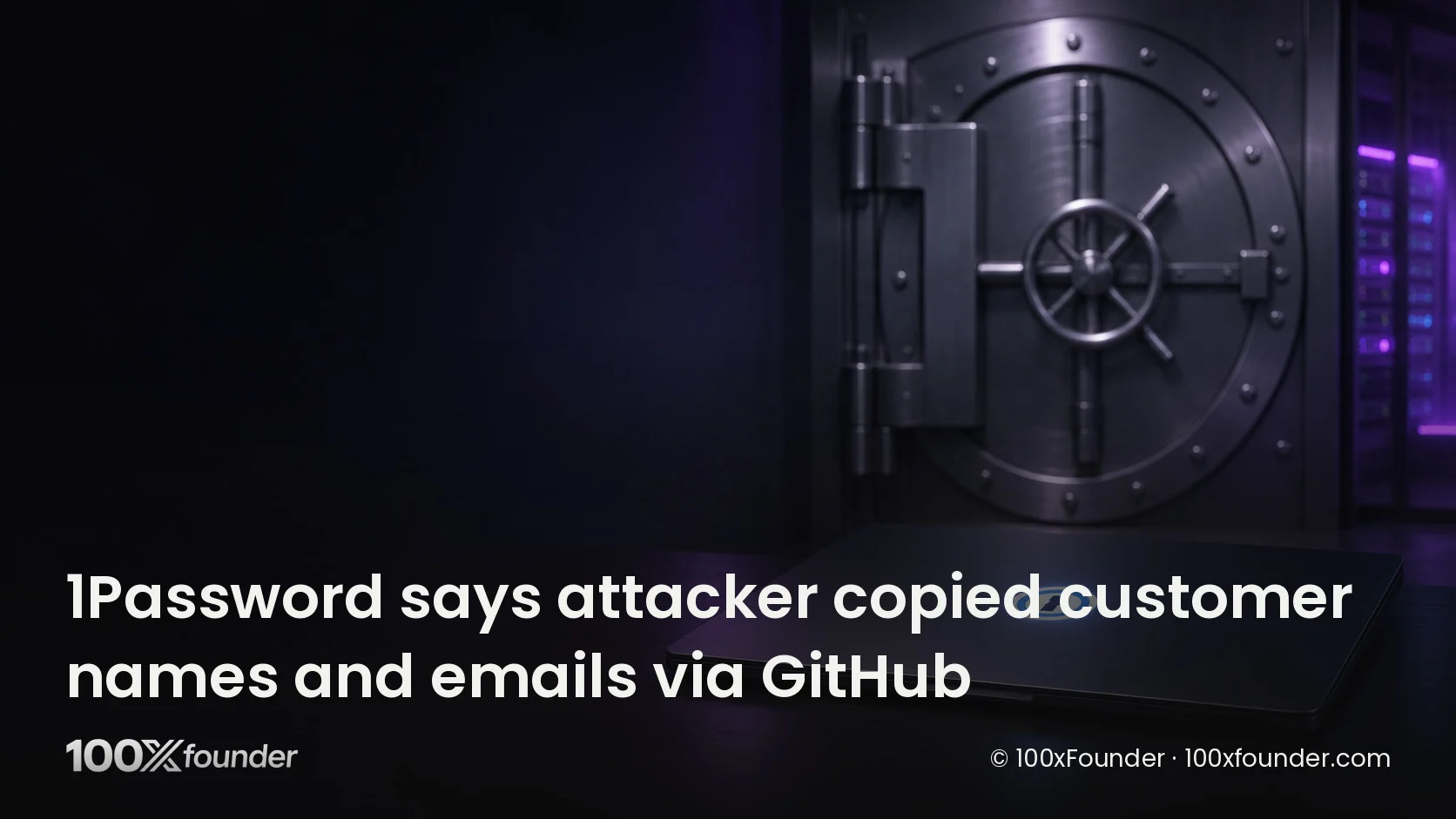
1Password disclosed on Wednesday, 25 November 2026, that an attacker used a hijacked employee GitHub account to push malicious code to its backend services and copy account records for a subset of customers, including the names and email addresses they use to sign in, according to the company’s incident update. 1Password says customer vaults, the items in them and the keys that protect them were not accessed, and that users do not need to change anything in their accounts.
For founders and IT leads whose teams keep credentials in 1Password, the practical risk is phishing: real customers’ names and emails are what an attacker needs to send convincing fake invites or recovery emails. The disclosure was the top story on Hacker News by points within hours, with more than 1,200 points and 520 comments by early Thursday (UTC).
Key takeaways
- 1Password began investigating a compromised employee GitHub account on 19 November 2026 and disclosed the incident on 25 November.
- The attacker copied names, emails, account IDs and some emailed tokens for a subset of customers, plus private source code.
- Vaults, vault keys, passwords, Secret Keys and recovery keys were not affected, according to 1Password.
- 1Password has not said how many customers were affected or how the GitHub account was compromised.
What happened at 1Password
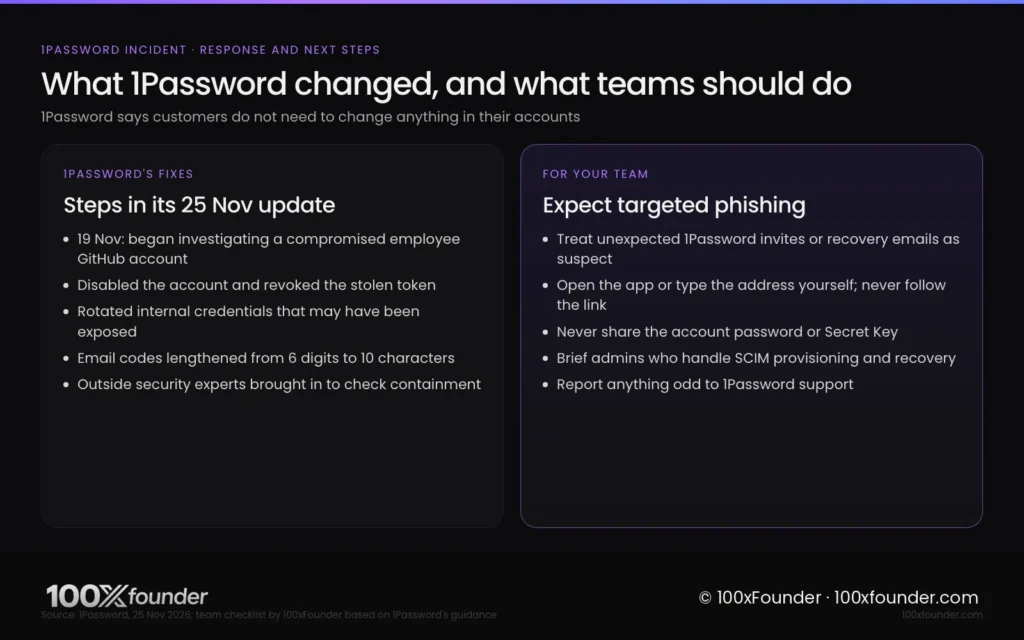
An attacker took over a 1Password employee’s corporate GitHub account and used it to push malicious code to backend services, which then downloaded customer account data, the company said. 1Password began investigating on 19 November, six days before disclosing it.
The company says it has disabled the account, revoked the stolen token, tightened GitHub and CI/CD controls, and brought in independent security experts. SiliconANGLE noted that 1Password did not say how the employee’s account was taken over, and BleepingComputer also reported the incident the same day.
What data was taken and what was not
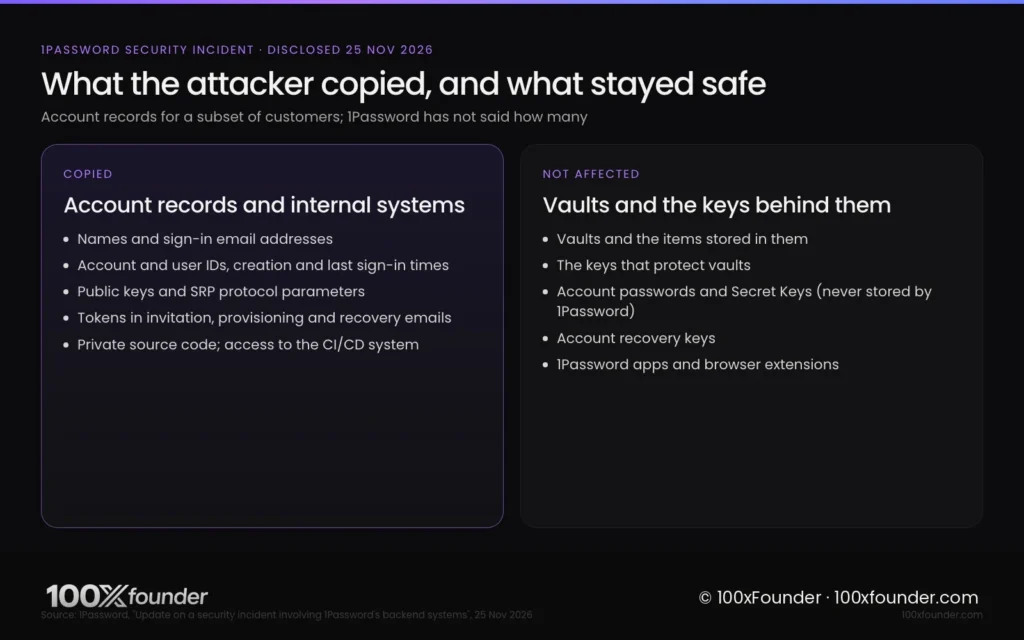
The 1Password breach exposed account records, not passwords: names, sign-in emails, account and user IDs, creation and last sign-in times, public keys, Secure Remote Password (SRP) parameters and tokens from certain invitation, provisioning and recovery emails, according to the company. Vaults, vault keys, recovery keys and the apps were untouched, and 1Password never stores account passwords or Secret Keys.
The attacker also copied private source code and reached 1Password’s CI/CD (build and deployment) system, which holds infrastructure secrets. 1Password says the code holds no user secrets and it has rotated every credential that may have been exposed.
Why the emailed tokens matter
The tokens in invitation and recovery emails are the most sensitive item on the list, but 1Password says none of them can open an account on its own. Completing a provisioning invite or an account recovery also requires a single sign-on (SSO) login or a six-digit code sent to the user’s registered email, according to the update.
A small number of users had a provisioning invite (SCIM Bridge or Hosted Provisioning) or recovery pending and were notified directly. 1Password lengthened the emailed code from six digits to ten alphanumeric characters and says it found no evidence of account takeovers.
What founders and IT teams should do now
1Password says customers need to change nothing, but should treat unexpected emails, texts or calls about invitations or account recovery as possible phishing; it will never ask for your password or Secret Key. For a startup, that means:
- Warn the team today. A convincing fake 1Password invite or recovery email is now likely.
- Never follow the link. Open the 1Password app or type 1password.com yourself.
- Brief your admins. Whoever handles provisioning or recovery should confirm any unexpected request with the person directly.
- Report anything suspicious to 1Password support, as the company asks.
The way this started is the wider lesson: one employee GitHub account with access to code and deployment pipelines was enough to reach customer data. Check who holds that access on your own team.
How this compares with earlier password-manager incidents
1Password has disclosed an incident before. In October 2023, it said an attacker had reached its Okta tenant using session data stolen in the breach of Okta’s customer support system, and it found no user data compromised in that case, as SiliconANGLE recalled. The difference this time is that data around accounts, not the vaults themselves, leaked: 1Password says vault secrets are encrypted with keys only users hold, so a server breach should not expose them.
What is still unknown
1Password, which SiliconANGLE says serves more than 200,000 businesses, has not said how many customers had records downloaded, how the employee’s GitHub account was compromised, or whether regulators have been notified. 1Password says it will update its post if the investigation changes anything, and we will update this article if it does.
FAQ
Was my 1Password vault hacked?
No, according to 1Password. The attacker copied account records such as names, email addresses and account IDs for a subset of customers, but never accessed vault contents or the keys that protect them. 1Password does not store your account password or Secret Key, so those were not taken, and the company says you do not need to change anything.
Should I change my 1Password password after the November 2026 breach?
1Password says it is not necessary, because your account password and Secret Key were never on its servers. Changing it does no harm. The bigger risk is phishing: distrust any unexpected email, text or call about a 1Password invitation or account recovery, and sign in only through the app or an address you type yourself.
How do I know if my 1Password account was affected?
1Password has not published how many customers were affected and its update does not describe a lookup tool. It says the small number of users with a pending provisioning invite or account recovery during the incident were notified directly. Everyone else should assume their name and email may be on the list and watch for phishing.
Sources
- 1Password, “Update on a security incident involving 1Password’s backend systems”, 25 November 2026.
- SiliconANGLE, “Attacker used 1Password employee’s GitHub account to copy customer records”, 25 November 2026.
- BleepingComputer, “1Password customer data stolen after employee GitHub account breach”, 25 November 2026.
- Hacker News, “1Password Security Incident” discussion thread (item 50644817), 25 November 2026.
Related stories

Sources (4)
- 1Password 25 Nov 2026Incident details: employee GitHub account, 19 Nov investigation, data copied, not affected, tokens, 6-digit to 10-character codes, response steps, user advice, whitepaper since 2015
- SiliconANGLE 25 Nov 2026Independent report; 200,000+ businesses; no count of affected customers; cause of GitHub compromise not given; October 2023 Okta incident; LastPass comparison
- BleepingComputer 25 Nov 2026Independent report of the same incident
- Hacker News 25 Nov 2026Trend signal: 1,200+ points and 520+ comments