EKA-1 and Dhīr explained: IndiaAI Mission’s new Indian AI models
EKA-1 and Dhīr are IndiaAI Mission's new Indian AI models: Soket's 26.3B EKA-1 and ZenteiQ's offline Dhīr 2B and 5B. See specs, languages and how to get them.
 Ishaan Vardhan15 Nov 2026 · 9 min read
India’s IndiaAI Mission released three new home-grown AI models on 3 November 2026: Soket Labs’ EKA-1, a 26.3-billion-parameter model for all 22 scheduled Indian languages and English, and ZenteiQ’s Dhīr 2B and Dhīr 5B, small open-source models that run offline in English and 10 Indian languages, according to the Press Information Bureau. Dhīr’s weights can be downloaded now under the Apache 2.0 licence; EKA-1 is, for most people, still behind an early-access waitlist.
Below: what each model is, where it runs, how to get it, and what is not yet proven. For how these compare with Sarvam, BharatGen and Krutrim, see our Indian AI models comparison.
Key takeaways
- EKA-1 from Soket Labs has 26.3 billion parameters and was trained on about 7.5 trillion tokens, according to the government; Soket says it is aimed at banking, financial services and cybersecurity.
- Dhīr 2B (2.03 billion parameters) and Dhīr 5B MoE (5.09 billion total, 1.79 billion active) are pretrained from scratch and run offline on laptops and edge devices, according to ZenteiQ.
- Dhīr is downloadable from the government’s AIKosh platform under Apache 2.0; Soket’s own site lists EKA-1 as “coming soon” with a waitlist.
- Both teams were picked under the IndiaAI Mission’s foundation-model pillar, with government support of ₹177.08 crore for Soket and ₹206.49 crore for ZenteiQ.
- No independent benchmarks or named customers have been published for either model yet.
What was released on 3 November 2026
The IndiaAI Mission, which sits under the Ministry of Electronics and Information Technology (MeitY), released EKA-1 and the two Dhīr models at a press event in New Delhi attended by MeitY Secretary S Krishnan, according to PIB. ThePrint (via PTI) and News On AIR reported the same launch.
Krishnan said models like these strengthen India’s “technological and strategic autonomy” in AI, and that platforms such as AIKosh can make them available to researchers, students and the public, according to PIB. News On AIR reported him saying they can run in air-gapped environments, meaning computers with no connection to outside networks.
EKA-1 by Soket Labs: a 26-billion-parameter model for enterprise work
EKA-1 is a 26.3-billion-parameter foundation model trained on about 7.5 trillion tokens, which PIB describes as an “open, sparse hybrid language model” for maths, code, reasoning and agentic use. A sparse model uses only part of its network for each word, which lowers running costs. The government says it covers all 22 scheduled Indian languages plus English.
Soket CEO Abhishek Upperwal said the model was built for India’s “banking, financial services and cybersecurity landscape”, according to PIB and Inc42. Soket describes itself as a Bengaluru research lab; Inc42 reported in July 2026 that it was founded in 2019.
EKA-1’s technical details on AIKosh
The government’s AIKosh listing for EKA-1-26B gives more detail than the press release. It describes a 52-layer architecture called RALSNet that mixes attention, recurrent and expert layers, a 64,000-token context window (the amount of text it can consider at once), an in-house tokenizer and an Apache 2.0 licence. It lists deployment through Soket’s inference platform, on-premise, fully air-gapped or in a private cloud.
The sources describe EKA-1’s language coverage differently. PIB says 22 scheduled Indian languages plus English; the AIKosh page says more than 100 Indian, Global South and programming languages; Soket’s own Project EKA page says 60+ languages. Treat the PIB figure as official until Soket publishes a model card.
Is EKA-1 open weights yet?
Not for most users. PIB calls EKA-1 “open” and AIKosh lists an Apache 2.0 licence with a 30.49 GB download, but the AIKosh listing is marked “Restricted”. Soket’s early-access page asks people to “join the waitlist”, and says the team reviews each request; its homepage lists EKA-26B as “coming soon”. The form asks users to let Soket use their prompts to improve its models.
Where EKA-1 fits in Soket’s larger plan
EKA-1 is a step towards a bigger model, not the end goal. When MeitY picked Soket in May 2025, the plan was India’s first open-source 120-billion-parameter foundation model, Outlook Business reported. In July 2026 Inc42 reported that Soket would first ship a roughly 24-billion-parameter model to prove its architecture, with the 120-billion-parameter model due in 2027, and that both would be open-sourced. Soket’s Project EKA page now says a 120B+ model is “in training” on 1,536 Nvidia H100 GPUs from the IndiaAI Mission.
Dhīr 2B and Dhīr 5B by ZenteiQ: small models that work offline
Dhīr 2B and Dhīr 5B MoE are compact language models from ZenteiQ AiTech Innovations, pretrained from scratch and built to run without an internet connection on laptops, embedded boards and edge devices, according to ZenteiQ’s Dhīr page. ZenteiQ says on its site that it was born at IISc Bangalore.
Dhīr 2B is a dense model with 2.03 billion parameters. Dhīr 5B MoE is a mixture-of-experts model with 5.09 billion parameters in total, of which 1.79 billion are active for any given token (it uses 2 of its 12 “experts” each time). Both handle 16,384 tokens of context and were pretrained on more than 6 trillion tokens each, ZenteiQ says.
The 10 Indian languages are Hindi, Bengali, Tamil, Telugu, Marathi, Gujarati, Kannada, Malayalam, Punjabi and Odia, alongside English. ZenteiQ says training ran on Google Cloud TPU v6e chips in Mumbai, and calls these the first billion-parameter generative models built in India and pretrained from scratch on TPUs, a claim we have not seen independently checked.
Can Dhīr run on a phone?
ZenteiQ CEO Prof Sashikumar said the models’ lightweight design allows “on-device deployment on mobile phones, without dependence on cloud connectivity”, according to PIB. A ZenteiQ launch presentation published online showed both models running on a Motorola Edge 70 Fusion phone with 12 GB of memory, using 4-bit compression, and noted that deployment depends on tested hardware. The 4-bit files are 1.21 GB for Dhīr 2B and 2.95 GB for Dhīr 5B MoE.
ZenteiQ’s own speed tests give 18.6 tokens a second for Dhīr 2B and 20.5 for Dhīr 5B MoE on laptop integrated graphics, and 2.3 and 2.8 on a Raspberry Pi 4.
EKA-1 and Dhīr compared
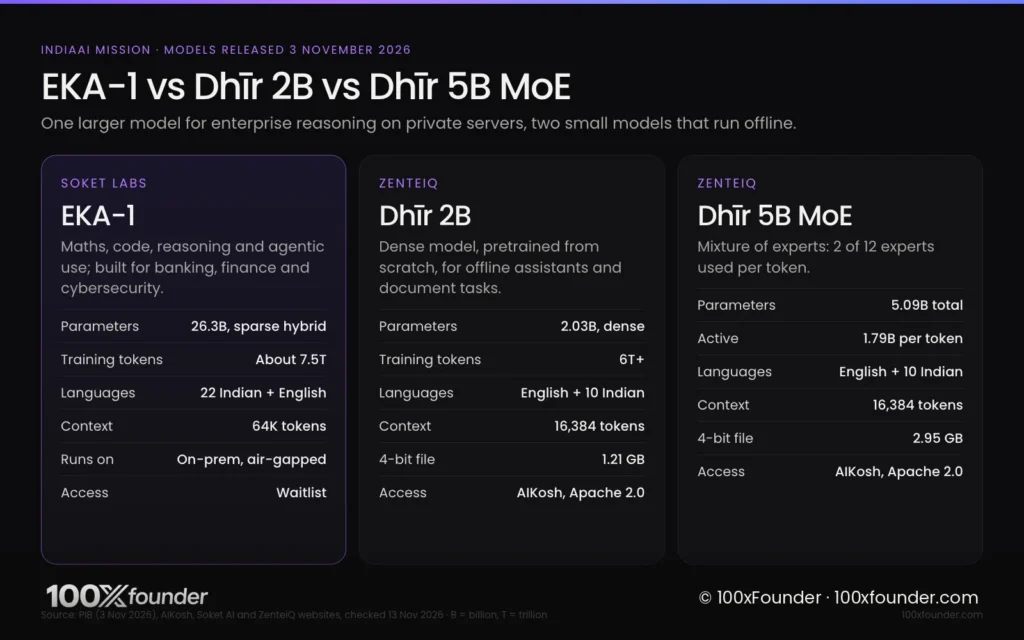
EKA-1 is a larger model for enterprise reasoning on private servers; Dhīr is a small model for offline devices.
IndiaAI’s November 2026 models compared. Sources: PIB (3 Nov 2026), AIKosh, Soket AI and ZenteiQ websites, checked 13 November 2026.
| EKA-1 | Dhīr 2B | Dhīr 5B MoE | |
|---|---|---|---|
| Maker | Soket Labs | ZenteiQ | ZenteiQ |
| Parameters | 26.3B, sparse hybrid | 2.03B, dense | 5.09B total, 1.79B active |
| Training tokens | About 7.5 trillion | 6 trillion+ | 6 trillion+ |
| Languages | 22 scheduled Indian languages + English (PIB) | English + 10 Indian languages | English + 10 Indian languages |
| Context | 64K tokens | 16,384 tokens | 16,384 tokens |
| Licence | Apache 2.0 listed on AIKosh | Apache 2.0 | Apache 2.0 |
| Runs on | On-premise, air-gapped, private cloud | Laptops, edge devices, phones (offline) | Laptops, edge devices, phones (offline) |
| How to get it | Waitlist; AIKosh listing restricted | Download on AIKosh | Download on AIKosh |
How EKA-1 and Dhīr fit the IndiaAI Mission
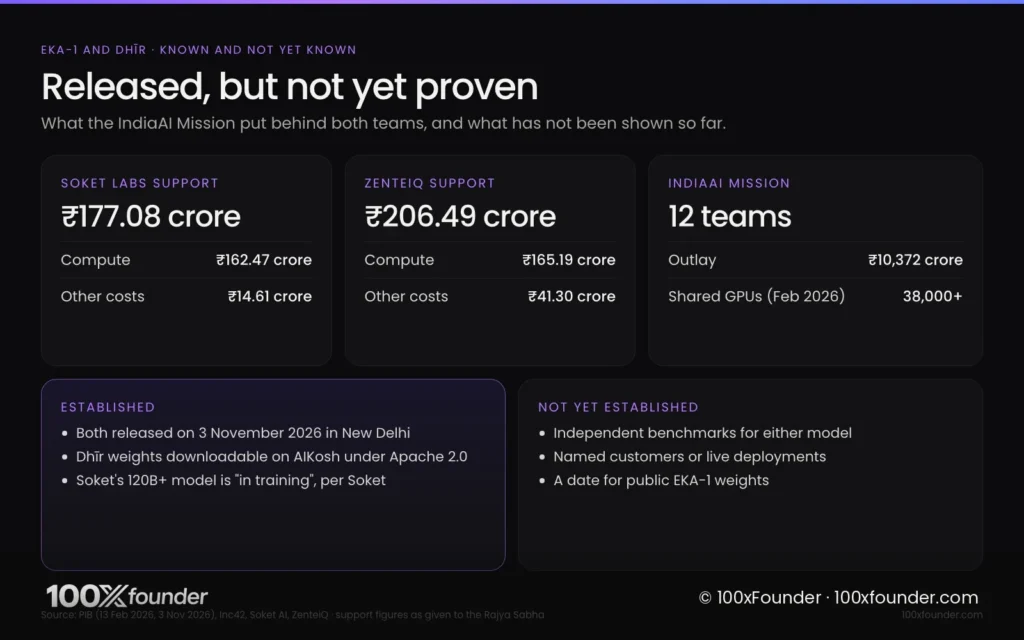
EKA-1 and Dhīr come out of the IndiaAI Innovation Centre (Foundation Models) pillar, one of seven pillars of the IndiaAI Mission that the Union Cabinet approved on 7 March 2024, according to PIB. The mission has an outlay of ₹10,372 crore and had onboarded more than 38,000 GPUs for subsidised shared compute by February 2026, a PIB release of 13 February 2026 said.
Twelve teams were picked to build Indian foundation models: Sarvam AI, Soket AI, Gnani AI, Gan AI, Avataar AI, the IIT Bombay-led BharatGen consortium, GenLoop, ZenteiQ, Intellihealth, Shodh AI, Fractal Analytics and Tech Mahindra Maker’s Lab, according to that release. Figures given to the Rajya Sabha put Soket’s support at ₹177.08 crore (₹162.47 crore of compute and ₹14.61 crore of other costs) and ZenteiQ’s at ₹206.49 crore (₹165.19 crore compute, ₹41.30 crore other). The models released so far, including Sarvam’s and BharatGen’s, are compared in our guide to Indian AI models.
What is not yet established
Neither EKA-1 nor Dhīr has independent benchmark results or named customers yet. Inc42 noted that the 3 November announcement included no benchmarks, deployment details or pricing.
- Performance: ZenteiQ reports average scores of 61.4 (Dhīr 2B) and 64.6 (Dhīr 5B MoE) across 41 benchmarks against 24 open models of 1–7 billion parameters. These are company numbers, though it has published its evaluation tools. Soket has published no benchmark scores for EKA-1 that we could find.
- Adoption: ZenteiQ’s site mentions unnamed pilot engagements in sectors such as automotive and semiconductors. Soket named no paying customers in Inc42’s July 2026 profile. Defence and citizen-service uses named at the launch are intentions, not deployments.
- Limits ZenteiQ itself lists: Dhīr is text-only, has no reasoning mode, is weakest at recalling facts without a source, and has had instruction-following measured only in English. ZenteiQ advises retrieval and human review for law, finance, medicine and similar areas.
- EKA-1 access: no date has been given for when EKA-1 weights will be public or when the waitlist will open more widely.
Why it matters
Dhīr is the more immediately useful release for developers: small, open, downloadable and able to run on a Raspberry Pi or a phone, which suits Indian-language assistants in places with poor connectivity. EKA-1 matters more as a signal that Soket’s route to a 120-billion-parameter model is on track, but until its weights and benchmarks are public, it is hard to judge against Sarvam’s open models. If you build with these, the AI roles on our AI and ML jobs board show who is hiring.
FAQ
What is EKA-1?
EKA-1 is a 26.3-billion-parameter AI language model built by Bengaluru’s Soket Labs under the IndiaAI Mission and released on 3 November 2026. It was trained on about 7.5 trillion tokens and, according to the government, covers all 22 scheduled Indian languages plus English. Soket aims it at maths, code, reasoning and banking, finance and cybersecurity work.
Can I download Dhīr and run it offline?
Yes. ZenteiQ offers Dhīr 2B and Dhīr 5B MoE as downloads on the government’s AIKosh platform under the Apache 2.0 licence. The 4-bit versions are 1.21 GB and 2.95 GB, and ZenteiQ says they run offline on laptops, edge boards such as the Jetson Orin NX, and phones, in English and 10 Indian languages.
Is EKA-1 open source?
Partly, on paper. The government calls EKA-1 “open” and AIKosh lists an Apache 2.0 licence, but the AIKosh download is marked restricted and Soket’s website asks users to join a waitlist. Until the weights are publicly downloadable, treat EKA-1 as early access rather than an open model you can use today.
Which Indian languages does Dhīr support?
Dhīr supports English plus Hindi, Bengali, Tamil, Telugu, Marathi, Gujarati, Kannada, Malayalam, Punjabi and Odia, according to ZenteiQ. Languages such as Assamese, Urdu or Sanskrit are not in Dhīr’s list, so for full 22-language coverage you would need a larger model such as EKA-1 or Sarvam’s.
Sources
- Press Information Bureau (MeitY), “IndiaAI Mission Released Indigenous Foundation Models EKA-1 by Soket and Dhīr 2B & Dhīr 5B by ZenteiQ Under the IndiaAI Innovation Centre Pillar”, 3 November 2026. Link
- Press Information Bureau (MeitY), “In less than 24 months, India AI Mission has Set up a Foundation for Development of AI Ecosystem in the Country”, 13 February 2026. Link
- AIKosh (IndiaAI), “EKA-1-26B” model listing, updated 3 November 2026. Link
- ZenteiQ, “Dhīr 2B and Dhīr 5B MoE” model page (accessed 13 November 2026). Link
- Soket AI, “Get early access to EKA-1” (accessed 13 November 2026). Link
- Soket AI, “Project EKA” (accessed 13 November 2026). Link
- Inc42, “Soket Labs & ZenteiQ Launch Indigenous AI Models”, 4 November 2026. Link
- News On AIR, “Govt launches 3 new indigenous AI foundation models under IndiaAI Mission to strengthen homegrown AI capabilities”, 4 November 2026. Link
- ThePrint (PTI), “AI push: Soket Labs, ZenteiQ launch indigenous foundation models”, 3 November 2026. Link
- Analytics India Magazine, “IndiaAI Mission Releases 3 Indigenous AI Models Developed by Soket, ZenteiQ”, 4 November 2026. Link
- Inc42, “Soket AI Wants To Turn The Language Gap In AI Into India’s Edge”, 22 July 2026. Link
- Outlook Business, “Gan AI, Gnan AI, Soket AI Selected by Govt to Build India’s Next Gen LLMs”, 30 May 2025. Link
- ZenteiQ, Dhīr launch presentation, November 2026. Link
Related stories


Sources (13)
- Press Information Bureau (MeitY) 3 Nov 2026Release event, EKA-1 26.3B/7.5T tokens/22 languages+English, Dhīr English+10 languages, on-prem offline, quotes from Krishnan, Upperwal, Sashikumar, Shrivastava, mission approved 7 Mar 2024, seven pillars
- Press Information Bureau (MeitY) 13 Feb 2026₹10,372 crore outlay, 38,000+ GPUs, 12 foundation model teams, support amounts for Soket and ZenteiQ
- AIKosh (IndiaAI) 3 Nov 2026EKA-1-26B RALSNet 52 layers, 64K context, Apache 2.0, 100+ languages, deployment options, 30.49 GB, Restricted
- ZenteiQ 13 Nov 2026Dhīr parameters, MoE 2 of 12, context, file sizes, 6T+ tokens, languages, TPU v6e Mumbai, Apache 2.0, benchmarks, speeds, limitations, pilots
- Soket AI 13 Nov 2026EKA-1 waitlist and data-use consent
- Soket AI 13 Nov 2026120B+ in training, 1,536 H100 GPUs, 60+ languages, Bengaluru
- Inc42 4 Nov 2026Launch details, Upperwal quote, no benchmarks/deployment/pricing in announcement
- News On AIR 4 Nov 2026Launch, Krishnan on air-gapped deployment
- ThePrint (PTI) 3 Nov 2026Launch in presence of MeitY Secretary
- Analytics India Magazine 4 Nov 2026Launch details and quotes, AIKosh access
- Inc42 22 Jul 2026Soket founded 2019, 24B proof-point model by end-2026, 120B in 2027, open-source plan, no named customers
- Outlook Business 30 May 2025Soket selected to build 120B open-source model
- ZenteiQ 3 Nov 2026On-device demo on Motorola Edge 70 Fusion (12 GB), 4-bit