Semrush Review 2026: Real Pricing, Limits and Cancellation
An honest Semrush review for 2026: the real monthly bill with every add-on, how the plan limits bite, and the cancellation step that gets people charged.
 Ishaan Vardhan6 Oct 2026 · 46 min read
Semrush is the broadest SEO platform you can buy, and in October 2026 the cheapest paid plan on its own pricing page is $139.95 a month. That is almost never what people end up paying. Seats, extra domains for AI-visibility tracking and per-location listing management are all sold separately, the 17% annual discount does not apply to any of them, and two of them multiply rather than add. This review prices the real bill, explains the three plan vocabularies Semrush now has in circulation, and walks through the cancellation form, because the step most people miss is a confirmation link that expires in 24 hours.
We have not run Semrush ourselves and will not pretend otherwise. Every verdict here rests on Semrush’s own documented prices, limits, help-centre articles and regulatory filings, checked on 4 October 2026; on published independent reviews and user-review platforms; or on arithmetic we have done on those published numbers and shown in full. One warning before the tables: Semrush is running live experiments on its own pricing page, so the plan names and layout you see may genuinely differ from what we recorded. Confirm the figures before you buy.
Verdict in 60 seconds
| Buy it if you want one platform covering keyword research, rank tracking, site auditing, backlinks and AI-search visibility, and you will pay $199–$299 a month to avoid stitching four tools together. It is the strongest option for someone who wants AI-visibility tracking in the same subscription as classic SEO, and one of very few tools here that still lets you trial a paid plan before paying. |
|---|
| Skip it if backlinks are your main job (Ahrefs has the better-regarded index), if you need API access on a mid-tier budget (Semrush gates it to the top plan; Ahrefs, Serpstat and SpyFu do not), if you are an agency buying several seats (SE Ranking charges $16 against Semrush’s $45 to $100), if content tooling is why you want the entry plan (Topic Research is capped at two searches per lifetime there), or if you want a $30–50 keyword tool. |
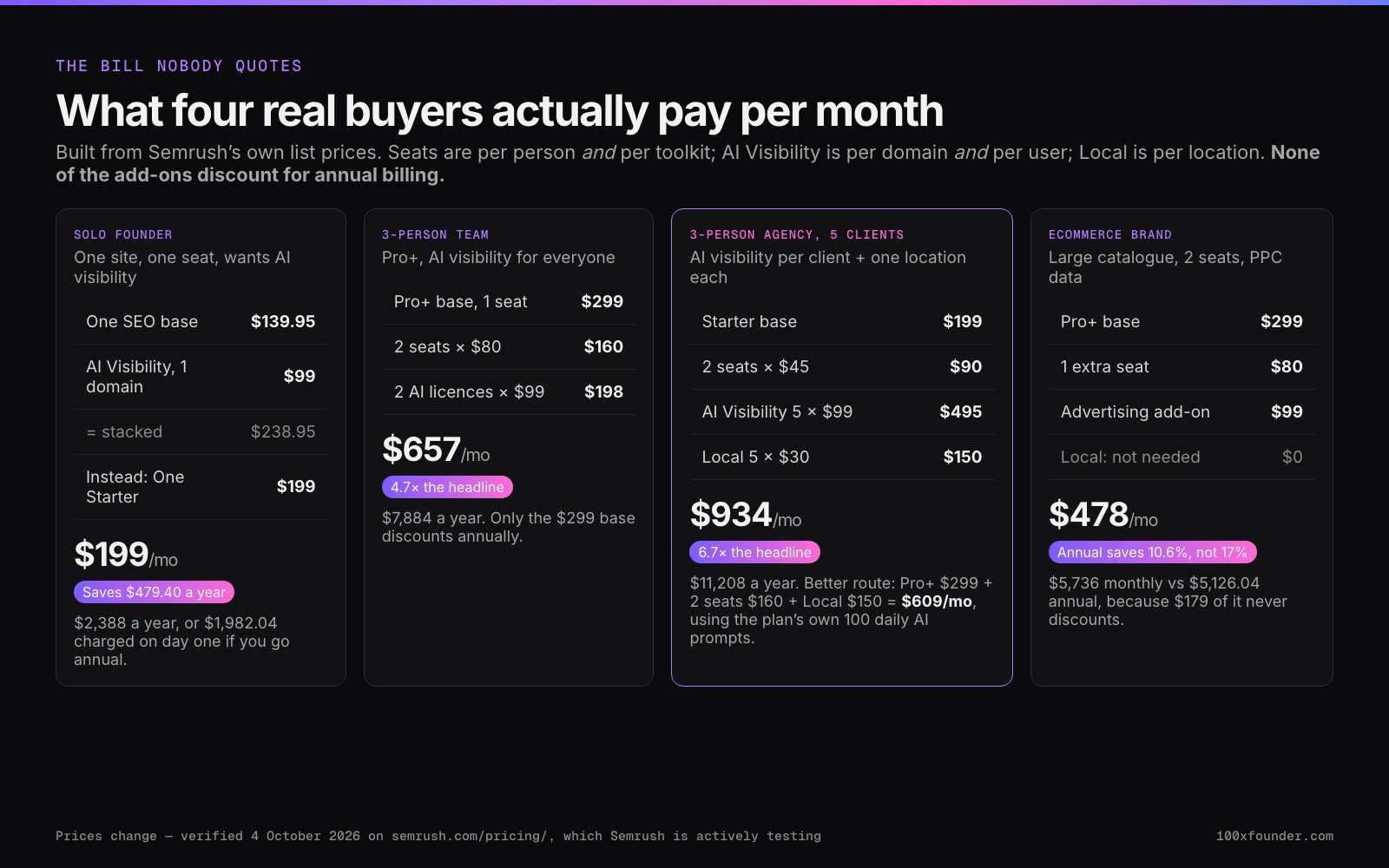
| The real cost. A solo founder who wants AI visibility should budget $199/mo. A three-person Pro+ team wanting AI visibility for everyone pays $657/mo. A three-person agency with five clients needing AI visibility and Local reaches $934/mo at list prices. An ecommerce brand on Pro+ with a second seat and the Advertising add-on lands near $478/mo. All shown below. |
| The thing that costs people money. Cancelling is not one click. You submit a form at semrush.com/cancel/, complete every required field, then open a confirmation email and click a link valid for 24 hours. Miss it and the cancellation is not processed. Refunds are seven days, on an initial annual subscription of 12 months or longer only, never on month-to-month, and must be requested in writing in the comment field of that same form. |
Our affiliate disclosure, before you click anything
| We may earn a commission if you buy Semrush through the links on this page, at no extra cost to you. You pay Semrush’s normal list price; the commission comes out of Semrush’s margin, not your card. Semrush’s affiliate programme publishes what it pays — $10 when someone starts a trial, up to $450 on a sale, on a 120-day cookie — so you can see exactly what our incentive is. It does not change our assessment. We have not been given a review account, nothing here was shown to Semrush before publication, and the sections on cancellation, the refund policy, the add-on multipliers, the declining customer count and the competitors that beat Semrush on price are here because they are what we would want to read before spending $1,982 upfront. Links pointing at a Semrush landing page are marked as sponsored; where we link to Semrush as a source — a help-centre article, the price list, the refund policy — those are ordinary links and earn us nothing. There is no coupon code, and the seven-day trial is a trial, not a discount. This disclosure meets the FTC’s endorsement guides and India’s ASCI influencer guidelines. |
|---|
Why most Semrush reviews are out of date right now
Semrush is no longer a public company, and most reviews have not noticed. Adobe’s acquisition completed on 28 April 2026; Semrush was delisted from the New York Stock Exchange that day and its SEC registration was terminated on 8 May 2026. Any review still describing Semrush as “NYSE: SEMR” is describing a company that stopped existing in that form five months ago.
Several page-1 competitors have an undisclosed interest. Backlinko ranks near the top for queries like “best SEO tools” and puts Semrush first; Backlinko is owned by Semrush, and that is not disclosed on the pages themselves. Separately, several pages ranking for “Semrush alternatives” are published by Semrush’s competitors — SE Ranking, StoryChief and Search Atlas each rank their own product first in a list presented as neutral. A ranking produced by a vendor about its own category tells you about the vendor, not the category. We have an interest too, which is why it is in a box above.
The stale pricing is worse than the conflicts. A page ranking for “Semrush review” quotes a $119.95 “Basic” plan and a $229.95 Guru; neither appears anywhere on semrush.com today, and that page was last updated in August 2024. Another lists the legacy Pro plan at $177.33 a month on annual billing when the published annual figure for the current entry plan is $117.33. A third lists three add-ons no longer sold.
Two smaller corrections. There is no coupon code: on the query “Semrush discount”, essentially every page-1 result implies one exists, but there is nothing to paste at checkout — what those pages have is an affiliate link, which is also what we have. The only saving Semrush publishes is annual billing at up to 17%, charged in full on day one and, as shown below, not applicable to the add-ons that make up most of a real bill. And the trial is seven days, not fourteen. Eight affiliate pages claim fourteen; Semrush’s own pricing page says seven, and the gap between day 7 and day 14 is where the “I was charged and did not expect it” complaints come from.
What Semrush actually is
Semrush was founded in 2008 by Oleg Shchegolev and Dmitry Melnikov as a competitive-keyword database and became a suite. In 2026 it is best understood as five overlapping jobs sold under one login.
- Keyword and competitor research. Keyword Magic, Keyword Gap, Domain Overview and Organic Research. A seed term or a competitor domain returns keyword lists with volume, difficulty and intent labels, plus estimates of which pages on a competitor’s site earn which traffic. This is the part most reviewers like and the part that justifies the subscription for most buyers.
- Rank tracking. Position Tracking monitors a defined keyword set daily by location and device. The daily keyword allowance is the most important number on the pricing page because it is the one you cannot work around: 500 on the two cheapest paid plans, 1,500 on Pro+, 5,000 on Advanced.
- Technical auditing. Site Audit crawls and files issues by severity; the monthly page-crawl allowance governs how often you can re-crawl a large site. Log File Analyzer and On Page SEO Checker sit here too.
- Backlinks. Backlink Analytics, Audit and Gap, built on a crawl Semrush says processes around ten billion pages a day. Semrush claims a 43-trillion-link index against Ahrefs’ claimed 35 trillion; neither is independently verified, and index size is not index quality.
- AI-search visibility. The reason the plan ladder changed. The AI Visibility Toolkit tracks whether and how your brand appears in AI-generated answers from ChatGPT, Perplexity, Gemini and Google’s AI Overviews: visibility share, how you are described, which prompts mention a competitor instead of you, and whether AI crawlers can reach your site.
Around those sit the paid extras: Local for listings, Advertising for PPC research, Social for scheduling, Traffic & Market for Similarweb-style estimates on domains you do not own, Lead Generation, AI PR, and an App Center of roughly 70 third-party apps at $10 to $349 per user per month. Treat all of them as separate products that share a login, because that is how they are billed.
If you want a vendor tour before our verdicts, Semrush’s own channel has two useful ones: “Semrush Overview: The All-in-One SEO Toolkit for Marketing Pros” and, for the AI side, “The Fastest Way to Measure Traffic Lost to AI Overviews”. They are marketing, and they let you see the interface without us reproducing Semrush’s screenshots. Semrush Academy runs a separate, also Semrush-owned channel for structured tutorials; many “official Semrush video” links in other reviews are in fact third-party uploads.
How big is the data? Semrush gives different answers
We went looking for one number and found several. The keyword database is published across Semrush’s own properties as 28.8 billion, 28 billion, 27.3 billion and 26 billion depending on the page; user counts appear as both 10 million and 28 million; AI prompts analysed as 261, 289 and 317 million; traffic history back to 2012 on one page and 2017 on another. Geographic coverage is quoted five ways for five datasets — 142 keyword geo-databases, 190+, 220+, 117 and 32 — which no Semrush page reconciles. The one that matters most to a non-US buyer is the smallest: AI-visibility prompt tracking covers 32 countries against 142 for ordinary keyword data, so check your market is on that list before paying for the AI plan. The lesson is to buy on the published plan limits, which are specific and consistent, rather than on headline scale claims, which are not.
How the limits and credits actually work
Three metering systems run at once and people conflate them. Daily caps: reports per day run 3,000 / 3,000 / 5,000 / 10,000 across the four plans, and the free plan is capped at ten a day — with Semrush’s own help centre and blog disagreeing about whether that is ten per tool or ten in total, so plan for the stricter reading. Monthly allowances: pages crawled 100,000 / 100,000 / 300,000 / 1,000,000, and keyword metric updates 250 / 250 / 1,000 / 5,000, where the 250 on both cheap plans is low enough to shape how you work. Standing capacities: websites 5 / 5 / 15 / 40, keywords tracked daily 500 / 500 / 1,500 / 5,000, results per report 10,000 / 10,000 / 30,000 / 50,000, AI prompts tracked daily none / 50 / 100 / 200, and scheduled PDF reports three on every plan including the $549 one.
Two entry-tier limits deserve naming because no competing review mentions them and they are severe. On the cheapest plan, Topic Research is capped at two searches per lifetime and the SEO Writing Assistant at two documents and 500 AI-generated words, also per lifetime. Not per month. If you are buying the $139.95 plan for help producing content, you will exhaust the content tooling in an afternoon and never get it back; content work needs the Guru-equivalent tier, where the Content Marketing Toolkit, historical data and multi-location features also sit.
Semrush pricing in October 2026: the full table
Here is what Semrush published on 4 October 2026. The annual column is the effective monthly figure Semrush advertises; the upfront column is that figure times twelve, which is what actually leaves your account, because Semrush’s billing FAQ is explicit that annual is paid in full and “is not a monthly payment plan”.
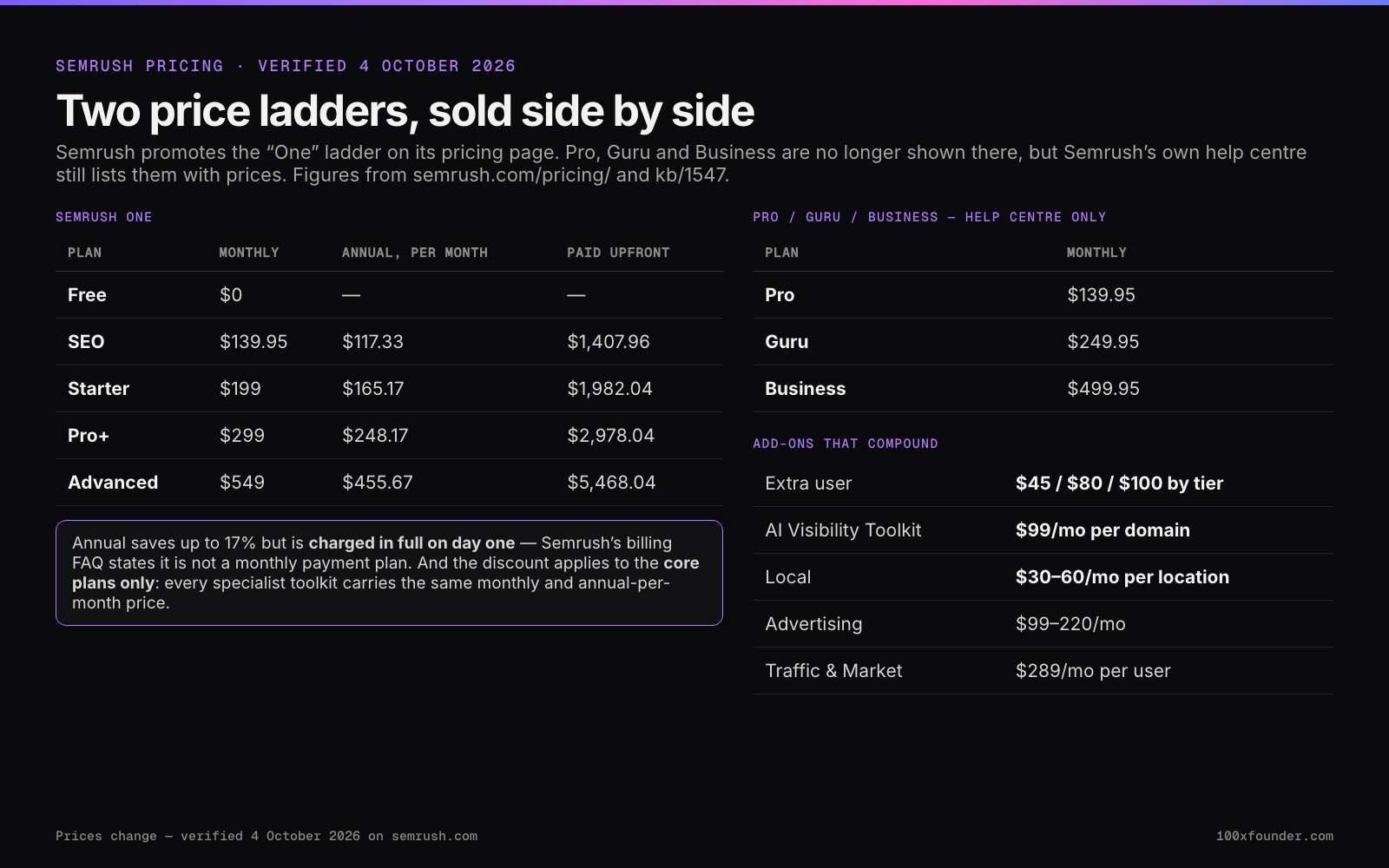
| Plan | Monthly | Annual, effective per month | Charged upfront on annual | What it is for |
|---|---|---|---|---|
| Free | $0 | — | — | Evaluation only. No exports at all. |
| SEO | $139.95 | $117.33 | $1,407.96 | Classic SEO, one person, up to 5 sites |
| Starter | $199 | $165.17 | $1,982.04 | The same, plus 50 AI prompts tracked daily |
| Pro+ | $299 | $248.17 | $2,978.04 | 15 sites, 1,500 keywords, 100 AI prompts daily |
| Advanced | $549 | $455.67 | $5,468.04 | 40 sites, 5,000 keywords, API access |
Prices change — verified 4 October 2026 on semrush.com/pricing/, which Semrush is actively running experiments on. Confirm the figures on the page before you buy. The page displays the entry price as $139 because the renderer truncates the decimal; the underlying value is $139.95.
Three things about that table are not obvious and all three are financial. All prices are in US dollars — Semrush’s own FAQ says so explicitly — and there is no tax line, so whatever tax applies where you are billed is added on top. The annual discount is a prepayment, not a payment plan: One Starter annually means $1,982.04 leaves your card now, with seven days to change your mind and then a twelve-month commitment with no mid-term refund. And the 17% discount applies only to the core plans. Every specialist toolkit carries an identical monthly and annual-per-month price — AI Visibility $99 either way, Local $30–60 either way, Content $60, Advertising $99 or $220 — which we have not seen published anywhere else and which materially changes the annual-versus-monthly maths for anyone whose bill is mostly add-ons.
Three plan vocabularies, no published crosswalk
Semrush currently has three sets of plan names in circulation on its own properties. The pricing page promotes SEO, Starter, Pro+ and Advanced. The help centre still uses Pro, Guru and Business throughout, with prices. A third help-centre article introduces “SEO Classic” as yet another label.
| Plan name | Monthly | Where it appears |
|---|---|---|
| Pro | $139.95 | Help centre, with prices and limits. Not on the pricing page. |
| Guru | $249.95 | Help centre, with prices and limits. Not on the pricing page. |
| Business | $499.95 | Help centre, with prices and limits. Not on the pricing page. |
Prices change — verified 4 October 2026 in Semrush’s help centre. Documented, not confirmed purchasable.
We want to be precise rather than tidy. We are not saying these plans were retired, because Semrush’s own help centre still lists them with prices and limits; nor that you can buy them, because we could not verify that a new customer can. Semrush publishes no crosswalk between the old names and the new — the help-centre article that sounds like one redirects to the pricing page. If anyone quotes you a Guru price, that is where it comes from, and you should ask support in writing whether that ladder is open to new accounts before budgeting on it.
Semrush One versus the SEO Classic plans, and the arithmetic that decides it
This is the most valuable piece of arithmetic in the whole purchase, and no competing page does it. The mapping below is our inference from matching limit values across two Semrush pages, not an official crosswalk, because Semrush does not publish one — but the limit values themselves are published and identical, which is what makes the price comparison fair.
| Help-centre plan | Current plan | What changes | Price difference |
|---|---|---|---|
| Pro $139.95 | SEO $139.95 | Nothing; the same entry price | $0 |
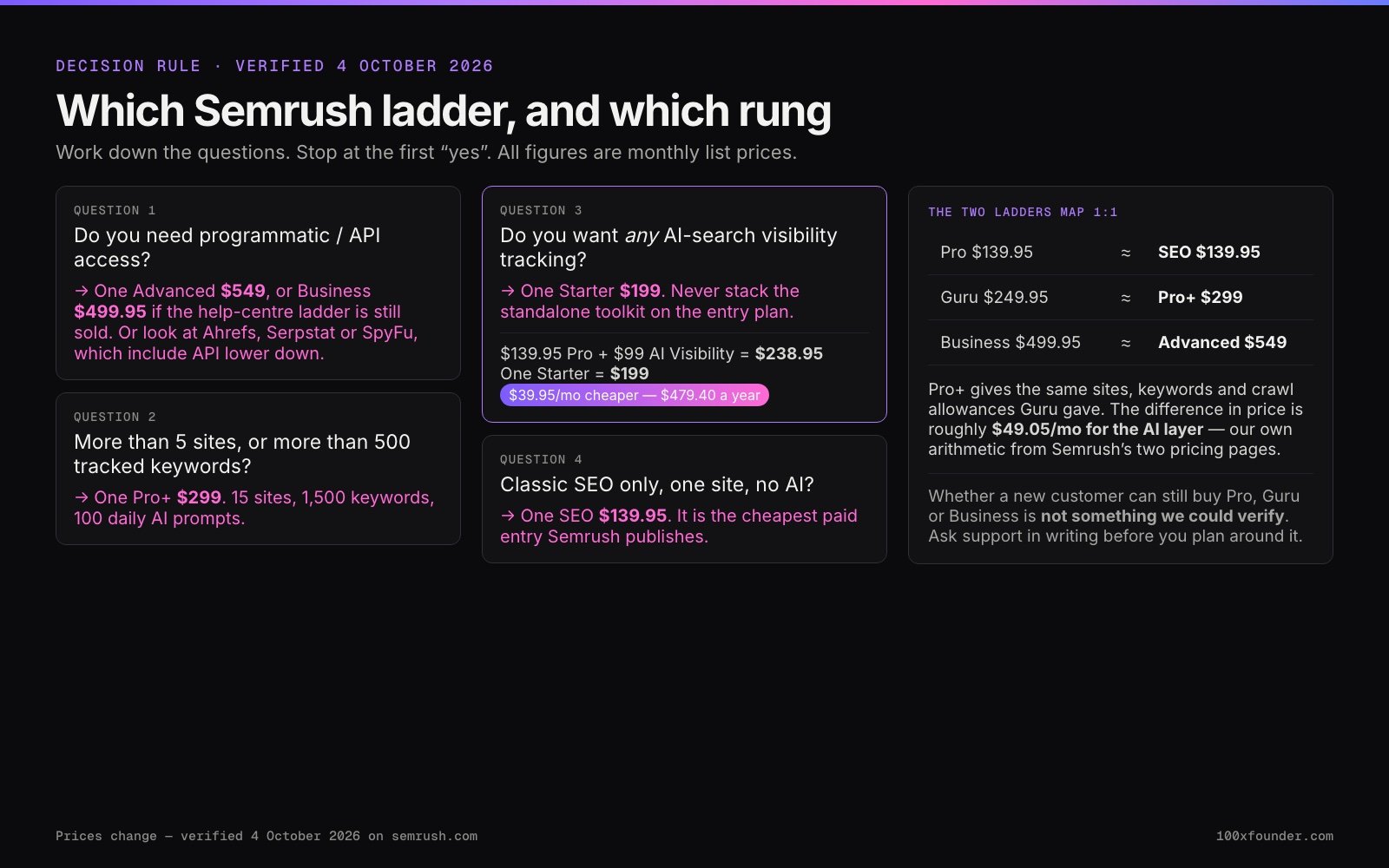
| Guru $249.95 | Pro+ $299 | Same sites, keywords, crawl and row limits, plus 100 AI prompts tracked daily | +$49.05 |
| Business $499.95 | Advanced $549 | Same shape, plus 200 AI prompts tracked daily | +$49.05 |
Prices change — verified 4 October 2026 on semrush.com/pricing/ and in Semrush’s help centre.
Read the middle row twice. Pro+ at $299 gives the websites, tracked keywords, crawl allowance and rows per report that Guru gave at $249.95, so the extra $49.05 a month is in effect what the bundled AI layer costs.
Here is the decision that saves real money. The AI Visibility Toolkit is also sold standalone at $99 a month, per domain. So someone who wants the entry plan plus AI visibility has two routes: the entry plan at $139.95 plus the toolkit at $99, which is $238.95 a month; or One Starter at $199 a month, which includes 50 AI prompts tracked daily. Starter is $39.95 a month cheaper — $479.40 a year — and it is the official, promoted plan. If you want any AI-visibility tracking at all, bolting the standalone add-on onto the cheapest plan is the most expensive way to get it. Several pages ranking for “Semrush pricing” present the add-on route without ever running this comparison.
The decision rule, in order
- Need API access? The top tier: Advanced at $549. Semrush publishes API packages but no dollar unit prices, so get a quote — and if the API is the only reason you are at the top, price Ahrefs, Serpstat and SpyFu first, because all three include it much further down.
- More than five websites, 500 tracked keywords or 10,000 rows per report? Pro+ at $299. There is no cheaper way past those ceilings.
- Want any AI-search visibility tracking? Starter at $199. Do not stack the $99 toolkit on the $139.95 plan.
- Producing content seriously? Also Pro+, because the entry tier’s Topic Research is two searches per lifetime.
- Classic SEO only, one site, no AI? SEO at $139.95, the cheapest paid entry Semrush publishes.
- Budget under $100? Semrush is the wrong tool, and the alternatives section below is the part of this page you want.
The real monthly bill: four scenarios with the arithmetic shown
Semrush’s headline price is for one person, on the base plan, with nothing added. Almost nobody buys that. The add-ons turn a $139.95 decision into a four-figure annual commitment, and they multiply: AI Visibility is priced per domain, Local per location, and seats per person and per toolkit.
| Add-on | Published price | How it scales | Annual discount? |
|---|---|---|---|
| Additional user | $45 / $80 / $100 by tier | Per person, per toolkit; $20 flat with no SEO plan | No |
| AI Visibility Toolkit | $99 | Per domain, and per user | No |
| Local | $30–60 | Per location | No |
| Content toolkit | $60 | Per account | No |
| Advertising | $99 or $220 | Per account | No |
| Social | $20–250 | Per account, by tier | No |
| Traffic & Market | $289–309 | Per user | No |
| Lead Generation | $90; reports $10–20 | Per account | No |
| AI PR | $149–499 | Per account | No |
| App Center apps | $10–349 | Per app, per user | No |
Prices change — verified 4 October 2026 on semrush.com/pricing/. The “no annual discount” column is the finding we think matters most on this page: the 17% saving is a core-plan discount only.
Scenario one: a solo founder with one site
One product site, you are the only person who logs in, and you want to know whether ChatGPT mentions you when someone asks for a tool like yours.
- One SEO base plan: $139.95, plus the standalone AI Visibility Toolkit for your one domain at $99 = $238.95/mo
- Instead, One Starter, which includes 50 AI prompts tracked daily: $199/mo
Budget $199 a month, or $2,388 a year. On annual billing that is $165.17 effective, which means $1,982.04 charged on day one and seven days to change your mind. If AI visibility does not matter to you, $139.95 a month is your floor. The honest question here is not which plan but whether $2,388 a year is the right use of the money when the whole operation is one domain. Often it is not: Search Console is free and shows real clicks rather than estimates, and a $30–50 keyword tool covers most of what you need until the site has something worth optimising. This is also precisely the buyer Semrush’s own filing describes as leaving.
Scenario two: a three-person team that all want AI visibility
- One Pro+ base plan, including one seat: $299
- Two extra seats at the Pro+ rate: 2 × $80 = $160
- AI Visibility licences for the two extra users: 2 × $99 = $198
- Total: $299 + $160 + $198 = $657 a month, or $7,884 a year.
That is 4.7 times the headline price for three people on a mid plan, and nothing but the $299 base is discountable by paying annually. If your team is the expensive part of your bill, Semrush is the wrong shape of product: SE Ranking charges $16 a seat, Mangools includes extra seats free from Premium, and Serpstat includes six users at $100.
Scenario three: a three-person agency with five clients, AI visibility and Local
Three people need logins, five clients need projects, each client wants AI-visibility reporting, and each has one physical location needing listing management.
Route A, the obvious way to buy it:
- One Starter base plan, covering 5 websites: $199
- Two extra seats at the entry-tier rate: 2 × $45 = $90
- AI Visibility per client domain: 5 × $99 = $495
- Local at the lowest published tier, one location each: 5 × $30 = $150
- Total: $934 a month, or $11,208 a year.
At the top of the published Local range the same basket is $1,084 a month, $13,008 a year, and if two clients have three branches each — eleven locations rather than five — Local alone runs $330 to $660 a month. The $934 figure is 6.7 times the headline price, and every component is a published list price.
Route B, the way to actually buy it:
- One Pro+ base plan: 15 websites, 1,500 tracked keywords, 30,000 rows per report, 100 AI prompts tracked daily: $299
- Two extra seats: 2 × $80 = $160; Local, five locations at $30: $150
- Total: $609 a month, or $7,308 a year.
Route B is $325 a month cheaper — $3,900 a year — and it triples the tracked-keyword allowance, triples the row ceiling and gives fifteen projects instead of five. Understand the trade: the plan’s 100 daily AI prompts are one pool across the account, so five clients share twenty prompts each, and the standalone toolkit is what gives a dedicated per-domain brand analysis. If all three staff also need AI access, add 2 × $99 and Route B becomes $807 — still $127 below Route A with far better classic-SEO limits. Either way, the number an agency should compare against competitors is not $139.95 but $609 to $934, and at those levels SE Ranking’s $16 seats and Serpstat’s thirty-user Agency plan at $410 stop being theoretical.
Scenario four: an ecommerce brand with one large catalogue
- One Pro+ base plan: $299. The 300,000-page crawl, 1,500 tracked keywords and 30,000-row reports are the reason; the entry plan’s 100,000 pages, 500 keywords and 10,000 rows do not cover a real catalogue.
- One extra seat at the Pro+ rate: $80; Advertising add-on at the lower published price: $99; Local, nothing to list: $0
- Total: $478 a month, or $5,736 a year.
Now watch what the annual discount does and does not do. The base plan drops from $299 to $248.17 effective, so the commitment is $2,978.04 upfront, while the seat and the Advertising add-on do not discount at all and stay at $179 a month, or $2,148 a year. Total on annual billing: $5,126.04 against $5,736 monthly — a saving of $609.96, which is 10.6%, not 17%. The more of your bill sits in add-ons, the smaller the annual discount gets; on the three-person AI scenario above it falls to around 7.7%.
Two cautions. Semrush’s PPC estimates are the part of its data most consistently questioned in user reviews, so if competitor ad intelligence is the main reason you are buying, price SpyFu first. And Semrush publishes API packages without dollar prices, so if your plan involves piping this data into a warehouse, get a written quote before committing.
The compounding, stated plainly
- Seats are per person and per toolkit. $45, $80 or $100 by tier, and a user who needs two toolkits is charged for both: a five-person Pro+ team is $320/mo in seats before any add-on.
- AI visibility is per domain and per user. Ten client domains is $990, more than the Advanced plan costs.
- Local is per location. A twelve-branch clinic group is $360–720 a month on top of the plan, where Moz Local covers the job at $20–40.
- None of it discounts annually. Price add-ons at full monthly rate for twelve months, add the discounted base, and that is your real annual number.
How the limits actually bite
Four documented limits change what the product can do for you. These are published facts from Semrush’s own pages, not user complaints.
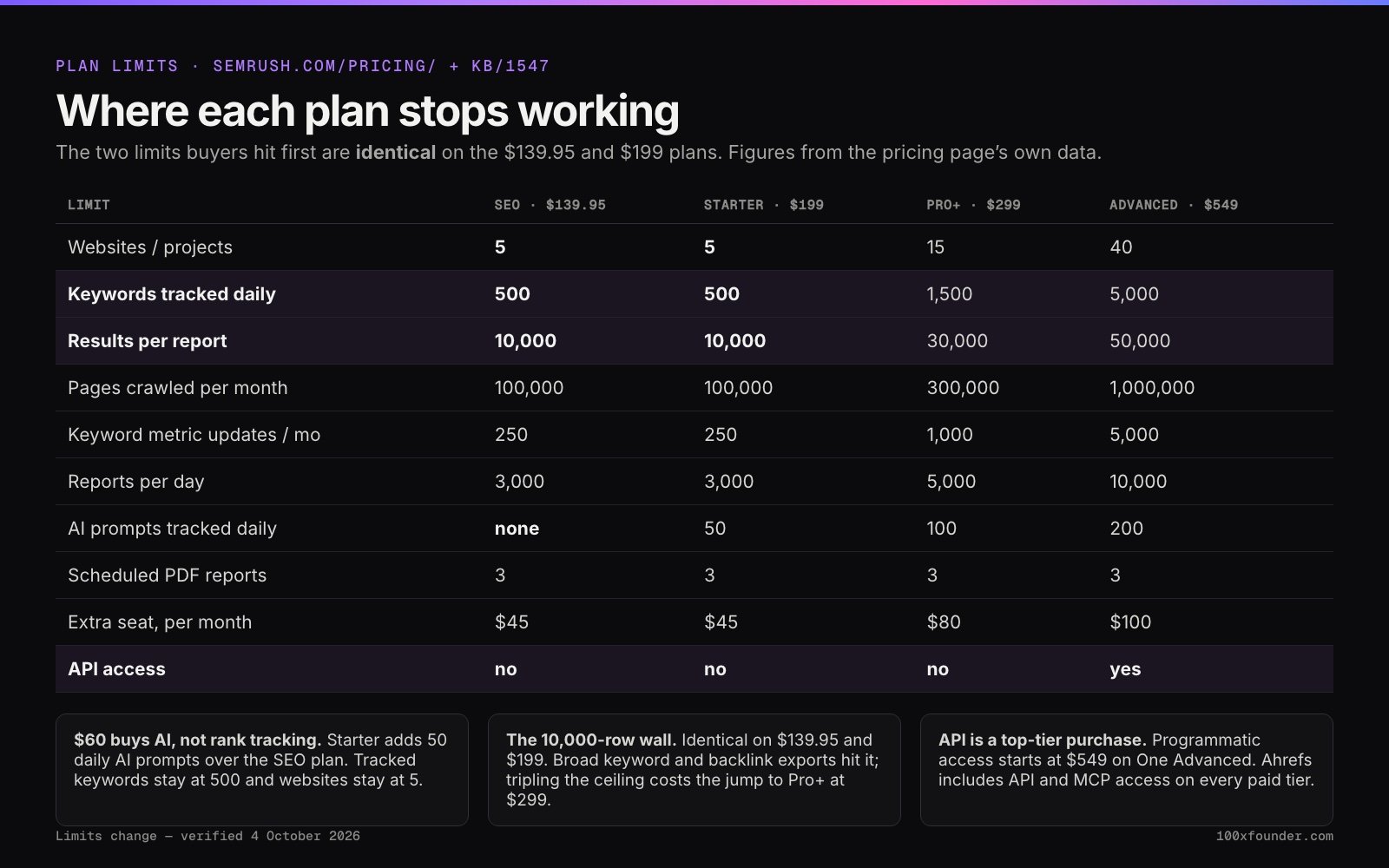
The 10,000-row ceiling, identical on $139.95 and $199. Results per report runs 10,000 / 10,000 / 30,000 / 50,000, so broad keyword and backlink exports that exceed ten thousand rows come back as a truncated sample rather than the dataset. Tripling the ceiling costs the jump to Pro+ at $299.
500 tracked keywords, also identical on $139.95 and $199. This is the one buyers get wrong most often. Going from SEO to Starter costs about $59 a month and buys 50 AI prompts tracked daily; it does not buy a single extra tracked keyword, website, crawl page or report row. If your reason for upgrading is “I need to track more rankings”, Starter is not the upgrade and Pro+ is. For context, Ahrefs Lite gives 750 tracked keywords at $129 and SE Ranking Core gives 2,000 at the same price.
API access only at the top of the ladder. Programmatic access starts at Advanced, $549 a month — a $6,000-a-year floor for anyone wanting Semrush data in a dashboard or pipeline, and now unusual in the category. Ahrefs made API and MCP access available on every paid tier in 2026, Serpstat bundles 200,000 API credits a month from its $100 plan, and SpyFu includes API access on its $39 plan. Only Moz is worse: its API is not in Moz Pro at all and is sold separately from $20 a month.
Three scheduled PDF reports on every plan, including the $549 one. If your client deliverable is a monthly PDF, three is the number to plan around regardless of what you pay.
The tools that matter, one by one
These assessments come from Semrush’s documented features and limits plus consistent themes in dated published reviews, not from our own use.
Keyword Magic Tool. Good at breadth: a seed term returns a large clustered list with volume, difficulty, intent labels and SERP features, and the intent labelling is what reviewers single out. Weak at precision, and not alone. An independent test by Ann Smarty at Practical Ecommerce in November 2024 put monthly US volume for “reddit marketing” at 880,000 in Google Ads, 590,000 in Semrush and 100,000 in Ahrefs; her conclusion travels — “keyword search volume is imprecise and inconsistent among the leading sources.” A BloggingX test in December 2025 found Semrush under-estimating one site’s Search Console clicks by about 43%. Volumes are 12-month averages, so they lag anything trending. Use them to rank candidates, then validate the handful you will build.
Position Tracking. Good at daily refresh, location and device granularity, and tracking competitors in the same report. Weak at the allowance: 500 keywords on both cheap plans, and it does not rise for Starter.
Site Audit. Good at the thing it is for — it crawls, files issues by severity, explains each in plain language and re-crawls on a schedule. It is consistently the second tool, after keyword research, that reviewers name as the reason they stay.
Backlink Analytics, Audit and Gap. Good at Backlink Gap: your domain plus two competitors returns the domains linking to them and not to you, which is an outreach list rather than a metric. Weak at reviewer confidence relative to Ahrefs, the clearest split in the whole comparison. Both vendors publish index sizes nobody can verify, and those should carry no weight. If link data is the main job, buy Ahrefs; on Capterra it holds 4.7/5 from 585 reviews against Semrush’s 4.6/5 from 2,329.
The content tools. Good at briefs from the Guru-equivalent tier up, where Topic Research, the SEO Writing Assistant and On Page SEO Checker form a workable pipeline. Weak at existing at all on the entry plan: two Topic Research searches per lifetime, two Writing Assistant documents and 500 AI words per lifetime — the strongest argument against the cheapest plan if content is your job.
The AI Visibility Toolkit. Good at being there, which currently matters: brand presence and share of voice in AI answers, how your brand is described, prompts where competitors appear and you do not, and whether AI crawlers can reach your pages. Semrush was named in Gartner’s Market Guide for Answer Engine Visibility Tools in July 2026. Weak at coverage and pricing: 32 countries against 142 geo-databases for keyword data, and at $99 per domain per user with no annual discount it is the most expensive line an agency adds.
Local, Advertising, Social and Traffic & Market. All competent, all separately priced, and all with a cheaper specialist alternative: Moz Local at $20–40 per location, SpyFu for ad research, Similarweb from $199 for traffic estimation.
The free plan and the seven-day trial: exactly what you get
The free plan is permanent and needs no card. One project, ten reports a day, Position Tracking on one website with ten keywords, Site Audit limited to 100 pages a month, one SEO Writing Assistant piece, some reports partially obscured, and — the important one — no data export of any kind. It is a showroom: useful for checking one competitor’s top pages, incapable of producing a piece of work.
The trial is seven days, on every plan except Advanced. The pricing page says “Try Semrush free for seven days. Cancel anytime”, and SEO, Starter and Pro+ show a trial button where Advanced does not.
- A card is required, with a $1 authorisation that is not a charge. The billing FAQ states virtual cards are rejected.
- One trial per toolkit per account, ever: “you can use the option to get a free trial only once. All the following attempts will lead to the purchase of a monthly plan.” If you trialled Semrush in 2021, you cannot trial it now.
- Exports are disabled during the trial, which shapes how you should use the week.
- It auto-converts unless you complete the full cancellation below, and a trial that converts is excluded from the refund guarantee.
To be explicit about something we have an incentive to blur: the trial is a trial, not a coupon, deal or discount. Several affiliate pages present it as one; Semrush’s own affiliate terms prohibit describing it that way, and it would be wrong regardless.
How to extract everything useful from seven days
Because exports are off, the week is for deciding, not collecting. Day 1: start on the plan you would actually buy, not the cheapest, and set a reminder for day 5. Days 1–2: run Site Audit across the whole site and copy out the top twenty issues by severity — that alone tells you whether the crawler finds things your setup misses. Days 2–3: set Position Tracking on your 50 most commercially important keywords. Days 3–4: run Keyword Gap and Backlink Gap against your two closest competitors; if the output surprises you the subscription is probably worth it, and if it only confirms Search Console it probably is not. Days 4–5: confirm your country is in the AI-visibility coverage and check data quality for your real language and location. Day 5: decide — and if the answer is no, run the whole cancellation today so the 24-hour window and any support delay fall inside the trial.
If you are going to start one, you can do it through Semrush’s trial page, which is the link that may earn us a commission, or go to semrush.com/pricing/ directly if you would rather we earned nothing.
Semrush versus Ahrefs, on a like-for-like basis
Both pricing pages were checked on 4 October 2026. We compare nearest equivalents by price rather than plan name, the only comparison that means anything.
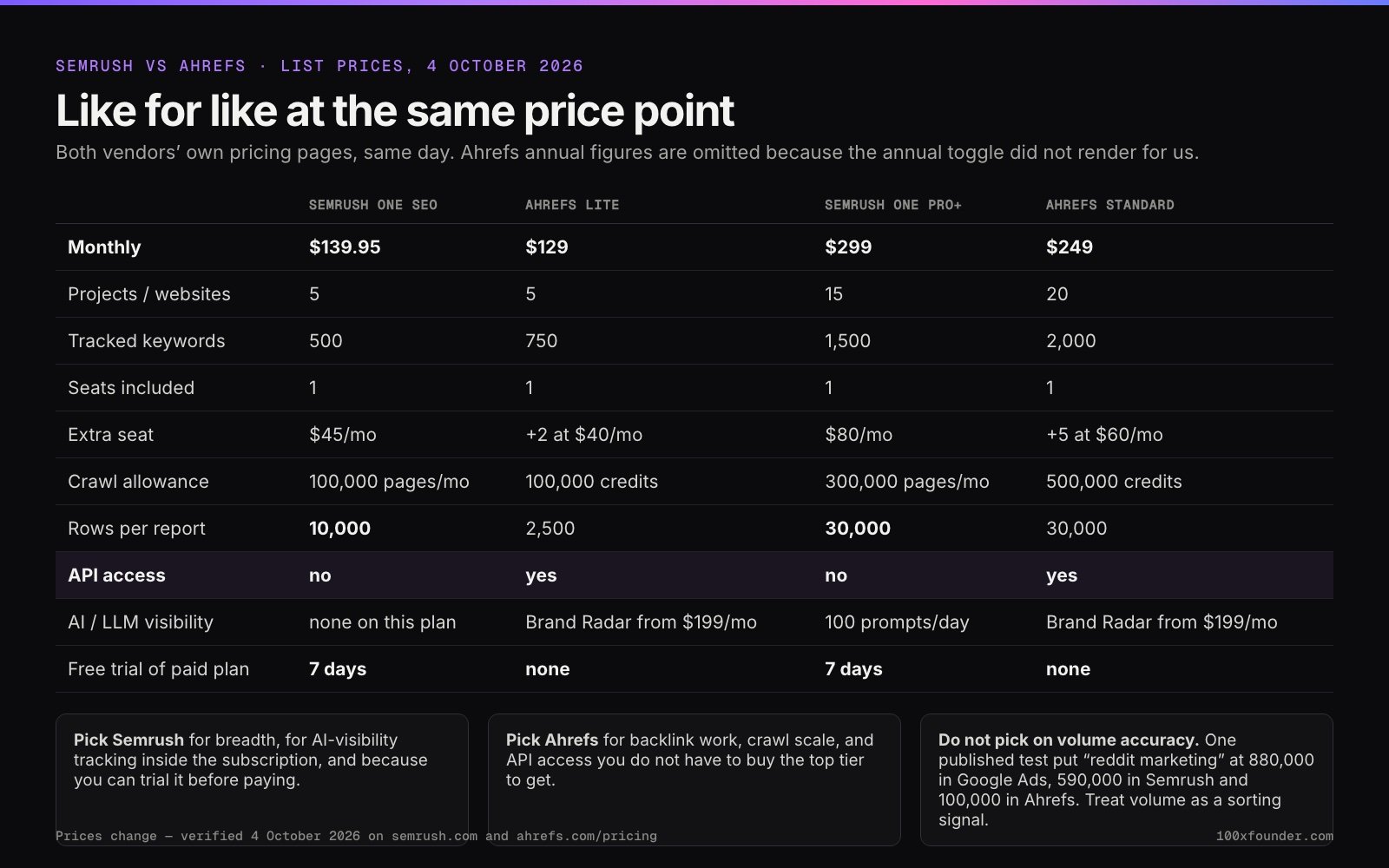
| Semrush One SEO | Ahrefs Lite | Semrush One Pro+ | Ahrefs Standard | |
|---|---|---|---|---|
| Monthly | $139.95 | $129 | $299 | $249 |
| Projects / websites | 5 | 5 | 15 | 20 |
| Tracked keywords | 500 | 750 | 1,500 | 2,000 |
| Extra seats | $45/mo each | up to 2 at $40/mo | $80/mo each | up to 5 at $60/mo |
| Crawl allowance | 100,000 pages/mo | 100,000 credits | 300,000 pages/mo | 500,000 credits |
| Rows per report | 10,000 | 2,500 | 30,000 | 30,000 |
| API access | No | Yes | No | Yes |
| AI / LLM visibility | None on this plan | Brand Radar, from $199/mo extra | 100 prompts/day included | Brand Radar, from $199/mo extra |
| Trial of a paid plan | 7 days | None | 7 days | None |
Prices change — verified 4 October 2026 on semrush.com/pricing/ and ahrefs.com/pricing. We are not quoting Ahrefs annual figures because the annual toggle on its page did not render for us, and we will not estimate one.
Ahrefs wins outright on API and MCP access across every paid tier, more tracked keywords at every comparable price, larger crawl allowances, a free tier giving real Site Explorer and Site Audit data on verified sites, and reviewer consensus on backlink index quality.
Semrush wins outright on having a trial at all — Ahrefs has none, which matters when you are spending $1,500 or more. AI-visibility tracking is in the subscription from $199, where an Ahrefs Lite user wanting LLM visibility pays $129 plus $199 for Brand Radar, or $328 a month. Entry-level rows per report are four times Ahrefs’, and the suite is broader.
Nobody wins on data accuracy. Both vendors publish studies showing they are the most accurate, benchmarked against different things, and the studies are not comparable. The independent tests above found all the major sources disagreeing with each other and with Google Ads by multiples. Do not choose on this axis.
Practically: link building is the core activity, buy Ahrefs. AI-search visibility is something you sell or report on, buy Semrush. API access without a top tier, Ahrefs or Serpstat.
Semrush versus the rest
| Tool | Entry to mid pricing | Extra seat | API | Beats Semrush at |
|---|---|---|---|---|
| Moz Pro | $49 / $99 ($79 annual) / $179 / $299; 20% annual discount | $49 | Not in Moz Pro; sold separately from $20/mo | Price floor; AI-prompt tracking on every tier; Moz Local at $20–40 per location; free Domain Authority |
| SE Ranking | Core $129 ($103.20 annual), Growth $279 ($223.20); Agency Pack from $69 | $16 | 25,000–100,000 credits included | Cost per seat and per tracked keyword. 2,000 daily keywords at the same $129. 14-day trial, no card |
| Mangools | $30.50 ($18.85 annual) / $40.50 ($26.35) / $70.50 ($48.85); 35% annual discount | Free from Premium | Not comparable | Absolute cost. But the money-back window was cut to 48 hours in 2026 |
| Ubersuggest | Published range $29–$99; per-plan dollar figures unconfirmed (the page geo-prices) | $5 | None at all | The lifetime licence, and the cheapest extra seat here. Lifetime purchases non-refundable |
| Serpstat | $50 ($38 annual) / $100 ($76) / $169 / $410 | 1 / 3 / 6 / 30 users included | 200,000–400,000 credits from the $100 tier | Bundled API on a mid-tier plan, and far larger exports |
| SpyFu | $39 ($29 annual) / $119 ($89 annual) / $249 | $15–30 | Every tier | Refund terms: 30 days, no forms. A decade-plus of competitor PPC history, unlimited exports from the mid plan |
| Similarweb | $199 ($125 annual) / $399 ($333) / $649 ($542) | 1 seat only, every tier | Enterprise or standalone | Panel-based traffic data for domains you do not own, up to 37 months of history, plus app and retail intelligence |
Prices change — verified 4 October 2026 on each vendor’s own pricing page. Note that third-party pages still quote SE Ranking’s retired Essential $65 / Pro $119 / Business $259 ladder and stale Serpstat and Mangools figures.
Three of those rows should change a decision. SE Ranking’s $16 seat means a five-person team costs $64 a month in seats there and $320 on Semrush Pro+. Serpstat’s bundled API credits from $100 undercut a capability Semrush reserves for $549. And Mangools Premium at $26.35 covers the daily work most solo operators do, against Semrush Starter’s $165.17.
Refund terms, side by side
| Tool | Money-back window | Conditions |
|---|---|---|
| SpyFu | 30 days | No forms |
| SE Ranking | 14-day trial, no card | — |
| Serpstat | 7-day trial | $1 verification charge; auto-renews after |
| Ubersuggest | 7-day trial | Monthly plans only; lifetime purchases non-refundable |
| Mangools | 48 hours | Cut from ten days in 2026 |
| Semrush | 7 days | First annual purchase of 12 months or longer only. Never on month-to-month. Must be requested in the cancellation form’s comment field. |
| Ahrefs | No trial of paid plans | Free tier on verified sites only |
Terms change — verified 4 October 2026 on each vendor’s own policy page.
Read that as a risk ladder. The most expensive tool here has the narrowest refund terms, and the condition that catches people is this: buy Semrush monthly and there is no refund at all, ever. SpyFu, at a third of the price, gives thirty days and no form. That should influence whether you commit annually on day one.
Is Semrush worth it for you specifically?
| You are | Verdict | Why |
|---|---|---|
| A solo founder, pre-revenue or early | Not yet | $2,388 a year for one domain is hard to justify when Search Console is free and a $26–40 tool covers keyword research. Buy when a 10% organic improvement is worth more than the subscription. This is also the segment Semrush’s own final annual report described as leaving. |
| An SEO freelancer with a few clients | Yes if you can bill it | Five client sites fit the entry plans, but check 500 tracked keywords across all clients and three scheduled PDF reports in total — four clients on a monthly-PDF deliverable puts you over the limit on every plan Semrush sells. SE Ranking’s $69 Agency Pack exists for this buyer. |
| A small agency, 3–10 people | Only with your eyes open | Seats, AI licences and Local locations all multiply and none discount annually: $657/mo for three people with AI visibility, $609–934 for five clients with locations. Price SE Ranking and Serpstat first — on seats and API credits they are several times cheaper. |
| An ecommerce brand | Yes, at Pro+ | Catalogue sites need the 300,000-page crawl, 1,500 keywords and 30,000-row reports, and $478/mo is a normal line item for a brand doing real organic revenue. If competitor ad intelligence is a major use case, SpyFu is better and cheaper. |
| A local business, one or a few locations | Usually not | $139.95 plus $30–60 for Local is $170–200 a month to manage one listing. Moz Local does listings at $20–40, Google Business Profile is free, and multi-location is gated to the Guru-equivalent tier. |
| An in-house team at a larger company | Yes — this is who it is now built for | Advanced at $549 gives 40 projects, 5,000 keywords, 50,000-row reports, 200 daily AI prompts and the API, and under Adobe the roadmap points at enterprise generative-engine optimisation. If you already run Adobe, that integration is a real reason to prefer Semrush over Ahrefs. |
Prices change — verified 4 October 2026.

What the ratings actually say, and why they look contradictory
| Platform | Rating | Reviews | Notes |
|---|---|---|---|
| Capterra | 4.6/5 | 2,329 | Ease of use 4.3, support 4.4, value for money 4.2 |
| GetApp | 4.6/5 | 2,329 | 82% positive |
| Software Advice | 4.6/5 | 2,329 | 70% five-star |
| Trustpilot | 1.7/5 | 1,406 | 41% five-star, 8% four, 4% three, 3% two, 44% one-star |
| G2 | 4.5/5 (reported) | ~3,400 | Page would not load for us; unconfirmed |
| TrustRadius | 8.6/10 (reported) | 777 | Usability 7.9 is its weakest sub-score. Unconfirmed. |
Ratings as read on 4 October 2026. The Trustpilot distribution was read directly; the G2 and TrustRadius figures came from search snippets, which is why they are flagged rather than presented as verified.
The Trustpilot distribution is the striking part: 41% five-star and 44% one-star with almost nothing between. That is not a mediocre product; it is one many people love and many are furious with.
But this is a category pattern, not a Semrush scandal. Ahrefs sits at 2.2/5 on Trustpilot from 323 reviews while holding around 4.5 on G2 — same shape, same gap, different vendor. The explanation is structural: software-review sites are populated largely by people recruited while actively using a tool and asked about features and workflow, while transaction-review sites are populated overwhelmingly by people with a billing grievance, and annual SaaS prepayment generates those right across the category. Any review presenting Semrush’s 1.7 as uniquely damning without checking the comparable figure for its main competitor is telling you something true and framing it misleadingly.
What the reviews actually say. The praise on product-review sites is consistent and specific: keyword research, Site Audit, competitor data. The most useful single data point we found is a Capterra reviewer, Theo M., a founder, who in September 2026 praised exactly those things and separately left a one-star review saying that cancelling the subscription did not stop the billing. We are paraphrasing rather than quoting at length and have not re-verified that pair on the live pages, but it is the cleanest summary available: people like the tool and leave because of the checkout. The recurring criticisms on Capterra are price then learning curve, and none of them concerns data quality. The Trustpilot one-star stream is dominated by September 2026 dates — current rather than legacy — and clusters on being charged after a believed cancellation, renewal without a reminder, a trial converting sooner or more expensively than expected, and how many steps cancelling takes.
How to cancel Semrush, downgrade, or get a refund
Every step below is from Semrush’s own help centre and refund policy, checked 4 October 2026. If you read one section of this review, read this.
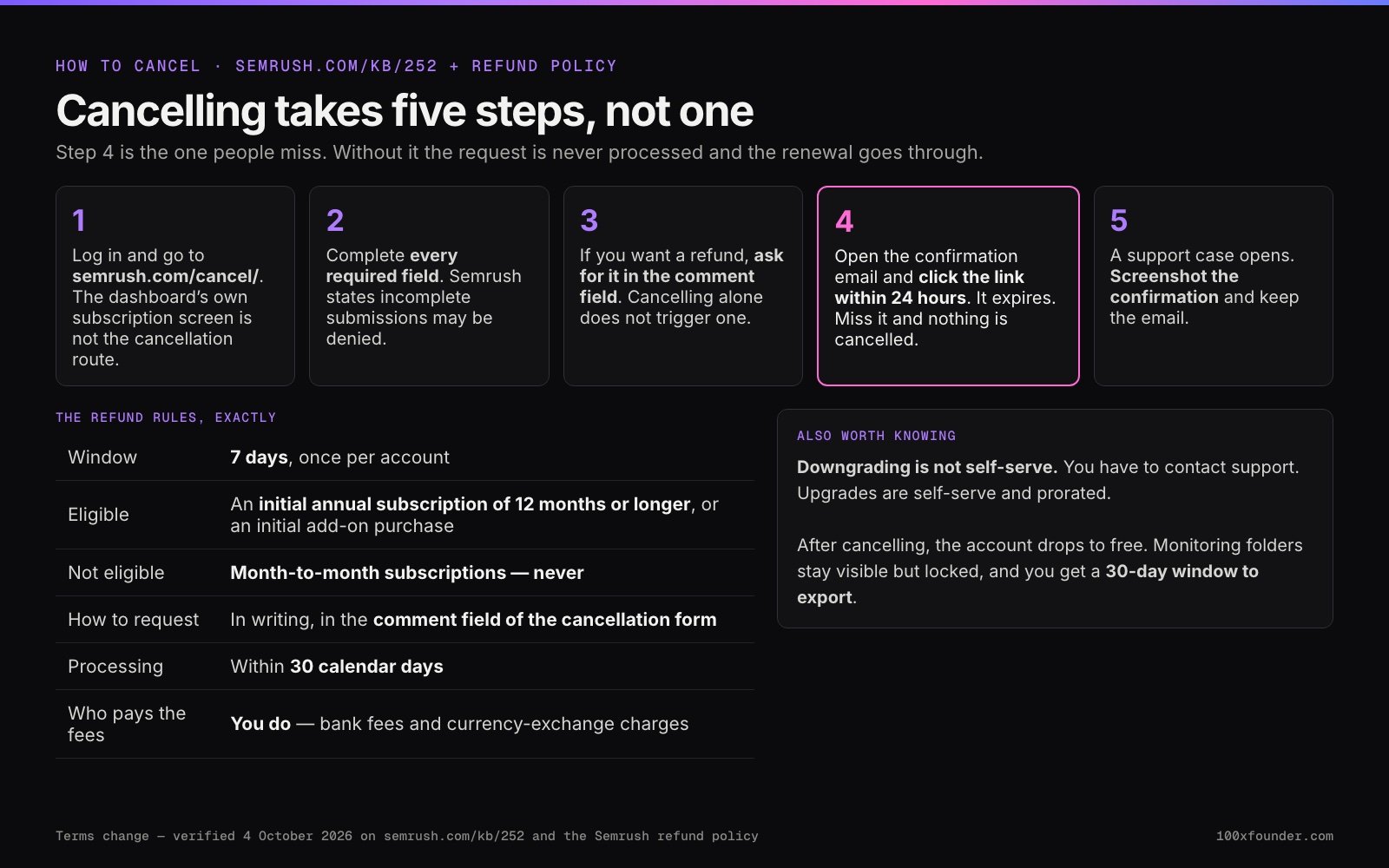
- Go to semrush.com/cancel/ while logged in. This is the route. Clicking something that looks like “cancel” inside the dashboard’s subscription screen does not by itself end the subscription, and that is the most common misunderstanding behind the “I cancelled and was charged anyway” complaints.
- Complete every required field. Semrush states that incomplete submissions may be denied, so do not skip the reason field or anything else marked required.
- If you want a refund, write the request into the comment field. This is not optional and not implied by cancelling. The refund policy requires it in writing, in that field, on that form.
- Open the confirmation email and click the link inside. It is valid for 24 hours. Until you click it, your request is not processed. If it expires you start again — and if your renewal date falls in the meantime, you are charged. This one mechanism explains most of the Trustpilot complaints, and it appears on no page-1 competitor for any Semrush query we looked at.
- A support case opens. Screenshot the confirmation and keep the email. If you are later charged, that screenshot and that email are the difference between a chargeback you win and one you lose.
Start at least five days before your renewal date so the 24-hour link window and any support latency fall inside the term, and do it where you can check the email immediately.
The refund rules, exactly
From Semrush’s refund policy, last updated 20 August 2025:
- A one-time seven-day money-back guarantee, on either an initial annual subscription with a committed term of 12 months or longer, or an initial add-on purchase.
- “Refunds are not available for month-to-month subscriptions.” That is the policy’s own wording. Pay monthly and there is no refund window at all.
- The request must be made in writing, in the comment field of the cancellation form.
- Refunds are processed within 30 calendar days.
- The customer bears bank fees and currency-exchange charges, so a refund on a dollar plan paid by a rupee or euro card comes back smaller than it went out.
- Cancellation takes effect at the end of your committed term, or within three business days for unpaid trial and free subscriptions. Cancelling an annual plan in month three stops the renewal, not months four to twelve.
- Trial-to-paid conversions are excluded.
Downgrading is not self-serve, and your data has a clock on it
You can upgrade yourself, prorated. You cannot downgrade yourself — that needs a support request, with no limit on how many you make, and monitoring data is kept 30 days afterwards. Plan for a support round-trip if you are cutting your bill before a renewal. After cancelling, the account drops to free: monitoring folders stay visible but locked, and you get a 30-day grace period to export, after which only the oldest folder’s data is retained. If you are leaving, export in the first week, not the fourth.
The Adobe acquisition, and what it means if you sign a 12-month plan now
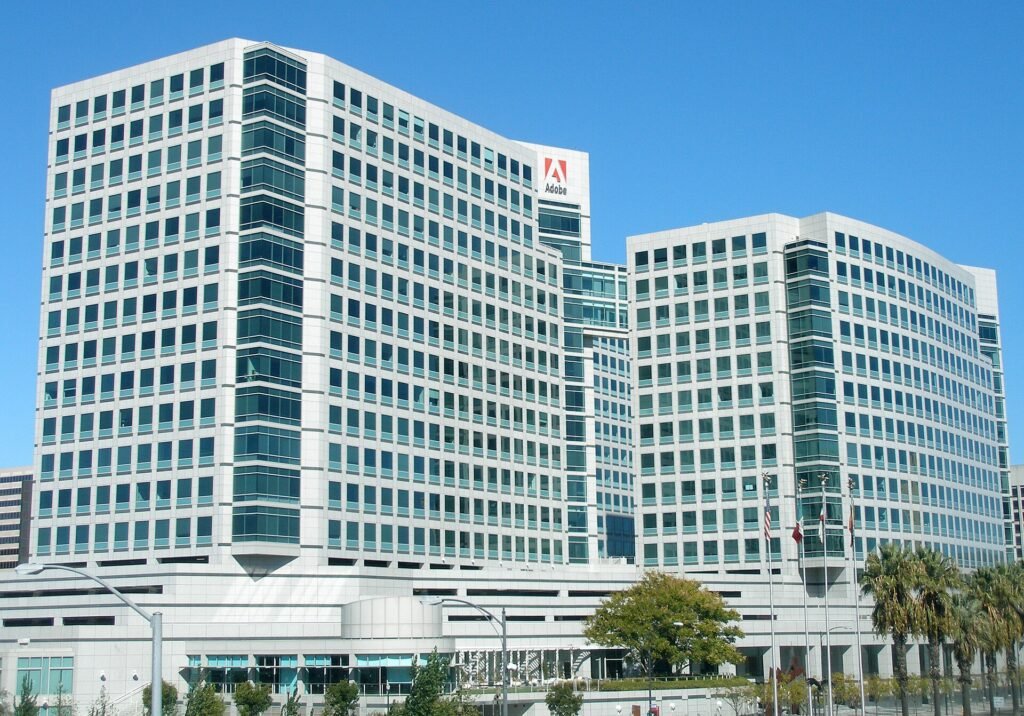
Adobe announced its agreement to acquire Semrush on 19 November 2025 at $12.00 a share, around a 77.5% premium, valuing the company at roughly $1.9 billion; Semrush stock rose about 74% on the day and Adobe’s fell about 2%. The deal completed on 28 April 2026 for approximately $1.87 billion, primarily in cash, and Semrush was delisted from the NYSE the same day.
Semrush now sits inside Adobe’s Digital Experience business and is wired into Adobe Brand Concierge, the stated purpose being generative engine optimisation. The 2026 sequence on Semrush’s own newsroom supports that: the April close, an Adobe Brand Visibility solution and the AI Visibility Index expanded to 126 million US AI prompts in June, Gartner recognition in July, and a Claude Connector in August.
Now the part where we disagree with most pages on this topic. Several competing reviews assert or imply that Adobe caused the plan restructure and the price rise. We cannot find support for that and will not repeat it. Adobe has said nothing about Semrush pricing since the deal closed. Its acquisition FAQ refers to “no changes to our existing contracts” and “no immediate changes” including to billing, and none of the Semrush announcements since the close mentions pricing or plans. The Semrush One structure reportedly launched in October 2025, before the acquisition was announced. Semrush publishes no price history and no crosswalk between old and new plan names, so any claim about the size or timing of an Adobe-caused increase is unverifiable. What is verifiable is the $49.05 monthly gap between the matched tiers.
What it actually means for your decision is not a price panic but three concrete things. A twelve-month commitment now is a commitment to a privately held Adobe subsidiary with no mid-term refund; nothing has been announced, but if repricing comes, your protection is the term you locked and your exposure is everything after it. There is no more public financial reporting, so you cannot check whether the small-customer segment keeps shrinking. And if you already run Adobe the integration is a genuine plus; if not, you are buying a component of someone else’s enterprise stack. Our reading: monthly billing costs more per month but keeps your options open in a year when both the ownership and the pricing structure have changed.
Is Semrush a Russian company?

This is asked on several pages ranking for Semrush queries and answered in one line on all of them, usually a line that is reassuring or alarming depending on who wrote it. Here is each leg, with what we could and could not verify.
Founded in 2008 by Oleg Shchegolev and Dmitry Melnikov. The founding year is confirmed in Semrush’s own SEC filings, which state “since our founding in 2008”. The founding location is not stated in those filings and we could not confirm it from a primary source. It is widely reported as Russia; we are flagging that rather than asserting it.
Incorporated in Delaware, headquartered in Boston. Confirmed from the annual report filed with the SEC: Semrush Holdings, Inc. is a Delaware corporation with principal executive offices at 800 Boylston Street, Suite 2475, Boston, Massachusetts, and Semrush Inc., incorporated in Delaware in 2012, was described as its primary operating entity and corporate headquarters. It traded on the NYSE as SEMR from 2021 until April 2026.
It exited Russia in 2022, and this part is unusually well documented. The annual report states that Semrush sold two Russian subsidiaries, Semrush RU Limited and Semrush SM Limited, with both sales completed on 3 August 2022, and that “as of August 10, 2022, we no longer have any operating subsidiaries in Russia”. Contemporaneous investor materials describe relocating the large majority of around 800 Russia-based employees to Spain, the Netherlands, Germany, Armenia, Serbia, Cyprus and the Czech Republic, at a cost the company put in the tens of millions of dollars for 2022.
The honest answer. Semrush was founded in 2008 by two Russian founders and had substantial engineering operations in Russia until 2022, when it sold those subsidiaries and relocated most of the staff. If your question is about procurement or data-residency risk today, you are buying from an Adobe subsidiary with no Russian operating entities we can find in its filings. If it is about origins, they are Russian — and the only leg we could not verify from a primary document is the specific founding location.
Semrush in India: what you will actually be charged
This section exists because our readers ask and every US-written review skips it. It is shorter than we wanted, because we will only state what we verified.
All prices are in US dollars. Semrush’s own FAQ says so in those words, and we found no other currency in the pricing page’s markup or data. On an Indian card, 18% GST is added on top, so a $199 plan is $234.82 before your bank touches it and a $1,982.04 annual prepayment becomes about $2,338.81. Your bank’s foreign-exchange markup and any cross-border fee apply on top — not speculation, because Semrush’s refund policy explicitly states the customer bears bank fees and currency-exchange charges, which also means a refund returns smaller than it went out. And a physical credit card is required for the trial, with virtual cards rejected, so a disposable card number is not available as a safety net against auto-conversion.
What we could not verify, stated plainly. Third-party blogs publish rupee price lists for Semrush and claim it bills natively in INR and issues GST-compliant invoices carrying your GSTIN, which would let an Indian business claim input tax credit. We found no support for any of that on semrush.com. No rupee figure appears in the pricing page’s markup or data, and the currency the page returns is US dollars. A currency-selection component does exist in the page’s code, so we are not ruling out that some buyers are routed to local-currency billing — we could not confirm it, and we will not publish rupee figures we cannot stand behind.
So before you buy from India: start the checkout and read the actual total on the payment screen, including the tax line, before confirming. If GST input credit matters, ask Semrush support in writing whether the invoice will carry your GSTIN and keep the reply. This is not tax advice; confirm your own position with a qualified chartered accountant or the GST portal. One comparative note holds: Ahrefs bills in US dollars only too, while SE Ranking at $103.20 and Mangools at $26.35 shrink the FX and GST problem simply by being smaller numbers.
Your first 30 days, if you do buy
The failure mode with a tool this broad is touring it: thirty days of clicking around produces nothing actionable and ends in a renewal you resent. One deliverable per week fixes that.
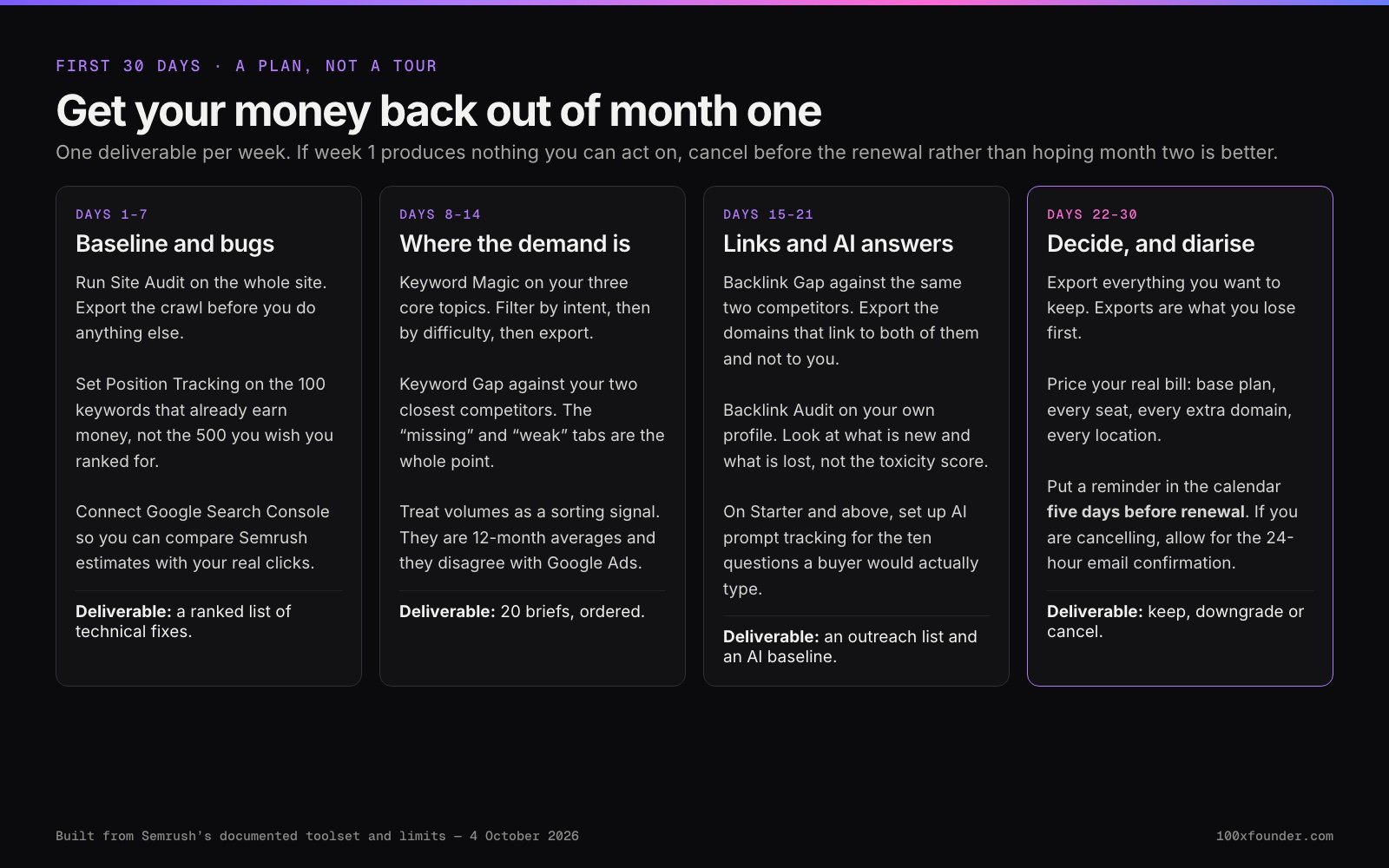
Days 1–7: baseline and bugs. Run Site Audit across the whole site and export the crawl before anything else, because exports are the first thing you lose if you leave. Set Position Tracking on the hundred keywords that already earn money rather than the five hundred you wish you ranked for. Connect Google Search Console so you can compare Semrush’s estimates against real clicks. Deliverable: a severity-ranked list of technical fixes.
Days 8–14: where the demand actually is. Run Keyword Magic on your three core topics, filter by intent then difficulty, and export within your 10,000-row limit. Run Keyword Gap against your two closest competitors; the “missing” and “weak” views are the entire point. Use the volumes to order your list, not to forecast traffic. Deliverable: twenty content briefs in priority order.
Days 15–21: links and AI answers. Run Backlink Gap against the same two competitors and export the domains linking to both of them and not to you — an outreach list, not a metric. Run Backlink Audit on your own profile and look at what is new and lost rather than the toxicity score. On Starter and above, set up AI prompt tracking on the ten questions a real buyer would type. Deliverable: an outreach list and an AI baseline.
Days 22–30: decide and diarise. Export everything you want to keep. Price your real bill — base plan, every seat, every extra domain, every location, with add-ons at full monthly rate because they do not discount. Then set a reminder five days before your renewal date, allowing for the 24-hour email confirmation if you are cancelling. Deliverable: a decision to keep, downgrade or cancel, made deliberately rather than by default.
If you should not buy it: the stack that covers most of the job
A fair review has to say what the alternative actually is, not just name cheaper competitors. For a founder or small operator, most of the value of a $199 subscription is available for under $40 a month.
- Google Search Console — free, and better than any estimate. Real impressions, clicks, average position and query data for your own site. Every paid tool is approximating what this gives you exactly.
- Bing Webmaster Tools — free. Keyword research and site scans, and increasingly relevant because Bing’s index feeds several AI assistants.
- Google Keyword Planner — free with an Ads account. The volume source every tool is modelling. Ranges rather than precise numbers, but it is the horse’s mouth.
- Google Analytics 4 and PageSpeed Insights — free. Behaviour and Core Web Vitals.
- Moz Link Explorer and the MozBar — free tier. Domain Authority and basic link data without a subscription.
- Ahrefs Free — free on verified sites. Site Explorer, Site Audit and Web Analytics for domains you own. No Keywords Explorer, no Rank Tracker, no exports, but a real crawler for nothing.
- Mangools Basic at $18.85 a month annual — the paid piece. Keyword research, 200 tracked keywords, SERP analysis; Premium at $26.35 adds more tracking and free seats.
That stack runs about $19–27 a month and covers keyword research, rank tracking, technical auditing, authority metrics and real performance data. What it does not give you is Semrush’s competitor traffic estimates, backlink gap analysis at scale, a content pipeline, or AI-visibility tracking — and those four things are what the extra $170 a month buys. If you can name a specific decision you would make differently with them, buy Semrush. If you cannot, the stack above is not a compromise; it is the correct answer.
Frequently asked questions
Is Semrush worth the cost in 2026?
For an ecommerce brand, an in-house team or an agency that bills it, yes — the breadth replaces several tools. For a solo founder with one site, usually not yet: $2,388 a year is a lot for one domain when Search Console is free.
Is Semrush good for beginners?
The data is good and the interface is not simple. Learning curve is the second most common criticism on Capterra after price, and TrustRadius’s usability sub-score is its weakest. Semrush Academy’s free courses are worth starting before you pay rather than after.
How accurate is Semrush’s data compared with Search Console or Ahrefs?
Treat it as a sorting signal. One published test found “reddit marketing” at 880,000 monthly searches in Google Ads, 590,000 in Semrush and 100,000 in Ahrefs; another found Semrush under-estimating a site’s Search Console clicks by about 43%. Use Search Console for your own site and Semrush for competitors, where you have no ground truth.
Is Semrush a Russian company?
It was founded in 2008 by two Russian founders and had large engineering operations in Russia until 2022, when it sold both Russian subsidiaries (completed 3 August 2022) and relocated most of around 800 staff. It has been a Delaware corporation headquartered in Boston throughout and is now an Adobe subsidiary. Its SEC filings confirm all of that except the founding location.
Can I use Semrush for free?
Yes, permanently and without a card, but only to look: one project, ten reports a day, ten tracked keywords, Site Audit on 100 pages a month and no exports at all. Semrush’s help centre and blog disagree on whether the ten reports are per tool or shared, so assume the stricter version.
Does Semrush offer refunds?
A one-time seven-day money-back guarantee, only on an initial annual subscription of 12 months or longer, or an initial add-on. The policy states that refunds are not available for month-to-month subscriptions. You must request it in writing in the cancellation form’s comment field, it is processed within 30 calendar days, and you bear the bank and FX charges.
Can I cancel Semrush anytime?
Yes, but cancelling stops the renewal rather than the current term, and it takes five steps. Submit the form at semrush.com/cancel/, complete every required field, then click the link in the confirmation email within 24 hours; miss it and the request is not processed. Start five days early and keep a screenshot.
Is the Semrush trial 7 days or 14, and can I get it without a card?
Seven days, on Semrush’s own pricing page; the widespread 14-day claim comes from affiliate pages, not from Semrush. A card is required, with a $1 authorisation rather than a charge, and virtual cards are rejected. For a no-card trial of a comparable tool, SE Ranking gives 14 days without one.
Can I get a trial again if I have used Semrush before?
No. The billing FAQ is explicit: “you can use the option to get a free trial only once. All the following attempts will lead to the purchase of a monthly plan.” One trial per toolkit per account, for the lifetime of the account.
What happens after the trial ends?
It converts to the paid plan automatically unless you have completed the full cancellation process first, including the email confirmation. A trial that converts is excluded from the seven-day refund guarantee, so it is harder to unwind than a fresh purchase.
Is Semrush One better than the Pro, Guru and Business plans, and what was the difference between Pro and Guru?
If you want AI-visibility tracking, One is better and measurably so: Starter at $199 beats the entry plan at $139.95 plus the $99 standalone toolkit, which is $238.95. If you want no AI tracking, Guru at $249.95 was $49.05 cheaper than Pro+ at $299 for the same documented limits. In the help centre, Pro gives 5 projects, 500 keywords, 10,000 rows and a 100,000-page crawl; Guru gives 15 projects, 1,500 keywords, 30,000 rows and 300,000 pages plus the Content Marketing Toolkit, historical data and multi-location features — which map onto the current SEO and Pro+ plans. Whether a new customer can still buy that ladder is something we could not verify.
Will Semrush pricing change now that Adobe owns it?
Nobody outside Adobe knows, and Adobe has said nothing about Semrush pricing since the deal closed on 28 April 2026 — its acquisition FAQ refers to no changes to existing contracts and no immediate billing changes. Reviews blaming Adobe for the restructure are speculating; Semrush One reportedly launched in October 2025, before the deal was announced. The risk to manage is that a 12-month prepayment has no mid-term refund.
Is Semrush still listed on the stock exchange?
No. It was delisted from the NYSE on 28 April 2026 and its SEC registration was terminated on 8 May 2026. Any review describing it as “NYSE: SEMR” is out of date.
Which plan is best for a small business?
If you want AI-visibility tracking, Starter at $199. If not, SEO at $139.95. If you produce content seriously, skip both for Pro+ at $299, because the entry tier caps Topic Research at two searches per lifetime and the SEO Writing Assistant at two documents.
Is Semrush or Ahrefs better for AI visibility, and which is cheaper?
Semrush on both counts at comparable tiers: it includes AI prompt tracking from the $199 Starter plan, while Ahrefs sells Brand Radar separately from $199 on top of a plan, putting an Ahrefs Lite user at about $328. On classic SEO, Ahrefs is cheaper at every comparable tier and includes API access Semrush reserves for $549. Check Semrush’s AI coverage includes your country: 32, against 142 for keyword data.
Is there a Semrush discount code or coupon?
No. There is nothing to paste at checkout, despite what most pages ranking for that query imply — what they have is an affiliate link, and so do we. The only saving Semrush publishes is annual billing at up to 17%, charged in full upfront, and it applies only to the core plans, not to any add-on.
Is there a student, non-profit or Black Friday deal?
We could not find any published student or non-profit pricing on semrush.com and will not guess. Semrush has run seasonal promotions before but published nothing for 2026 that we could verify, so treat any page promising a Black Friday deal in advance as speculation.
Is there anything better than Semrush, and what is Semrush MCP?
Better at specific jobs, yes, and often much cheaper: Ahrefs for backlinks and API access, SE Ranking for seats and tracked keywords, SpyFu for PPC history and refund terms, Serpstat for bundled API credits, Similarweb for third-party traffic data, Mangools for cost. Better at being one tool that does all of it adequately, no. On MCP: the Model Context Protocol lets AI assistants call external tools and data, and Semrush shipped a Claude Connector in August 2026, while Ahrefs made both API and MCP access available on every paid tier.
Bottom line
Semrush is a good product with a difficult commercial model. The keyword research, site auditing and competitor data are why 2,329 Capterra reviewers average it at 4.6, and they are real. The billing is why 44% of 1,406 Trustpilot reviewers give it one star — and a large part of why those reviews exist is a 24-hour confirmation link most buyers never hear about until they are arguing about a charge.
Buy it if the breadth solves a problem you can name. Buy the plan that matches the limit you will actually hit, not the cheapest one. Price every seat and add-on at full monthly rate before choosing monthly or annual. And put the renewal date in your calendar on the day you sign up. If that feels like more friction than the tool is worth, the free stack plus a $26 keyword tool is a legitimate answer, not a lesser one. If you have decided it is right for you, this is our Semrush link; semrush.com/pricing/ works just as well and earns us nothing.
How this article was made: researched and drafted with AI assistance by the 100xFounder editorial desk from vendors’ own pricing and help pages, regulatory filings and published independent reviews, checked on the dates given in the text. Read our editorial policy, or report an error through our corrections policy.